>
Perciformes/Scorpaenoidei (Scorpionfishes) >
Sebastidae (Rockfishes, rockcods and thornyheads) > Sebastinae
Etymology: Helicolenus: Greek, helike, -es = spiral + Greek, lenos, -ou = cavity (Ref. 45335).
Environment: milieu / climate zone / rango de profundidad / distribution range
Ecología
marino batidemersal; rango de profundidad 50 - 1100 m (Ref. 41452), usually 150 - 600 m (Ref. 84778). Deep-water; 70°N - 46°S
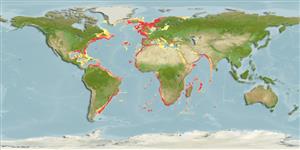
Western Atlantic: Nova Scotia, Canada to Venezuela. Eastern Atlantic: Iceland (Ref. 12462) and Norway to the Mediterranean and the Gulf of Guinea, including Madeira, the Azores, and the Canary Islands; also Walvis Bay, Namibia to Natal, South Africa (Ref. 4313).
Length at first maturity / Tamaño / Peso / Age
Madurez: Lm 32.0 range ? - ? cm
Max length : 50.0 cm TL macho / no sexado; (Ref. 89108); common length : 25.0 cm TL macho / no sexado; (Ref. 4510); peso máximo publicado: 1.6 kg (Ref. 40637); edad máxima reportada: 43 años (Ref. 41452)
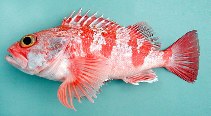
Espinas dorsales (total) : 12; Radios blandos dorsales (total) : 12 - 13; Espinas anales: 3; Radios blandos anales: 5. Pinkish with faint dusky bars; Y-shaped dark bar between soft dorsal and anal fins (Ref. 4313).
Body shape (shape guide): fusiform / normal.
Adults are found in soft bottom areas of the continental shelf and upper slope. They feed on both benthic and pelagic organisms (crustaceans, fishes, cephalopods, and echinoderms) (Ref. 4570). The reproductive mode is a zygoparous form of oviparity, intermediate between oviparity and viviparity (Ref. 36265, 79712). Larvae and juveniles are pelagic (Ref. 4570). Anterolateral glandular grooves with venom gland (Ref. 57406). Sold fresh (Ref. 27121).
The reproductive mode is a zygoparous form of oviparity, intermediate between oviparity and viviparity (Ref. 36265, 79712). Eggs covered with gelatinous material are fertilised in the ovary. Eggs are released into the seabed at various stages of development and larvae assumes a planktonic existence once the gelatinous covering dissolves (Ref. 31150).
Eschmeyer, W.N. and L.J. Dempster, 1990. Scorpaenidae. p. 665-679. In J.C. Quero, J.C. Hureau, C. Karrer, A. Post and L. Saldanha (eds.) Check-list of the fishes of the eastern tropical Atlantic (CLOFETA). JNICT, Lisbon; SEI, Paris; and UNESCO, Paris. Vol. 2. (Ref. 4510)
IUCN Red List Status (Ref. 130435: Version 2025-1)
Human uses
Pesquerías: comercial; pesca deportiva: si
Herramientas
Special reports
Download XML
Fuentes de Internet
Estimates based on models
Preferred temperature (Referencia
123201): 4 - 18.1, mean 10.6 °C (based on 1236 cells).
Phylogenetic diversity index (Referencia
82804): PD
50 = 0.5020 [Uniqueness, from 0.5 = low to 2.0 = high].
Bayesian length-weight: a=0.01047 (0.00908 - 0.01207), b=3.08 (3.04 - 3.12), in cm total length, based on LWR estimates for this species (Ref.
93245).
Nivel trófico (Referencia
69278): 3.5 ±0.0 se; based on diet studies.
Generation time: 9.6 (7.0 - 14.1) years. Estimated as median ln(3)/K based on 18
growth studies.
Resiliencia (Referencia
120179): Bajo, población duplicada en un tiempo mínimo de 4.5-14 años (K=0.06-0.2; tm=13-16; tmax=43).
Prior r = 0.40, 95% CL = 0.27 - 0.61, Based on 1 data-limited stock assessment.
Fishing Vulnerability (Ref.
59153): High to very high vulnerability (68 of 100).
🛈
Nutrients (Ref.
124155): Calcium = 19.7 [7.7, 55.8] mg/100g; Iron = 0.376 [0.168, 0.881] mg/100g; Protein = 16.7 [14.9, 18.7] %; Omega3 = 0.561 [0.214, 1.568] g/100g; Selenium = 21.7 [8.2, 65.8] μg/100g; VitaminA = 14.6 [3.1, 72.9] μg/100g; Zinc = 0.495 [0.271, 0.819] mg/100g (wet weight); based on
nutrient studies.