Élasmobranches (requins et raies) (sharks and rays) >
Heterodontiformes (Bullhead and horn sharks) >
Heterodontidae (Bullhead, horn, or Port Jackson sharks)
Etymology: Heterodontus: heteros (Gr.), different; odontos (Gr.), tooth, referring to pointy teeth (for clutching prey) at front of jaws, different than rounded molar-like teeth (for grinding hard-shelled invertebrates) at the back (See ETYFish); francisci: Of Francisco, probably referring to San Francisco (city and/or bay), California, USA (although its range does not extend that far north of its type locality, Monterey Bay) (See ETYFish).
Eponymy: The original description has no etymology but the specific name probably derives from the city of San Francisco (although the holotype was collected from Monterey Bay rather than San Francisco Bay). (Ref. 128868), visit book page.
More on author: Girard.
Environment: milieu / climate zone / profondeur / distribution range
Écologie
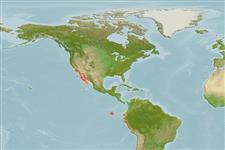
marin démersal; profondeur 0 - 152 m (Ref. 106604), usually 2 - 11 m (Ref. 9253). Subtropical; 37°N - 15°S, 124°W - 75°W
Eastern Pacific: central California, USA to the Gulf of California, and probably Ecuador and Peru.
Length at first maturity / Taille / Poids / Âge
Maturité: Lm ?, range 59 - ? cm
Max length : 122 cm TL mâle / non sexé; (Ref. 247); common length : 97.0 cm TL mâle / non sexé; (Ref. 247); âge max. reporté: 12 années (Ref. 72467)
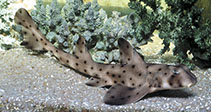
Sluggish, nocturnal, and mostly solitary species. Inhabit rocky bottoms, kelp beds, sandy draws between rocks, on sand flats, deep crevices and small caves and also large underwater caverns. Adults tend to return to the same resting place every day (Ref. 43278). Feed on benthic invertebrates, especially sea urchins, crabs and probably abalone, also fishes. Oviparous (Ref. 50449). May bite back when harassed. Has broad muscular paired fins used as limbs for clambering on the bottom. Catch reduced to fish meal; fin spines used in production of jewels.
Oviparous (Ref. 205). Distinct pairing with embrace (Ref. 205). Courtship starts when the male chases the female, then when both are ready, they drop to the bottom (Ref. 43278). During courtship and prior to copulation, the male bites and wraps its body to the female pectoral fin, body, tail, and gills (Ref. 51127, 49562). The male then inserts a single clasper in the female's cloaca; copulation lasts 30 to 40 min. After one or two weeks later, the eggs are laid in about 11 to 14 intervals for 4 months which were deposited under rocks or in crevices, as was observed in nature. In captivity, the female drops the eggs on the bottom where the contents of the egg cases maybe eaten by these sharks; the eggs are hatched in 7 to 9 months. The young begin to feed one month after hatching (Ref. 43278).
Compagno, L.J.V., 2001. Sharks of the world. An annotated and illustrated catalogue of shark species known to date. Vol. 2. Bullhead, mackerel and carpet sharks (Heterodontiformes, Lamniformes and Orectolobiformes). FAO Spec. Cat. Fish. Purp. 1(2):269 p. FAO, Rome. (Ref. 43278)
Statut dans la liste rouge de l'IUCN (Ref. 130435: Version 2025-1)
Utilisations par l'homme
Pêcheries: intérêt commercial mineur; Aquarium: Aquariums publics
Outils
Articles particuliers
Télécharger en XML
Sources Internet
Estimates based on models
Preferred temperature (Réf.
123201): 15.9 - 23.7, mean 21.4 °C (based on 159 cells).
Phylogenetic diversity index (Réf.
82804): PD
50 = 0.5029 [Uniqueness, from 0.5 = low to 2.0 = high].
Bayesian length-weight: a=0.00437 (0.00235 - 0.00810), b=3.15 (2.98 - 3.32), in cm total length, based on LWR estimates for this species & (Sub)family-body (Ref.
93245).
Niveau trophique (Réf.
69278): 3.2 ±0.3 se; based on diet studies.
Résilience (Réf.
120179): Faible, temps minimum de doublement de population : 4,5 à 14 années (Fec=20).
Fishing Vulnerability (Ref.
59153): High to very high vulnerability (73 of 100).
🛈
Nutrients (Ref.
124155): Calcium = 21.1 [4.1, 95.1] mg/100g; Iron = 0.68 [0.18, 2.01] mg/100g; Protein = 19 [17, 21] %; Omega3 = 0.201 [0.090, 0.442] g/100g; Selenium = 28.1 [8.6, 83.2] μg/100g; VitaminA = 7.36 [2.35, 22.58] μg/100g; Zinc = 0.646 [0.318, 1.171] mg/100g (wet weight);