>
Gobiiformes (Gobies) >
Gobiidae (Gobies) > Gobiinae
Etymology: Valenciennea: From Achille Valenciennes 1794-1865; he worked with Duméril, Cuvier and Lacepède since 1815; malacologist, author of a "Histoire naturelle des poissons" (Ref. 45335).
Eponymy: Achille Valenciennes (1794–1865) was a French zoologist; primarily an ichthyologist and conchologist. [...] (Ref. 128868), visit book page.
Environment: milieu / Klimaatzone / Diepte / distribution range
Ecologie
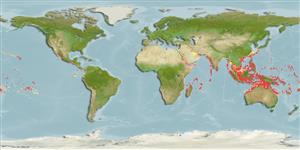
marien rifbewoner; diepte 2 - 84 m (Ref. 86942), usually 10 - 30 m (Ref. 8527). Tropical; 22°C - 26°C (Ref. 27115); 32°N - 24°S
Indo-Pacific: Red Sea to Samoa, north to southern Japan, south to the Great Barrier Reef and New Caledonia.
Grootte / Gewicht / Leeftijd
Maturiteit: Lm ? range ? - ? cm
Max length : 20.0 cm SL mannelijk / geslacht onbekend; (Ref. 48637)
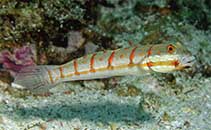
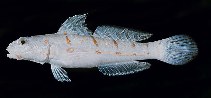
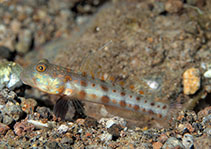
Dorsale stekels (totaal) : 7; Dorsale zachte stralen (totaal) : 11 - 12; Anale stekels: 1; Anale zachte stralen: 11 - 12. Characterized by pale grey body color for Pacific fish with row of large orange spots on side, a series of dash-like markings below, smaller orange spots on back and blue to whitish streaks or spots on head; Indian Ocean fish with pale blue-grey body color with orange stripe across lower head, cheeks with blue markings and orange bars on side connected to pale orange stripe on lower half; third dorsal spine, longest, filamentous in juveniles under 40 mm SL; rounded caudal fin, 3.0-4.2 in SL; longitudinal scale series 79-91; ctenoid body scales, becoming cycloid anteriorly before first dorsal fin, on lower side, and midline of abdomen; head or midline of nape without scales; side of nape with scales extending forward to above middle of operculum; scaleless pectoral fin base; partly to fully scaled prepelvic area; depth of body 4.8-6.0 in SL (Ref. 90102).
Body shape (shape guide): fusiform / normal.
Inhabits sandy areas of clear lagoon and seaward reefs (Ref. 9710, 48637). Occurs in pairs and use burrows as refuge. Monogamous (Ref. 52884). The burrow is shallow, only a few cm, and made under large pieces of rubble. May be found on dark volcanic sand such as those in the Philippines, Indonesia, and the northern Mariana Is. Also Ref. 58652.
Levenscyclus en paargedrag
Maturiteit | Voortplanting | Paaien | Eieren | Fecunditeit | Larven
Monogamous mating is observed as both obligate and social (Ref. 52884).
Hoese, D.F. and H.K. Larson, 1994. Revision of the Indo-Pacific gobiid fish genus Valenciennea, with descriptions of seven new species. Indo-Pac. Fish. (23):71 p. (Ref. 8527)
Status op de Rode Lijst van het IUCN (Ref. 130435: Version 2025-1)
Gevaar voor de mens
Harmless
Gebruik door de mens
Visserij: commercieel; Aquarium: Commercieel
Tools
Speciale rapporten
Download XML
Internetbronnen
Estimates based on models
Preferred temperature (Ref.
123201): 25.5 - 29, mean 28 °C (based on 842 cells).
Fylogenetische diversiteitsindex (Ref.
82804): PD
50 = 0.5000 [Uniqueness, from 0.5 = low to 2.0 = high].
Bayesian length-weight: a=0.01023 (0.00477 - 0.02194), b=3.01 (2.83 - 3.19), in cm total length, based on LWR estimates for this (Sub)family-body shape (Ref.
93245).
Trofisch niveau (Ref.
69278): 3.2 ±0.3 se; based on size and trophs of closest relatives
Weerstandsvermogen (Ref.
120179): Gemiddeld, minimale populatieverdubbelingstijd 1,4-4,4 jaar (Preliminary K or Fecundity.).
Fishing Vulnerability (Ref.
59153): Low vulnerability (14 of 100).
🛈
Nutrients (Ref.
124155): Calcium = 67.3 [37.5, 120.7] mg/100g; Iron = 0.642 [0.338, 1.122] mg/100g; Protein = 18.4 [16.4, 20.1] %; Omega3 = 0.145 [0.070, 0.232] g/100g; Selenium = 30.2 [18.0, 54.9] μg/100g; VitaminA = 107 [30, 312] μg/100g; Zinc = 1.57 [1.09, 2.26] mg/100g (wet weight);