



Ladda upp din foton och Videor
Google image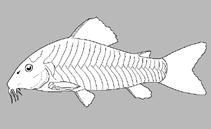 No image available for this species;
drawing shows typical species in Callichthyidae.
Google image
drawing shows typical species in Callichthyidae.
Klassificering / Namn Populärnamn | synonymer | Catalog of Fishes(Släkte, Arter) | ITIS | CoL | WoRMS | Cloffa
> Siluriformes (Catfishes) > Callichthyidae (Callichthyid armored catfishes) > Corydoradinae
Etymology: Corydoras: Greek, kory = helmet + greek, doras = skin (Ref. 45335); desana: Named after an ethnic group that inhabits the rio Tiquié basin, the Desana, which is closely related linguistically and culturally to the Tukano indians, who also inhabit the rio Tiquié basin; This name is also referring to the resemblance between the mimic pair C. desana and C. tukano; name in apposition.
Etymology: Corydoras: Greek, kory = helmet + greek, doras = skin (Ref. 45335); desana: Named after an ethnic group that inhabits the rio Tiquié basin, the Desana, which is closely related linguistically and culturally to the Tukano indians, who also inhabit the rio Tiquié basin; This name is also referring to the resemblance between the mimic pair C. desana and C. tukano; name in apposition.
Miljö: miljö / Klimatzon / djupintervall / distributionsområde Ekologi
; sötvatten bottenlevande. Tropical
Utbredning Territorier | FAO områden | Ekosystem | Förekomster | Prickkarta | Utplanteringar | Faunafri
South America: Brazil.
Storlek / Vikt / Ålder
Kort beskrivning Bestämningsnycklar | Morfologi | Morfometri
This species is distinguished by the following characters: color pattern with ground color clear, with three large blotches, the first one (‘mask’) in the head at the eye level, the second humeral blotch at the dorsal fin level, and a third blotch at the caudal peduncle; sout long, 59.3-70.6% of head length, or 1.4-1.7 within the head length; pectoral-fin spine with well-developed serrations along posterior margin (Ref. 138491).
Body shape (shape guide): short and / or deep; Cross section: oval.
Body shape (shape guide): short and / or deep; Cross section: oval.
Currently known only from the Igarapé Castanha, a tributary of the rio Tiquié (itself a tributary of rio Uaupés), upper rio Negro basin, Amazonas state, in Brazil. It was only recorded a little upstream of the indian village of Santa Rosa and other collecting sites downstream the Igarapé Castanha and along the rio Tiquié only revealed its co-mimic, Corydoras tukano, which is not only more distributed but also considerably more abundant than the rare C. desana. The four specimens of Corydoras desana collected between September and November 2006 were schooling along with C. tukano at sandy beaches. The Igarapé Castanha is a meandering river with oxbow lakes, alternating sandy beaches and river terraces, with clear water, but with a considerable amount of suspended sediments (quite distinct from the rio Tiquié, which is a typical black water river at least before its junction with the Igarapé Castanha) (Ref. 138491).
Livscykel och parningsbeteende Könsmognad | Reproduktion | Lek | Ägg | Fekunditet | Larver
Huvudreferens
Ladda upp dina referenser | referenser | Koordinator : Reis, Roberto E. | Medarbetare
Lima, F.C.T. and I. Sazima, 2017. Corydoras desana, a new plated catfish from the upper rio Negro, Brazil, with comments on mimicry within Corydoradinae (Ostariophysi: Siluriformes: Callichthyidae). aqua, International Journal of Ichthyology 23(1):19-31. (Ref. 138491)
CITES
Not Evaluated
Hot mot människor
Harmless
Mänskliga användningsområden
FAO - Publication: search | FishSource |
Ytterligare information
Trofisk ekologi
Livsmedelsartiklar (preys)
Födosammansättning
Födointag
Matransoner
Predatorer
Livsmedelsartiklar (preys)
Födosammansättning
Födointag
Matransoner
Predatorer
Ekologi
Ekologi
Ekologi
Populationsdynamik
Tillväxtparametrar
Max. åldrar / storlekar
Längd-vikt rel.
Längd-längd rel.
Längd-frekvenser
Massakonvertering
Rekrytering
Abundans
Tillväxtparametrar
Max. åldrar / storlekar
Längd-vikt rel.
Längd-längd rel.
Längd-frekvenser
Massakonvertering
Rekrytering
Abundans
Livscykel
Reproduktion
Könsmognad
Mognad/Gills rel.
Fekunditet
Lek
Lekande aggregat
Ägg
Utveckling av ägg
Larver
Larvdynamik
Reproduktion
Könsmognad
Mognad/Gills rel.
Fekunditet
Lek
Lekande aggregat
Ägg
Utveckling av ägg
Larver
Larvdynamik
Anatomi
Gälyta
Hjärna
Otolit
Gälyta
Hjärna
Otolit
Fysiologi
Kroppssammansättning
Näringsämnen
Syreförbrukning
Typ av simning
Simhastighet
Visuella pigment
Ljud från fisk
Sjukdomar & Parasiter
Toxicitet (LC50)
Kroppssammansättning
Näringsämnen
Syreförbrukning
Typ av simning
Simhastighet
Visuella pigment
Ljud från fisk
Sjukdomar & Parasiter
Toxicitet (LC50)
Genetik
Genom
Genetik
Heterozygositet
Ärftlighet
Genetisk mångfald
Genom
Genetik
Heterozygositet
Ärftlighet
Genetisk mångfald
Människorelaterad
Vattenbrukssystem
Vattenbruksprofiler
Avelslinjer
Ciguatera-fall
Frimärken, mynt, diverse.
Vattenbrukssystem
Vattenbruksprofiler
Avelslinjer
Ciguatera-fall
Frimärken, mynt, diverse.
Verktyg
Särskilda rapporter
Kontrollera för underhåll av akvarium | Kontrollera om det finns faktablad om arter | Kontrollera om det finns faktablad om vattenbruk
Ladda ner XML
Internet-källor
AFORO (otoliths) | Aquatic Commons | BHL | Cloffa | Websites from users | Check FishWatcher | CISTI | Catalog of Fishes: Släkte, Arter | DiscoverLife | ECOTOX | FAO - Publication: search | Faunafri | Fishipedia | Fishtrace | GloBI | Google Books | Google Scholar | Google | IGFA World Record | OneZoom | Open Tree of Life | Otolith Atlas of Taiwan Fishes | PubMed | Reef Life Survey | Socotra Atlas | TreeBase | Tree of Life | Wikipedia: Go, sök | World Records Freshwater Fishing | Zoobank | Zoologiskt register
Uppskattningar baserade på modeller
Index för fylogenetisk mångfald (Ref. 82804): PD50 = 0.5000 [Uniqueness, from 0.5 = low to 2.0 = high].
Bayesian length-weight: a=0.02455 (0.00934 - 0.06448), b=3.00 (2.77 - 3.23), in cm total length, based on LWR estimates for this (Sub)family-body shape (Ref. 93245).
Trofisk nivå (Ref. 69278): 3.0 ±0.3 se; based on size and trophs of closest relatives
Resiliens (Ref. 120179): Hög, lägsta populationsfördubblingstid mindre än 15 månader (Preliminary K or Fecundity.).