



Uploaden van uw Foto's en video's
Google afbeelding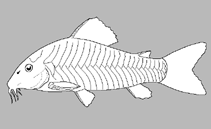 No image available for this species;
drawing shows typical species in Callichthyidae.
Google afbeelding
drawing shows typical species in Callichthyidae.
Classificatie / Namen Lokale namen | Synoniemen | Catalog of Fishes(Genus, Soort(en)) | ITIS | CoL | WoRMS | Cloffa
> Siluriformes (Catfishes) > Callichthyidae (Callichthyid armored catfishes) > Corydoradinae
Etymology: Corydoras: Greek, kory = helmet + greek, doras = skin (Ref. 45335); desana: Named after an ethnic group that inhabits the rio Tiquié basin, the Desana, which is closely related linguistically and culturally to the Tukano indians, who also inhabit the rio Tiquié basin; This name is also referring to the resemblance between the mimic pair C. desana and C. tukano; name in apposition.
Etymology: Corydoras: Greek, kory = helmet + greek, doras = skin (Ref. 45335); desana: Named after an ethnic group that inhabits the rio Tiquié basin, the Desana, which is closely related linguistically and culturally to the Tukano indians, who also inhabit the rio Tiquié basin; This name is also referring to the resemblance between the mimic pair C. desana and C. tukano; name in apposition.
Milieu: milieu / Klimaatzone / Diepte / verspreidingsgebied Ecologie
; zoet water demersaal. Tropical
Verspreiding Gebieden | FAO regio's | Ecosystemen | Voorkomen | Verspreidingskaart | Introducties | Faunafri
South America: Brazil.
Grootte / Gewicht / Leeftijd
Korte beschrijving Determinatiesleutels | Morfologie | Morfometrie
This species is distinguished by the following characters: color pattern with ground color clear, with three large blotches, the first one (‘mask’) in the head at the eye level, the second humeral blotch at the dorsal fin level, and a third blotch at the caudal peduncle; sout long, 59.3-70.6% of head length, or 1.4-1.7 within the head length; pectoral-fin spine with well-developed serrations along posterior margin (Ref. 138491).
Body shape (shape guide): short and / or deep; Cross section: oval.
Body shape (shape guide): short and / or deep; Cross section: oval.
Currently known only from the Igarapé Castanha, a tributary of the rio Tiquié (itself a tributary of rio Uaupés), upper rio Negro basin, Amazonas state, in Brazil. It was only recorded a little upstream of the indian village of Santa Rosa and other collecting sites downstream the Igarapé Castanha and along the rio Tiquié only revealed its co-mimic, Corydoras tukano, which is not only more distributed but also considerably more abundant than the rare C. desana. The four specimens of Corydoras desana collected between September and November 2006 were schooling along with C. tukano at sandy beaches. The Igarapé Castanha is a meandering river with oxbow lakes, alternating sandy beaches and river terraces, with clear water, but with a considerable amount of suspended sediments (quite distinct from the rio Tiquié, which is a typical black water river at least before its junction with the Igarapé Castanha) (Ref. 138491).
Levenscyclus en paargedrag Maturiteit | Voortplanting | Paaien | Eieren | Fecunditeit | Larven
Hoofdreferentie
Upload uw referenties | Referenties | Coördinator : Reis, Roberto E. | Medewerkers
Lima, F.C.T. and I. Sazima, 2017. Corydoras desana, a new plated catfish from the upper rio Negro, Brazil, with comments on mimicry within Corydoradinae (Ostariophysi: Siluriformes: Callichthyidae). aqua, International Journal of Ichthyology 23(1):19-31. (Ref. 138491)
CITES
Not Evaluated
Gevaar voor de mens
Harmless
Gebruik door de mens
FAO - Publication: search | FishSource |
Meer informatie
Trofische ecologie
Voedsel (prooien)
Dieetsamenstelling
Voedselconsumptie
Voedselrantsoenen
Predatoren
Voedsel (prooien)
Dieetsamenstelling
Voedselconsumptie
Voedselrantsoenen
Predatoren
Ecologie
Ecologie
Ecologie
Populatiedynamica
Groeiparameters
Max. leeftijden / maten
Lengte-gewicht rel.
Lengte-lengte rel.
Lengtefrequenties
Massaconversie
Rekrutering
Abundantie
Groeiparameters
Max. leeftijden / maten
Lengte-gewicht rel.
Lengte-lengte rel.
Lengtefrequenties
Massaconversie
Rekrutering
Abundantie
Levenscyclus
Voortplanting
Maturiteit
Rijpheid/kieuwen rel.
Fecunditeit
Paaien
Paaibestanden
Eieren
Ontwikkeling van de eieren
Larven
Larvale populatiedynamiek
Voortplanting
Maturiteit
Rijpheid/kieuwen rel.
Fecunditeit
Paaien
Paaibestanden
Eieren
Ontwikkeling van de eieren
Larven
Larvale populatiedynamiek
Anatomie
Kieuwoppervlak
Hersenen
Otoliet
Kieuwoppervlak
Hersenen
Otoliet
Fysiologie
Lichaamssamenstelling
Voedingsstoffen
Zuurstofverbruik
Type zwemmen
Zwemsnelheid
Visuele pigmenten
Vis geluid
Ziekten en parasieten
Toxiciteit (LC50)
Lichaamssamenstelling
Voedingsstoffen
Zuurstofverbruik
Type zwemmen
Zwemsnelheid
Visuele pigmenten
Vis geluid
Ziekten en parasieten
Toxiciteit (LC50)
Genetica
genoom
Genetica
Heterozygositeit
Erfelijkheid
Genetische diversiteit
genoom
Genetica
Heterozygositeit
Erfelijkheid
Genetische diversiteit
Menselijk gerelateerd
Aquacultuursystemen
Aquacultuurprofielen
Kweeklijnen
Ciguatera gevallen
Postzegels, munten, diversen.
Aquacultuursystemen
Aquacultuurprofielen
Kweeklijnen
Ciguatera gevallen
Postzegels, munten, diversen.
Tools
Speciale rapporten
Bekijk gegevens voor het houden in een aquarium | Bekijk Fact Sheets voor de soort | Bekijk Aquacultuur Fact Sheets
Download XML
Internetbronnen
AFORO (otoliths) | Aquatic Commons | BHL | Cloffa | Websites from users | Bekijk FishWatcher | CISTI | Catalog of Fishes: Genus, Soort(en) | DiscoverLife | ECOTOX | FAO - Publication: search | Faunafri | Fishipedia | Fishtrace | GloBI | Google Books | Google Scholar | Google | IGFA World Record | OneZoom | Open Tree of Life | Otolith Atlas of Taiwan Fishes | PubMed | Reef Life Survey | Socotra Atlas | TreeBase | Tree of Life | Wikipedia: ga naar, zoek | World Records Freshwater Fishing | Zoobank | Zoological Record
Schattingen op basis van modellen
Fylogenetische diversiteitsindex (Ref. 82804): PD50 = 0.5000 [Uniqueness, from 0.5 = low to 2.0 = high].
Bayesian length-weight: a=0.02455 (0.00934 - 0.06448), b=3.00 (2.77 - 3.23), in cm total length, based on LWR estimates for this (Sub)family-body shape (Ref. 93245).
Trofisch niveau (Ref. 69278): 3.0 ±0.3 se; based on size and trophs of closest relatives
Weerstandsvermogen (Ref. 120179): Hoog, minimale populatieverdubbelingstijd minder dan 15 maanden (Preliminary K or Fecundity.).