



Plectranthias maekawa Wada, Senou & Motomura, 2018
Maekawa’s perchlet
Carica il tuo foto e Video
Google image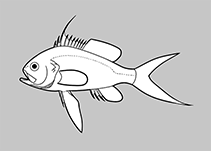 No image available for this species;
drawing shows typical species in Anthiadidae.
Google image
drawing shows typical species in Anthiadidae.
Classificazione / Nomi Nomi Comuni | Sinonimi | Catalog of Fishes(Genere, Specie) | ITIS | CoL | WoRMS | Cloffa
> Perciformes/Serranoidei (Groupers) > Anthiadidae (Fairy basslets or Streamer basses)
Etymology: Plectranthias: Bleeker (1873) disagrees with the generic placement of Plectropoma anthioides by Günther. He, therefore, erected Plectranthias to accommodate Pl. anthioides. The name is presumably the combination of the first part of Plectropoma (plectrum), and anthias. Plectrum = Plektron = πλῆκτρον (Greek, plektron = anyhting to strike with, spur + Greek, anthias = a fish, Ref. 45335); maekawa: Named for Mr. Takanori Maekawa (and the Maekawa Fisheries Co., Ltd.), who has kindly supported our ichthyofaunal research in the Ryukyu Islands; noun in apposition.
Eponymy: Takanori Maekawa is an amateur ichthyologist working in the industry who has often presented fish gleaned as by-catch from catches and fish markets that he recognises as being possibly new to science. [...] (Ref. 128868), visit book page.
Etymology: Plectranthias: Bleeker (1873) disagrees with the generic placement of Plectropoma anthioides by Günther. He, therefore, erected Plectranthias to accommodate Pl. anthioides. The name is presumably the combination of the first part of Plectropoma (plectrum), and anthias. Plectrum = Plektron = πλῆκτρον (Greek, plektron = anyhting to strike with, spur + Greek, anthias = a fish, Ref. 45335); maekawa: Named for Mr. Takanori Maekawa (and the Maekawa Fisheries Co., Ltd.), who has kindly supported our ichthyofaunal research in the Ryukyu Islands; noun in apposition.
Eponymy: Takanori Maekawa is an amateur ichthyologist working in the industry who has often presented fish gleaned as by-catch from catches and fish markets that he recognises as being possibly new to science. [...] (Ref. 128868), visit book page.
Ambiente: milieu / zona climatica / distribuzione batimetrica / gamma di distribuzione Ecologia
marino demersale; distribuzione batimetrica 150 - 200 m (Ref. 138292). Subtropical
Distribuzione Territories | Aree FAO | Ecosistemi | Presenze | Mappa dei ritrovamenti | Introduzioni | Faunafri
Northwest Pacific: Japan.
Dimensione / Peso / Età
Breve descrizione Chiavi di identificazione | Morfologia | Morfometria
Spine dorsali (totale) : 10; Raggi dorsali molli (totale) : 15 - 16; Spine anali: 3; Raggi anali molli: 7. This speces is distinguished from all its congeners by the following set of characters: D X,15-16; pectoral-fin rays 14; lateral line complete, pored scales 30; scale rows above lateral line 3; diagonal rows of large scales on cheek between eye and corner of preopercle 6; antrorse spines on ventral margin of preopercle 2; margins of subopercle and interopercle smooth; its body depth 33.5-34.7% of SL, its width 17.2-17.4% of SL; third dorsal-fin spine longest, with length 46.2-47.2% of HL; caudal-peduncle depth 58.0-63.2% of caudal-peduncle length. Colouration: when fresh: body pinkish-white with five orange-red bands on lateral surface, first band broadest, first, fourth and fifth bands vertical to body longitudinal axis, second and third bands slightly backwardly oblique; small poorly defined yellow blotches scattered below the lateral line, especially along red bands; scales above lateral line white, with distinct red margins; most cheek scales white or yellowish-white, without distinct red or yellow margins; when preserved, body uniformly pale, with reduced nape pigmentation (Ref. 138292).
Body shape (shape guide): fusiform / normal; Cross section: compressed.
Body shape (shape guide): fusiform / normal; Cross section: compressed.
Occurs over rocky substrate (Ref. 138292).
Ciclo vitale e comportamento di accoppiamento Maturità | Riproduzione | Deposizione | Uova | Fecondità | Larve
Riferimento principale
Caricare le referenze | Bibliografia | Coordinatore | Collaboratori
Wada, H., H. Senou and H. Motomura, 2018. Plectranthias maekawa, a new species of perchlet from the Tokara Islands, Kagoshima, Japan, with a review of Japanese records of P. wheeleri (Serranidae: Anthiadinae). Ichthyol. Res. 66(2):269-279. (Ref. 138292)
CITES
Not Evaluated
Minaccia per l'uomo
Harmless
Usi umani
Pesca: di potenziale interesse
FAO - Publication: search | FishSource |
Informazioni ulteriori
Ecologia trofica
Articoli alimentari (prede)
Alimentazione
Consumo di cibo
Razioni alimentari
Predatori
Articoli alimentari (prede)
Alimentazione
Consumo di cibo
Razioni alimentari
Predatori
Ecologia
Ecologia
Ecologia
Dinamica della popolazione
Parametri di crescita
Età massima / dimensioni massime
Rapporto lunghezza-peso.
Lunghezza-lunghezza rel.
Lunghezza-frequenze
Conversione di massa
Reclutamento
Abbondanza
Parametri di crescita
Età massima / dimensioni massime
Rapporto lunghezza-peso.
Lunghezza-lunghezza rel.
Lunghezza-frequenze
Conversione di massa
Reclutamento
Abbondanza
Ciclo di vita
Riproduzione
Maturità
Maturità/Gli occhielli sono relativi.
Fecondità
Deposizione
Aggregazioni riproduttive
Uova
Sviluppo delle uova
Larve
Dinamica popolazioni larvali
Riproduzione
Maturità
Maturità/Gli occhielli sono relativi.
Fecondità
Deposizione
Aggregazioni riproduttive
Uova
Sviluppo delle uova
Larve
Dinamica popolazioni larvali
Anatomia
Area branchiale
Cervello
Otolite
Area branchiale
Cervello
Otolite
Fisiologia
Composizione corporea
Nutrienti
Consumo di ossigeno
Tipo di nuoto
Velocità di nuoto
Pigmenti visivi
Suono del pesce
Malattie e parassiti
Tossicità (LC50)
Composizione corporea
Nutrienti
Consumo di ossigeno
Tipo di nuoto
Velocità di nuoto
Pigmenti visivi
Suono del pesce
Malattie e parassiti
Tossicità (LC50)
Genetica
Genome
Genetica
Eterozigosi
Ereditarietà
Diversità genetica
Genome
Genetica
Eterozigosi
Ereditarietà
Diversità genetica
Legato all'uomo
Sistemi di acquacoltura
Profili di acquacoltura
Varietà
Casi di Ciguatera
Francobolli, monete, materiale vario.
Sistemi di acquacoltura
Profili di acquacoltura
Varietà
Casi di Ciguatera
Francobolli, monete, materiale vario.
Strumenti
Libro elettronico | Giuda pratica | Generatore frequenze di lunghezza | Strumento Parametri Biologici | Mappa dei ritrovamenti |
Cattura-MSY |
Rapporti speciali
Controllo della manutenzione dell'acquario | Verificare la presenza di schede informative sulle specie | Verifica delle schede informative sull'acquacoltura
Scarica XML
Fonti Internet
AFORO (otoliths) | Aquatic Commons | BHL | Cloffa | Websites from users | Check FishWatcher | CISTI | Catalog of Fishes: Genere, Specie | DiscoverLife | ECOTOX | FAO - Publication: search | Faunafri | Fishipedia | Fishtrace | GloBI | Google Books | Google Scholar | Google | IGFA World Record | OneZoom | Open Tree of Life | Otolith Atlas of Taiwan Fishes | PubMed | Reef Life Survey | Socotra Atlas | TreeBase | Tree of Life | Wikipedia: Go, ricerca | World Records Freshwater Fishing | Zoobank | Record zoologico
Stime basate su modelli
Indice di diversità filogenetica (Fonte Biblio. 82804): PD50 = 0.5000 [Uniqueness, from 0.5 = low to 2.0 = high].
Bayesian length-weight: a=0.01413 (0.00621 - 0.03212), b=3.00 (2.81 - 3.19), in cm total length, based on LWR estimates for this (Sub)family-body shape (Ref. 93245).
Livello trofico (Fonte Biblio. 69278): 3.5 ±0.6 se; based on size and trophs of closest relatives
Resilienza (Fonte Biblio. 120179): Alto, tempo minimo di raddoppiamento della popolazione meno di 15 mesi (Preliminary K or Fecundity.).