



Plectranthias maekawa Wada, Senou & Motomura, 2018
Maekawa’s perchlet
Uploaden van uw Foto's en video's
Google afbeelding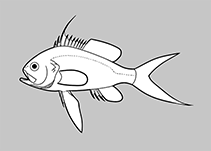 No image available for this species;
drawing shows typical species in Anthiadidae.
Google afbeelding
drawing shows typical species in Anthiadidae.
Classificatie / Namen Lokale namen | Synoniemen | Catalog of Fishes(Genus, Soort(en)) | ITIS | CoL | WoRMS | Cloffa
> Perciformes/Serranoidei (Groupers) > Anthiadidae (Fairy basslets or Streamer basses)
Etymology: Plectranthias: Bleeker (1873) disagrees with the generic placement of Plectropoma anthioides by Günther. He, therefore, erected Plectranthias to accommodate Pl. anthioides. The name is presumably the combination of the first part of Plectropoma (plectrum), and anthias. Plectrum = Plektron = πλῆκτρον (Greek, plektron = anyhting to strike with, spur + Greek, anthias = a fish, Ref. 45335); maekawa: Named for Mr. Takanori Maekawa (and the Maekawa Fisheries Co., Ltd.), who has kindly supported our ichthyofaunal research in the Ryukyu Islands; noun in apposition.
Eponymy: Takanori Maekawa is an amateur ichthyologist working in the industry who has often presented fish gleaned as by-catch from catches and fish markets that he recognises as being possibly new to science. [...] (Ref. 128868), visit book page.
Etymology: Plectranthias: Bleeker (1873) disagrees with the generic placement of Plectropoma anthioides by Günther. He, therefore, erected Plectranthias to accommodate Pl. anthioides. The name is presumably the combination of the first part of Plectropoma (plectrum), and anthias. Plectrum = Plektron = πλῆκτρον (Greek, plektron = anyhting to strike with, spur + Greek, anthias = a fish, Ref. 45335); maekawa: Named for Mr. Takanori Maekawa (and the Maekawa Fisheries Co., Ltd.), who has kindly supported our ichthyofaunal research in the Ryukyu Islands; noun in apposition.
Eponymy: Takanori Maekawa is an amateur ichthyologist working in the industry who has often presented fish gleaned as by-catch from catches and fish markets that he recognises as being possibly new to science. [...] (Ref. 128868), visit book page.
Milieu: milieu / Klimaatzone / Diepte / verspreidingsgebied Ecologie
marien demersaal; diepte 150 - 200 m (Ref. 138292). Subtropical
Verspreiding Gebieden | FAO regio's | Ecosystemen | Voorkomen | Verspreidingskaart | Introducties | Faunafri
Northwest Pacific: Japan.
Grootte / Gewicht / Leeftijd
Korte beschrijving Determinatiesleutels | Morfologie | Morfometrie
Dorsale stekels (totaal) : 10; Dorsale zachte stralen (totaal) : 15 - 16; Anale stekels: 3; Anale zachte stralen: 7. This speces is distinguished from all its congeners by the following set of characters: D X,15-16; pectoral-fin rays 14; lateral line complete, pored scales 30; scale rows above lateral line 3; diagonal rows of large scales on cheek between eye and corner of preopercle 6; antrorse spines on ventral margin of preopercle 2; margins of subopercle and interopercle smooth; its body depth 33.5-34.7% of SL, its width 17.2-17.4% of SL; third dorsal-fin spine longest, with length 46.2-47.2% of HL; caudal-peduncle depth 58.0-63.2% of caudal-peduncle length. Colouration: when fresh: body pinkish-white with five orange-red bands on lateral surface, first band broadest, first, fourth and fifth bands vertical to body longitudinal axis, second and third bands slightly backwardly oblique; small poorly defined yellow blotches scattered below the lateral line, especially along red bands; scales above lateral line white, with distinct red margins; most cheek scales white or yellowish-white, without distinct red or yellow margins; when preserved, body uniformly pale, with reduced nape pigmentation (Ref. 138292).
Body shape (shape guide): fusiform / normal; Cross section: compressed.
Body shape (shape guide): fusiform / normal; Cross section: compressed.
Occurs over rocky substrate (Ref. 138292).
Levenscyclus en paargedrag Maturiteit | Voortplanting | Paaien | Eieren | Fecunditeit | Larven
Hoofdreferentie
Upload uw referenties | Referenties | Coördinator | Medewerkers
Wada, H., H. Senou and H. Motomura, 2018. Plectranthias maekawa, a new species of perchlet from the Tokara Islands, Kagoshima, Japan, with a review of Japanese records of P. wheeleri (Serranidae: Anthiadinae). Ichthyol. Res. 66(2):269-279. (Ref. 138292)
CITES
Not Evaluated
Gevaar voor de mens
Harmless
Gebruik door de mens
Visserij: van potentieel belang
FAO - Publication: search | FishSource |
Meer informatie
Trofische ecologie
Voedsel (prooien)
Dieetsamenstelling
Voedselconsumptie
Voedselrantsoenen
Predatoren
Voedsel (prooien)
Dieetsamenstelling
Voedselconsumptie
Voedselrantsoenen
Predatoren
Ecologie
Ecologie
Ecologie
Populatiedynamica
Groeiparameters
Max. leeftijden / maten
Lengte-gewicht rel.
Lengte-lengte rel.
Lengtefrequenties
Massaconversie
Rekrutering
Abundantie
Groeiparameters
Max. leeftijden / maten
Lengte-gewicht rel.
Lengte-lengte rel.
Lengtefrequenties
Massaconversie
Rekrutering
Abundantie
Levenscyclus
Voortplanting
Maturiteit
Rijpheid/kieuwen rel.
Fecunditeit
Paaien
Paaibestanden
Eieren
Ontwikkeling van de eieren
Larven
Larvale populatiedynamiek
Voortplanting
Maturiteit
Rijpheid/kieuwen rel.
Fecunditeit
Paaien
Paaibestanden
Eieren
Ontwikkeling van de eieren
Larven
Larvale populatiedynamiek
Anatomie
Kieuwoppervlak
Hersenen
Otoliet
Kieuwoppervlak
Hersenen
Otoliet
Fysiologie
Lichaamssamenstelling
Voedingsstoffen
Zuurstofverbruik
Type zwemmen
Zwemsnelheid
Visuele pigmenten
Vis geluid
Ziekten en parasieten
Toxiciteit (LC50)
Lichaamssamenstelling
Voedingsstoffen
Zuurstofverbruik
Type zwemmen
Zwemsnelheid
Visuele pigmenten
Vis geluid
Ziekten en parasieten
Toxiciteit (LC50)
Genetica
genoom
Genetica
Heterozygositeit
Erfelijkheid
Genetische diversiteit
genoom
Genetica
Heterozygositeit
Erfelijkheid
Genetische diversiteit
Menselijk gerelateerd
Aquacultuursystemen
Aquacultuurprofielen
Kweeklijnen
Ciguatera gevallen
Postzegels, munten, diversen.
Aquacultuursystemen
Aquacultuurprofielen
Kweeklijnen
Ciguatera gevallen
Postzegels, munten, diversen.
Tools
Speciale rapporten
Bekijk gegevens voor het houden in een aquarium | Bekijk Fact Sheets voor de soort | Bekijk Aquacultuur Fact Sheets
Download XML
Internetbronnen
AFORO (otoliths) | Aquatic Commons | BHL | Cloffa | Websites from users | Bekijk FishWatcher | CISTI | Catalog of Fishes: Genus, Soort(en) | DiscoverLife | ECOTOX | FAO - Publication: search | Faunafri | Fishipedia | Fishtrace | GloBI | Google Books | Google Scholar | Google | IGFA World Record | OneZoom | Open Tree of Life | Otolith Atlas of Taiwan Fishes | PubMed | Reef Life Survey | Socotra Atlas | TreeBase | Tree of Life | Wikipedia: ga naar, zoek | World Records Freshwater Fishing | Zoobank | Zoological Record
Schattingen op basis van modellen
Fylogenetische diversiteitsindex (Ref. 82804): PD50 = 0.5000 [Uniqueness, from 0.5 = low to 2.0 = high].
Bayesian length-weight: a=0.01413 (0.00621 - 0.03212), b=3.00 (2.81 - 3.19), in cm total length, based on LWR estimates for this (Sub)family-body shape (Ref. 93245).
Trofisch niveau (Ref. 69278): 3.5 ±0.6 se; based on size and trophs of closest relatives
Weerstandsvermogen (Ref. 120179): Hoog, minimale populatieverdubbelingstijd minder dan 15 maanden (Preliminary K or Fecundity.).