



Curculionichthys monolechis Moaris, Gamarra & Reis, 2024
Adicionar o seu Fotografias e vídeos
Imagem do Google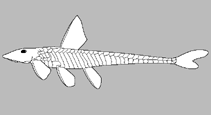 No image available for this species;
drawing shows typical species in Loricariidae.
Imagem do Google
drawing shows typical species in Loricariidae.
Classificação / Nomes Nomes comuns | Sinónimos | Catalog of Fishes(Género, Espécies) | ITIS | CoL | WoRMS | Cloffa
> Siluriformes (Catfishes) > Loricariidae (Armored catfishes) > Hypoptopomatinae
Etymology: Curculionichthys: Derived from the from the Latin 'curculionem' (elongated snout) and from the Greek 'ichthys' (fishes), in reference to the relatively elongated snouts of the fish species included in this genus; monolechis: Name from the Greek word 'monos' meaning one or single, and 'lekos' for plate, referring to the single rostral plate; noun in apposition.
Etymology: Curculionichthys: Derived from the from the Latin 'curculionem' (elongated snout) and from the Greek 'ichthys' (fishes), in reference to the relatively elongated snouts of the fish species included in this genus; monolechis: Name from the Greek word 'monos' meaning one or single, and 'lekos' for plate, referring to the single rostral plate; noun in apposition.
Ambiente: milieu / zona climática / intervalo de profundidade / gama de distribuição Ecologia
; Água doce demersal. Tropical
Distribuição Territórios | Áreas FAO | Ecossistemas | Ocorrências | Mapa dos pontos | Introduções | Faunafri
South America: Suriname and French Guiana.
Tamanho / Peso / Idade
Descrição breve Chaves de identificação | Morfologia | Morfometria
Vértebras: 29. This species is distinguished from its congeners by having the following characters: rostral plate single (vs. paired, but variably single in insperatus, luteofrenatus, oliveirai, karipuna); differs from its congeners (except luteofrenatus, piracanjuba, scaius) by having more numerous premaxillary teeth, 20-28 (vs. 6-19) and (except with luteofrenatus, scaius)
with more numerous dentary teeth, 19-25 (vs. 4-18); differs from luteofrenatus, coxipone by having fewer plates in median lateral series, 22-24 (vs. 25-27), from oliveirai, paresi by having more numerous lateral abdominal plates, 6-8 (vs. 4-5 and 4-6, respectively); further differs from insperatus, sabaji, sagarana by having a single series of large median ventral plates (vs. usually three or more regular series of median ventral plates, or small plates irregularly distributed); differs from piracanjuba, scaius by having a longer caudal penduncle, 27.0-31.6% SL (vs. 20.6-25.0 and 25.4-26.8% SL, respectively) and from luteofrenatus, oliveirai by having narrower cleithral width, 22.3-23.7% SL (vs. 23.-25.2 and 23.8-26.8% SL, respectively); further diagnosed from the geographically closer species C. karipuna, by having a shorter head, 29.2-35% SL (vs. 36.4-44.1% HL), larger suborbital depth, 23.0-26.1% HL (vs. 13.3-22.9% HL), total vertebrae 29 (vs. 27-28), more numerous premaxillary teeth 20-28 (vs. 11-17), and at least 5% genetic distance in gene coI (Ref. 130866).
This species was collected in rivers and small- to medium-sized rainforest creeks in areas of rocky rapids and sandbanks. The extinction risk of this species is estimated to be low despite incomplete knowledge of its populational trends and geographic distribution. The species is known from at least 16 localities in the Saramacca River of Suriname and the Marowijne
(¼Maroni) in Suriname and French Guiana, with an estimated Extension of Occurrence (EOO) of 56,513 km2, based on the minimum convex polygon around known localities. It seems to be abundant and despite logging and gold mining being widespread in the area, no specific threats were identified in the region, which is largely forested. Thus, for these reasons, this species is tentatively categorized as Least Concern (LC) according to the IUCN categories and criteria
(IUCN Standards and Petitions Subcommittee, 2019) (Ref. 130866).
Ciclo de vida e comportamento de acasalamento Maturidade | Reprodução | Desova | Ovos | Fecundidade | Larvas
Referência principal
Carregar as suas referências | Referências | Coordenador : Fisch-Muller, Sonia | Colaboradores
Morais, A. de, S.P. Gamarra and R.E. Reis, 2024. A new species of Curculionichthys (Siluriformes: Loricariidae) from the Saramacca and Marowijne River basins, Suriname and French Guiana. Ichthyology & Herpetology 112(1):60-68. (Ref. 130866)
CITES
Not Evaluated
Ameaça para o homem
Harmless
Utilização humana
Pescarias: sem interesse
FAO - Publication: search | FishSource |
Mais informação
Ecologia Trófica
Produtos alimentares (presas)
Composição da dieta
Consumo alimentar
Rações alimentares
Predadores
Produtos alimentares (presas)
Composição da dieta
Consumo alimentar
Rações alimentares
Predadores
Ecologia
Ecologia
Ecologia
Dinâmica das populações
Parâmetros de crescimento
Idades / tamanhos máximos
Comprimento-peso rel.
Comprimento-comprimento rel.
Frequência de comprimento
Conversão de massa
Recrutamento
Abundância
Parâmetros de crescimento
Idades / tamanhos máximos
Comprimento-peso rel.
Comprimento-comprimento rel.
Frequência de comprimento
Conversão de massa
Recrutamento
Abundância
Ciclo de vida
Reprodução
Maturidade
Maturidade/Rel. das guelras
Fecundidade
Desova
Agregações de desova
Ovos
Desenvolvimento dos ovos
Larvas
Dinâmica larvar
Reprodução
Maturidade
Maturidade/Rel. das guelras
Fecundidade
Desova
Agregações de desova
Ovos
Desenvolvimento dos ovos
Larvas
Dinâmica larvar
Anatomia
Área branquial
Cérebro
Otólitos
Área branquial
Cérebro
Otólitos
Fisiologia
Composição corporal
Nutrientes
Consumo de oxigénio
Tipo de natação
Velocidade de natação
Pigmentos visuais
Som de peixe
Doenças e Parasitas
Toxicidade (LC50s)
Composição corporal
Nutrientes
Consumo de oxigénio
Tipo de natação
Velocidade de natação
Pigmentos visuais
Som de peixe
Doenças e Parasitas
Toxicidade (LC50s)
Genética
genoma
Genética
Heterozigotia
Hereditariedade
Diversidade genética
genoma
Genética
Heterozigotia
Hereditariedade
Diversidade genética
Relacionado com o ser humano
Sistemas de aquacultura
Perfis para aquacultura
Estirpes
Casos de Ciguatera
Selos, moedas, diversos.
Sistemas de aquacultura
Perfis para aquacultura
Estirpes
Casos de Ciguatera
Selos, moedas, diversos.
Ferramentas
E-book | Guia de campo | Ferramenta auxiliar de frequências de comprimento | Ferramenta sobre a história de vida | Mapa dos pontos |
Captura-MSY |
Relatórios especiais
Descarregue XML
Fontes da internet
AFORO (otoliths) | Aquatic Commons | BHL | Cloffa | Websites from users | Consultar FishWatcher | CISTI | Catalog of Fishes: Género, Espécies | DiscoverLife | ECOTOX | FAO - Publication: search | Faunafri | Fishipedia | Fishtrace | GloBI | Google Books | Google Scholar | Google | IGFA World Record | OneZoom | Open Tree of Life | Otolith Atlas of Taiwan Fishes | PubMed | Reef Life Survey | Socotra Atlas | TreeBase | Árvore da vida | Wikipedia: ir para, procurar | World Records Freshwater Fishing | Zoobank | Registo zoológico
Estimativas baseadas em modelos
Índice de diversidade filogenética (Ref. 82804): PD50 = 0.5001 [Uniqueness, from 0.5 = low to 2.0 = high].
Bayesian length-weight: a=0.00977 (0.00434 - 0.02202), b=3.06 (2.87 - 3.25), in cm total length, based on LWR estimates for this (Sub)family-body shape (Ref. 93245).
Nível Trófico (Ref. 69278): 2.7 ±0.1 se; based on size and trophs of closest relatives
Resiliência (Ref. 120179): Elevada, tempo mínimo de duplicação da população menor que 15 meses (Preliminary K or Fecundity.).