



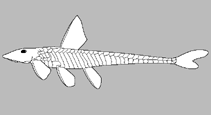
Curculionichthys monolechis Moaris, Gamarra & Reis, 2024
分類 / 名前 共通名の | 類義語 | Catalog of Fishes(部類, 種) | ITIS | CoL | WoRMS | Cloffa
> Siluriformes (Catfishes) > Loricariidae (Armored catfishes) > Hypoptopomatinae
Etymology: Curculionichthys: Derived from the from the Latin 'curculionem' (elongated snout) and from the Greek 'ichthys' (fishes), in reference to the relatively elongated snouts of the fish species included in this genus; monolechis: Name from the Greek word 'monos' meaning one or single, and 'lekos' for plate, referring to the single rostral plate; noun in apposition.
Etymology: Curculionichthys: Derived from the from the Latin 'curculionem' (elongated snout) and from the Greek 'ichthys' (fishes), in reference to the relatively elongated snouts of the fish species included in this genus; monolechis: Name from the Greek word 'monos' meaning one or single, and 'lekos' for plate, referring to the single rostral plate; noun in apposition.
環境:環境 / 気候帯 / 深さの範囲 / 分布範囲 生態学
; 新鮮な水 底生の. Tropical
分布 領土 | 国連食糧農業機関の区域 | エコシステム | 事件 | 目的のマップ | 導入 | Faunafri
South America: Suriname and French Guiana.
サイズ / 重さ / 年齢
簡単な記述 検索表 | 形態学 | 形態計測学
脊つい: 29. This species is distinguished from its congeners by having the following characters: rostral plate single (vs. paired, but variably single in insperatus, luteofrenatus, oliveirai, karipuna); differs from its congeners (except luteofrenatus, piracanjuba, scaius) by having more numerous premaxillary teeth, 20-28 (vs. 6-19) and (except with luteofrenatus, scaius)
with more numerous dentary teeth, 19-25 (vs. 4-18); differs from luteofrenatus, coxipone by having fewer plates in median lateral series, 22-24 (vs. 25-27), from oliveirai, paresi by having more numerous lateral abdominal plates, 6-8 (vs. 4-5 and 4-6, respectively); further differs from insperatus, sabaji, sagarana by having a single series of large median ventral plates (vs. usually three or more regular series of median ventral plates, or small plates irregularly distributed); differs from piracanjuba, scaius by having a longer caudal penduncle, 27.0-31.6% SL (vs. 20.6-25.0 and 25.4-26.8% SL, respectively) and from luteofrenatus, oliveirai by having narrower cleithral width, 22.3-23.7% SL (vs. 23.-25.2 and 23.8-26.8% SL, respectively); further diagnosed from the geographically closer species C. karipuna, by having a shorter head, 29.2-35% SL (vs. 36.4-44.1% HL), larger suborbital depth, 23.0-26.1% HL (vs. 13.3-22.9% HL), total vertebrae 29 (vs. 27-28), more numerous premaxillary teeth 20-28 (vs. 11-17), and at least 5% genetic distance in gene coI (Ref. 130866).
This species was collected in rivers and small- to medium-sized rainforest creeks in areas of rocky rapids and sandbanks. The extinction risk of this species is estimated to be low despite incomplete knowledge of its populational trends and geographic distribution. The species is known from at least 16 localities in the Saramacca River of Suriname and the Marowijne
(¼Maroni) in Suriname and French Guiana, with an estimated Extension of Occurrence (EOO) of 56,513 km2, based on the minimum convex polygon around known localities. It seems to be abundant and despite logging and gold mining being widespread in the area, no specific threats were identified in the region, which is largely forested. Thus, for these reasons, this species is tentatively categorized as Least Concern (LC) according to the IUCN categories and criteria
(IUCN Standards and Petitions Subcommittee, 2019) (Ref. 130866).
ライフサイクルと交尾行動 成熟 | 繁殖 | 放精 | 卵 | 生産力 | 幼生
主な参考文献
参考文献のアップロード | 参考文献 | コーディネーター : Fisch-Muller, Sonia | 協力者
Morais, A. de, S.P. Gamarra and R.E. Reis, 2024. A new species of Curculionichthys (Siluriformes: Loricariidae) from the Saramacca and Marowijne River basins, Suriname and French Guiana. Ichthyology & Herpetology 112(1):60-68. (Ref. 130866)
CITES
Not Evaluated
人間に対する脅威
Harmless
人間の用途
水産業: 興味がない
FAO - Publication: search | FishSource |
より多くの情報
養殖生態
食料品(獲物)
餌の構成
摂食量
食料配給
捕食動物
食料品(獲物)
餌の構成
摂食量
食料配給
捕食動物
生態学
生態学
生態学
人口動態
成長のパラメーター
最大年齢/サイズ
長さ-重量比。
長短関係。
体長組成
質量変換
補充
豊度
成長のパラメーター
最大年齢/サイズ
長さ-重量比。
長短関係。
体長組成
質量変換
補充
豊度
ライフサイクル
繁殖
成熟
成熟度/エラ
生産力
放精
産卵群
卵
卵の開発
幼生
幼生の動力
繁殖
成熟
成熟度/エラ
生産力
放精
産卵群
卵
卵の開発
幼生
幼生の動力
解剖学
カマ
脳
オトリス
カマ
脳
オトリス
生理学
体組成
栄養素
酸素消費
水泳タイプ
泳ぐ速さ
視覚色素
フィッシュ・サウンド
病気と寄生虫
毒性(LC50)
体組成
栄養素
酸素消費
水泳タイプ
泳ぐ速さ
視覚色素
フィッシュ・サウンド
病気と寄生虫
毒性(LC50)
遺伝子の
ゲノム
遺伝子の
ヘテロ接合性
遺伝
遺伝的多様性
ゲノム
遺伝子の
ヘテロ接合性
遺伝
遺伝的多様性
用具
特記事項
XMLをダウンロードして下さい
インターネットの情報源
AFORO (otoliths) | Aquatic Commons | BHL | Cloffa | Websites from users | Check FishWatcher | CISTI | Catalog of Fishes: 部類, 種 | DiscoverLife | ECOTOX | FAO - Publication: search | Faunafri | Fishipedia | Fishtrace | GloBI | Google Books | Google Scholar | Google | IGFA World Record | OneZoom | Open Tree of Life | Otolith Atlas of Taiwan Fishes | PubMed | Reef Life Survey | Socotra Atlas | TreeBase | 生命の木 | Wikipedia: 行く, 検索する | World Records Freshwater Fishing | Zoobank | 動物に関する記録
モデルに基づく推定値
系統多様性指数 (参照 82804): PD50 = 0.5001 [Uniqueness, from 0.5 = low to 2.0 = high].
Bayesian length-weight: a=0.00977 (0.00434 - 0.02202), b=3.06 (2.87 - 3.25), in cm total length, based on LWR estimates for this (Sub)family-body shape (Ref. 93245).
栄養段階 (参照 69278): 2.7 ±0.1 se; based on size and trophs of closest relatives
回復力 (参照 120179): 高い, 15か月以下の倍増期間の最小個体群 (Preliminary K or Fecundity.).