



Nannocharax hadros Katemo Manda, Snoeks, Chocha Manda & Vreven, 2021
Sube tu fotos y Vídeos
Google image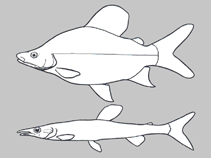 No image available for this species;
drawing shows typical species in Distichodontidae.
Google image
drawing shows typical species in Distichodontidae.
Clasificación / Nombres Nombres comunes | Sinónimos | Catalog of Fishes(Género, Especie) | ITIS | CoL | WoRMS | Cloffa
> Characiformes (Characins) > Distichodontidae (Distichodus)
Etymology: Nannocharax: Latin, nannus = small + Greek, charax = a marine fish without identification (Ref. 45335); hadros: The specific name is derived from the Greek adjective 'hadros', meaning well-developed, strong, great, bulky and refers to its large maximum size, exceeding that of its currently known congeners (Ref. 127100).
Etymology: Nannocharax: Latin, nannus = small + Greek, charax = a marine fish without identification (Ref. 45335); hadros: The specific name is derived from the Greek adjective 'hadros', meaning well-developed, strong, great, bulky and refers to its large maximum size, exceeding that of its currently known congeners (Ref. 127100).
Entorno: milieu / zona climática / rango de profundidad / gama de distribución Ecología
; agua dulce pelágico; pH range: 7.0 - 8.4; rango de profundidad 1 - 1 m (Ref. 127100). Tropical; 18°C - 28°C (Ref. 127100)
Distribución Territorios | Áreas FAO | Ecosistemas | Ocurrencias, apariciones | Mapa de puntos | Introducciones | Faunafri
Africa: Kalule Nord River, Upper Lualaba, Congo River basin in Democratic Republic of the Congo (Ref. 127100).
Tamaño / Peso / Edad
Descripción breve Claves de identificación | Morfología | Morfometría
Espinas dorsales (total) : 0; Radios blandos dorsales (total) : 13 - 14; Espinas anales: 0; Radios blandos anales: 8 - 9; Vértebra: 32 - 33. Diagnosis: Nannocharax hadros is distinguished from all its congeners by the possession of a completely pored lateral line vs. incompletely in N. angolensis, N. dageti, N. hastatus, N. lineostriatus, N. machadoi, N. minutus, N. monardi, N. multifasciatus, N. ocellicauda, N. rubensteini, N. uniocellatus and N. wittei; 37-43 lateral line scales vs. fewer scales in N. ogoensis (36) and N. pteron (35), and more scales in N. elongatus (52-57), N. intermedius (46-55), N. lineomaculatus (47-53), N. luapulae (49-55), N. macropterus (45-47), N. maculicauda (55-61), N. niloticus (50-55), N. occidentalis (50-56), N. reidi (46-48), N. rubrolabiatus (45-50), and N. signifer (46-48); 14-16 circumpeduncular scales, vs. 12 in N. altus and N. schoutedeni; 11-12 scales between the dorsal and adipose fins, vs. 9-10 in N. brevis, and 8-9 in N. seyboldi (Ref. 127100). In N. hadros, the dorsal-fin origin is situated well behind the pelvic-fin origin, vs. origin situated anterior to pelvic-fin origin in N. ansorgii, N. fasciolaris, N. gracilis, N. hollyi, N. latifasciatus, N. micros, and N. taenia or at the same level as the pelvic-fin origin in N. fasciatus; Nannocharax hadros has the tip of the longest pectoral-fin ray extending beyond the vertical through the insertion of the pelvic fin, vs. not reaching the pelvic-fin insertion in N. parvus, and a large distance between the posterior margin of the anus and the insertion of first anal-fin ray, 5.5-8.4% of standard length vs. 0.9-1.9% in N. usongo and 2.2-3.8% in N. zebra; it is most similar to N. procatopus and can be distinguished from it by a higher number of pectoral-fin rays, 16-17 vs. 12-15, respectively, a deeper body at the anal-fin origin, 15.5-19.3% of standard length vs. 10.9-15.0%, respectively, and a smaller internostril distance, 11-16% of head length vs. 17-23%, respectively (Ref. 127100).
Body shape (shape guide): elongated.
Body shape (shape guide): elongated.
Found in a shallow water zone with a high current over the rocky substrate (Ref. 127100)
Ciclo vital y comportamiento de apareamiento Madurez | Reproducción | Puesta | Huevos | Fecundidad | Larva
Referencia principal
Suba sus referencias | Referencias | Coordinador | Colaboradores
Katemo Manda, B., J. Snoeks, A. Chocha Manda and E. Vreven, 2021. Nannocharax hadros (Teleostei: Distichodontidae), a new species from the Kalule Nord River in the Upemba National Park, Upper Congo basin. Ichthyol. Explor. Freshwaters 30(4):317-330. (Ref. 127100)
CITES
Not Evaluated
Amenaza para el ser humano
Harmless
Usos humanos
Pesquerías: de interés potencial
FAO - Publication: search | FishSource |
Más información
Ecología Trófica
Alimentos (presas)
Composición de la dieta
consumo de alimento
Raciones de comida
Despredadores
Alimentos (presas)
Composición de la dieta
consumo de alimento
Raciones de comida
Despredadores
Dinámica de la población
Coeficiente del crecimiento para
Edades / tallas máximas
Longitud-peso rel.
Longitud-longitud rel.
Longitud-frecuencias
Conversión de masas
Reclutamiento
Abundancia
Coeficiente del crecimiento para
Edades / tallas máximas
Longitud-peso rel.
Longitud-longitud rel.
Longitud-frecuencias
Conversión de masas
Reclutamiento
Abundancia
Ciclo de vida
Reproducción
Madurez
Madurez/Gills rel.
Fecundidad
Puesta
Agregaciones de desove
Huevos
Desarrollo de los huevos
Larva
Dinámica larvaria
Reproducción
Madurez
Madurez/Gills rel.
Fecundidad
Puesta
Agregaciones de desove
Huevos
Desarrollo de los huevos
Larva
Dinámica larvaria
Distribución
Territorios
Áreas FAO
Ecosistemas
Ocurrencias, apariciones
Introducciones
BRUVS - Vídeos
Territorios
Áreas FAO
Ecosistemas
Ocurrencias, apariciones
Introducciones
BRUVS - Vídeos
Anatomía
Superficie branquial
Cerebro
Otolito
Superficie branquial
Cerebro
Otolito
Fisiología
Composición corporal
Nutrientes
Consumo del oxígeno
Tipo de natación
Velocidad de natación
Pigmentos visuales
Sonido de peces
Enfermedades y parásitos
Toxicidad (CL50)
Composición corporal
Nutrientes
Consumo del oxígeno
Tipo de natación
Velocidad de natación
Pigmentos visuales
Sonido de peces
Enfermedades y parásitos
Toxicidad (CL50)
Genética
Genoma
Genética
Heterocigosidad
heritabilidad
Diversidad genética
Genoma
Genética
Heterocigosidad
heritabilidad
Diversidad genética
Relacionados con el ser humano
Sistemas de acuicultura
Perfiles de acuicultura
Razas
Ciguatera cases
Sellos, monedas, varios
Sistemas de acuicultura
Perfiles de acuicultura
Razas
Ciguatera cases
Sellos, monedas, varios
Herramientas
Libro electrónico | Guía de campo | Asistente para frecuencias de tallas | Herramienta de ciclo de vida | Mapa de puntos |
Catch-MSY |
Informes especiales
Comprobar el mantenimiento del acuario | Buscar fichas sobre especies | Consulte las hojas informativas sobre acuicultura
Descargar XML
Fuentes de Internet
AFORO (otoliths) | Aquatic Commons | BHL | Cloffa | Websites from users | Check FishWatcher | CISTI | Catalog of Fishes: Género, Especie | DiscoverLife | ECOTOX | FAO - Publication: search | Faunafri | Fishipedia | Fishtrace | GloBI | Google Books | Google Scholar | Google | IGFA World Record | OneZoom | Open Tree of Life | Otolith Atlas of Taiwan Fishes | PubMed | Reef Life Survey | Socotra Atlas | TreeBase | Árbol de la vida | Wikipedia: Go, búsqueda | World Records Freshwater Fishing | Zoobank | Expediente Zoológico
Estimaciones basadas en modelos
Índice de diversidad filogenética (Referencia 82804): PD50 = 0.5000 [Uniqueness, from 0.5 = low to 2.0 = high].
Bayesian length-weight: a=0.00447 (0.00186 - 0.01072), b=3.17 (2.97 - 3.37), in cm total length, based on LWR estimates for this (Sub)family-body shape (Ref. 93245).
Nivel trófico (Referencia 69278): 3.2 ±0.4 se; based on size and trophs of closest relatives