



Nannocharax hadros Katemo Manda, Snoeks, Chocha Manda & Vreven, 2021
Uploaden van uw Foto's en video's
Google afbeelding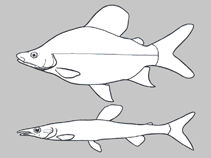 No image available for this species;
drawing shows typical species in Distichodontidae.
Google afbeelding
drawing shows typical species in Distichodontidae.
Classificatie / Namen Lokale namen | Synoniemen | Catalog of Fishes(Genus, Soort(en)) | ITIS | CoL | WoRMS | Cloffa
> Characiformes (Characins) > Distichodontidae (Distichodus)
Etymology: Nannocharax: Latin, nannus = small + Greek, charax = a marine fish without identification (Ref. 45335); hadros: The specific name is derived from the Greek adjective 'hadros', meaning well-developed, strong, great, bulky and refers to its large maximum size, exceeding that of its currently known congeners (Ref. 127100).
Etymology: Nannocharax: Latin, nannus = small + Greek, charax = a marine fish without identification (Ref. 45335); hadros: The specific name is derived from the Greek adjective 'hadros', meaning well-developed, strong, great, bulky and refers to its large maximum size, exceeding that of its currently known congeners (Ref. 127100).
Milieu: milieu / Klimaatzone / Diepte / verspreidingsgebied Ecologie
; zoet water pelagisch; pH range: 7.0 - 8.4; diepte 1 - 1 m (Ref. 127100). Tropical; 18°C - 28°C (Ref. 127100)
Verspreiding Gebieden | FAO regio's | Ecosystemen | Voorkomen | Verspreidingskaart | Introducties | Faunafri
Africa: Kalule Nord River, Upper Lualaba, Congo River basin in Democratic Republic of the Congo (Ref. 127100).
Grootte / Gewicht / Leeftijd
Korte beschrijving Determinatiesleutels | Morfologie | Morfometrie
Dorsale stekels (totaal) : 0; Dorsale zachte stralen (totaal) : 13 - 14; Anale stekels: 0; Anale zachte stralen: 8 - 9; Wervels: 32 - 33. Diagnosis: Nannocharax hadros is distinguished from all its congeners by the possession of a completely pored lateral line vs. incompletely in N. angolensis, N. dageti, N. hastatus, N. lineostriatus, N. machadoi, N. minutus, N. monardi, N. multifasciatus, N. ocellicauda, N. rubensteini, N. uniocellatus and N. wittei; 37-43 lateral line scales vs. fewer scales in N. ogoensis (36) and N. pteron (35), and more scales in N. elongatus (52-57), N. intermedius (46-55), N. lineomaculatus (47-53), N. luapulae (49-55), N. macropterus (45-47), N. maculicauda (55-61), N. niloticus (50-55), N. occidentalis (50-56), N. reidi (46-48), N. rubrolabiatus (45-50), and N. signifer (46-48); 14-16 circumpeduncular scales, vs. 12 in N. altus and N. schoutedeni; 11-12 scales between the dorsal and adipose fins, vs. 9-10 in N. brevis, and 8-9 in N. seyboldi (Ref. 127100). In N. hadros, the dorsal-fin origin is situated well behind the pelvic-fin origin, vs. origin situated anterior to pelvic-fin origin in N. ansorgii, N. fasciolaris, N. gracilis, N. hollyi, N. latifasciatus, N. micros, and N. taenia or at the same level as the pelvic-fin origin in N. fasciatus; Nannocharax hadros has the tip of the longest pectoral-fin ray extending beyond the vertical through the insertion of the pelvic fin, vs. not reaching the pelvic-fin insertion in N. parvus, and a large distance between the posterior margin of the anus and the insertion of first anal-fin ray, 5.5-8.4% of standard length vs. 0.9-1.9% in N. usongo and 2.2-3.8% in N. zebra; it is most similar to N. procatopus and can be distinguished from it by a higher number of pectoral-fin rays, 16-17 vs. 12-15, respectively, a deeper body at the anal-fin origin, 15.5-19.3% of standard length vs. 10.9-15.0%, respectively, and a smaller internostril distance, 11-16% of head length vs. 17-23%, respectively (Ref. 127100).
Body shape (shape guide): elongated.
Body shape (shape guide): elongated.
Found in a shallow water zone with a high current over the rocky substrate (Ref. 127100)
Levenscyclus en paargedrag Maturiteit | Voortplanting | Paaien | Eieren | Fecunditeit | Larven
Hoofdreferentie
Upload uw referenties | Referenties | Coördinator | Medewerkers
Katemo Manda, B., J. Snoeks, A. Chocha Manda and E. Vreven, 2021. Nannocharax hadros (Teleostei: Distichodontidae), a new species from the Kalule Nord River in the Upemba National Park, Upper Congo basin. Ichthyol. Explor. Freshwaters 30(4):317-330. (Ref. 127100)
CITES
Not Evaluated
Gevaar voor de mens
Harmless
Gebruik door de mens
Visserij: van potentieel belang
FAO - Publication: search | FishSource |
Meer informatie
Trofische ecologie
Voedsel (prooien)
Dieetsamenstelling
Voedselconsumptie
Voedselrantsoenen
Predatoren
Voedsel (prooien)
Dieetsamenstelling
Voedselconsumptie
Voedselrantsoenen
Predatoren
Populatiedynamica
Groeiparameters
Max. leeftijden / maten
Lengte-gewicht rel.
Lengte-lengte rel.
Lengtefrequenties
Massaconversie
Rekrutering
Abundantie
Groeiparameters
Max. leeftijden / maten
Lengte-gewicht rel.
Lengte-lengte rel.
Lengtefrequenties
Massaconversie
Rekrutering
Abundantie
Levenscyclus
Voortplanting
Maturiteit
Rijpheid/kieuwen rel.
Fecunditeit
Paaien
Paaibestanden
Eieren
Ontwikkeling van de eieren
Larven
Larvale populatiedynamiek
Voortplanting
Maturiteit
Rijpheid/kieuwen rel.
Fecunditeit
Paaien
Paaibestanden
Eieren
Ontwikkeling van de eieren
Larven
Larvale populatiedynamiek
Anatomie
Kieuwoppervlak
Hersenen
Otoliet
Kieuwoppervlak
Hersenen
Otoliet
Fysiologie
Lichaamssamenstelling
Voedingsstoffen
Zuurstofverbruik
Type zwemmen
Zwemsnelheid
Visuele pigmenten
Vis geluid
Ziekten en parasieten
Toxiciteit (LC50)
Lichaamssamenstelling
Voedingsstoffen
Zuurstofverbruik
Type zwemmen
Zwemsnelheid
Visuele pigmenten
Vis geluid
Ziekten en parasieten
Toxiciteit (LC50)
Genetica
genoom
Genetica
Heterozygositeit
Erfelijkheid
Genetische diversiteit
genoom
Genetica
Heterozygositeit
Erfelijkheid
Genetische diversiteit
Menselijk gerelateerd
Aquacultuursystemen
Aquacultuurprofielen
Kweeklijnen
Ciguatera gevallen
Postzegels, munten, diversen.
Aquacultuursystemen
Aquacultuurprofielen
Kweeklijnen
Ciguatera gevallen
Postzegels, munten, diversen.
Tools
Speciale rapporten
Bekijk gegevens voor het houden in een aquarium | Bekijk Fact Sheets voor de soort | Bekijk Aquacultuur Fact Sheets
Download XML
Internetbronnen
AFORO (otoliths) | Aquatic Commons | BHL | Cloffa | Websites from users | Bekijk FishWatcher | CISTI | Catalog of Fishes: Genus, Soort(en) | DiscoverLife | ECOTOX | FAO - Publication: search | Faunafri | Fishipedia | Fishtrace | GloBI | Google Books | Google Scholar | Google | IGFA World Record | OneZoom | Open Tree of Life | Otolith Atlas of Taiwan Fishes | PubMed | Reef Life Survey | Socotra Atlas | TreeBase | Tree of Life | Wikipedia: ga naar, zoek | World Records Freshwater Fishing | Zoobank | Zoological Record
Schattingen op basis van modellen
Fylogenetische diversiteitsindex (Ref. 82804): PD50 = 0.5000 [Uniqueness, from 0.5 = low to 2.0 = high].
Bayesian length-weight: a=0.00447 (0.00186 - 0.01072), b=3.17 (2.97 - 3.37), in cm total length, based on LWR estimates for this (Sub)family-body shape (Ref. 93245).
Trofisch niveau (Ref. 69278): 3.2 ±0.4 se; based on size and trophs of closest relatives