This website uses cookies to enhance your browsing experience and ensure the functionality of our site. For more detailed information about the types of cookies we use and how we protect your privacy, please visit our Privacy Information page.
×
Cookie Settings
This website uses different types of cookies to enhance your experience. Please select your preferences below:
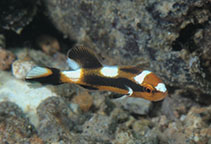
Épines dorsales (Total) : 12 - 13; Rayons mous dorsaux (Total) : 18 - 20; Épines anales: 3; Rayons mous anaux: 7 - 8. This species is distinguished by the following characters: chin with 6 pores, no median pit; gill rakers on first gill arch 7-11 + 1 + 17-19 = 26-30; D XIII,18-20, 3rd to 5th spines longest; lips fleshy, moderately swollen with age; scales ctenoid (rough to touch); lateral line tubed scales about 54-58; body depth 2.6-2.9 in SL; caudal fin slightly rounded in juveniles, truncate in adults. Colour of juveniles with few horizontal to slightly oblique dark brown bands which subdivide with age until the body appears to be dark chocolate brown above, with a network of fine white lines running up and back, the broad brown bars breaking up into smaller and smaller spots on lower sides; belly white; lips and fins bright yellow, anal and caudal fins dotted with black; pectoral fins with a splash of bright crimson or scarlet red at the base (Ref. 47695, 90102). Body shape (shape guide): fusiform / normal; Cross section: compressed.
Found in deep inner to outer reef habitats (Ref. 48635). Occurs singly or in aggregations along coral slopes of clear lagoon and seaward reefs. Juveniles solitary on shallow protected reefs (Ref. 48635). Generally nocturnal, feeding on benthic invertebrates in open sand flats and seagrass beds at night and conspicuously rests during the day (Ref. 9710, 90102). At Palau, it aggregates to spawn around new moon (Ref. 37816). Taken by handline and spear. Marketed fresh, a small quantity is salted (Ref. 47695). Maximum depth reported taken from Ref. 128797.
Cycle de vie et comportement reproducteur Maturité | Reproduction | Frai | Œufs | Fécondité | Larves
Oviparous, distinct pairing during breeding (Ref. 205).
Cycle de vie Reproduction Maturité Maturité/épines rel. Fécondité Frai Agrégats de frai Œufs Développement de l'œuf Larves Dynamique des populations larvaires
Physiologie Composition corporelle Nutriments Consommation d'oxygène Type de natation Vitesse de nage Pigments visuels Son de poisson Maladies et parasites Toxicité (CL50)
Température préférée (Réf. 123201): 24.4 - 29.3, mean 28.4 °C (based on 3196 cells).
Indice de diversité phylogénétique (Réf. 82804): PD50 = 0.5000 [Uniqueness, from 0.5 = low to 2.0 = high].
Bayesian length-weight: a=0.01175 (0.00765 - 0.01804), b=3.02 (2.89 - 3.15), in cm total length, based on LWR estimates for this species & Genus-body shape (Ref. 93245).
Niveau trophique (Réf. 69278): 3.9 ±0.59 se; based on food items.
Generation time: 3.7 ( na - na) years. Estimated as median ln(3)/K based on 1 growth studies.
Résilience (Réf. 120179): Milieu, temps minimum de doublement de population : 1,4 à 4,4 années (K=0.3;).
Vulnérabilité de la pêche (Ref. 59153): Moderate vulnerability (37 of 100). 🛈