



Gymnogeophagus terrapurpura Loureiro, Zarucki, Malabarba & González-Bergonzoni, 2016
Tải lên của bạn hình ảnh Và Video
Các tranh (Ảnh) | Google image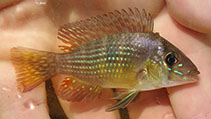 Gymnogeophagus terrapurpura
Hình ảnh của Petersen, P.
Các tranh (Ảnh) | Google image
Hình ảnh của Petersen, P.
Phân loại / Tên Tên thường gặp | Các synonym ( Các tên trùng) | Catalog of Fishes(Giống, Các loài) | ITIS | CoL | WoRMS | Cloffa
> Cichliformes (Cichlids, convict blennies) > Cichlidae (Cichlids) > Geophaginae
Etymology: Gymnogeophagus: Greek, gymnos = naked + Greek, gea = the earth + Greek, phaegein, to eat (Ref. 45335); terrapurpura: Named for the novel of G. E. Hudson 'La Tierra Purpúrea' (as it is known in the Spanish translation), in which the main character makes a trip through the same region where the new species occurs; noun in apposition.
Etymology: Gymnogeophagus: Greek, gymnos = naked + Greek, gea = the earth + Greek, phaegein, to eat (Ref. 45335); terrapurpura: Named for the novel of G. E. Hudson 'La Tierra Purpúrea' (as it is known in the Spanish translation), in which the main character makes a trip through the same region where the new species occurs; noun in apposition.
Môi trường: môi trường / vùng khí hậu / Mức độ sâu / phạm vi phân phối Sinh thái học
; nước ngọt sống nổi và đáy. Tropical
Sự phân bố Lãnh thổ | Các khu vực của FAO | Các hệ sinh thái | Những lần xuất hiện | Bản đồ điểm | Những chỉ dẫn | Faunafri
South America: Uruguay.
Bộ gần gũi / Khối lượng (Trọng lượng) / Tuổi
Chín muồi sinh dục: Lm ? range ? - ? cm
Max length : 9.2 cm SL con đực/không giới tính; (Ref. )
Max length : 9.2 cm SL con đực/không giới tính; (Ref. )
Mô tả ngắn gọn Khóa để định loại | Hình thái học | Sinh trắc học
Các tia vây lưng cứng (tổng cộng) : 14 - 15; Các vây lưng mềm (tổng cộng) : 8 - 9; Tia cứng vây hậu môn: 3; Tia mềm vây hậu môn: 7 - 9. This species is distinguished from its congeners except for G. rhabdotus, G. meridionalis, G. setequedas, G. che by the number of E1 scales, 23-25 (vs. 26-30), and its substrate-brooding behavior. This species differs from the four species by the unique pigmentation of the dorsal fin: it differs from meridionalis in having diagonal bright blue stripes (light brown in preserved specimens) over a red background (brown in preserved specimens) in the spiny section, and a combination of round, elliptical, and elongated bright blue spots (light brown in preserved specimens) in the soft section versus whitish light blue round spots (white to light brown in preserved specimens) over a red background (brown in preserved specimens) in the whole fin of meridionalis or diagonal whitish light blue stripes (white to light brown in preserved specimens) over a red background in the whole spiny section of the fin and the distal ¾ of the soft section in rhabdotus, setequedas and che; further distinguished from rhabdotus by the termination of the bright blue band that runs above the upper lateral line before reaching a bright blue spot placed above the first perforated scale (vs. band continuous with that spot); differs further from meridionalis, setequedas and che by the anal fin pigmentation pattern which consists of light blue rounded spots (light brown in preserved specimens) over a red to orange background (brown in preserved specimens) versus white irregularly shaped spots over a dark red back ground in meridionalis or diagonal light stripes in setequedas and che; differs from meridionalis by the absence of small clear spots between anal fin rays that reach the distal edge of the fin vs. presence (Ref, 123556).
Cross section: compressed.
Cross section: compressed.
This species is found in a large variety of habitats including shallow lakes, floodplain lakes, rivers, and streams, mainly associated with cobble, sandy or muddy substrates. It is an omnivore, feeding on zooplankton, macroinvertebrates, and periphyton (to a lesser extent). Feeding activity reduces greatly during autumn and winter when water temperature decreases (behavior reported in a low-impacted lowland stream in Florida Department and in a eutrophic shallow lake of Montevideo). It has been observed to brood on the substrate and exhibits substantial parental care, including aggressive territorial behavior in both males and females during the reproductive season which is from November to January (Ref. 123556).
Vòng đời và hành vi giao phối Chín muồi sinh dục | Sự tái sinh sản | Đẻ trứng | Các trứng | Sự sinh sản | Ấu trùng
Tài liệu tham khảo chính
Tải lên tài liệu tham khảo của bạn | Các tài liệu tham khảo | Người điều phối : Kullander, Sven O. | Người cộng tác
Loureiro, M., M. Zarucki, L.R. Malabarba and I. González-Bergonzoni, 2016. A new species of Gymnogeophagus Miranda Ribeiro from Uruguay (Teleostei: Cichliformes). Neotropical Ichthyol. 14(1):155-164. (Ref. 123556)
Tình trạng Sách đỏ IUCN (Ref. 130435: Version 2025-2 (Global))
Least Concern (LC) ; Date assessed: 18 February 2021
CITES
Not Evaluated
Mối đe dọa đối với con người
Harmless
Sử dụng của con người
FAO - Publication: search | FishSource |
Thêm thông tin
Sinh thái dinh dưỡng
Thức ăn (con mồi)
Thành phần thức ăn
Thành phần thức ăn
Khẩu phần ăn
Các động vật ăn mồi
Thức ăn (con mồi)
Thành phần thức ăn
Thành phần thức ăn
Khẩu phần ăn
Các động vật ăn mồi
Sinh thái học
Sinh thái học
Sinh thái học
Biến động dân số
Các thông số tăng trưởng
Độ tuổi / kích thước tối đa
Chiều dài-trọng lượng tương đối
Chiều dài-chiều dài tương đối.
Chiều dài-tần số
Chuyển đổi khối lượng
Bổ xung
Sự phong phú
Các thông số tăng trưởng
Độ tuổi / kích thước tối đa
Chiều dài-trọng lượng tương đối
Chiều dài-chiều dài tương đối.
Chiều dài-tần số
Chuyển đổi khối lượng
Bổ xung
Sự phong phú
Vòng đời
Sự tái sinh sản
Chín muồi sinh dục
Độ trưởng thành/Mang liên quan
Sự sinh sản
Đẻ trứng
Tập hợp sinh sản
Các trứng
Sự phát triển của trứng
Ấu trùng
Sự biến động ấu trùng
Sự tái sinh sản
Chín muồi sinh dục
Độ trưởng thành/Mang liên quan
Sự sinh sản
Đẻ trứng
Tập hợp sinh sản
Các trứng
Sự phát triển của trứng
Ấu trùng
Sự biến động ấu trùng
Sự phân bố
Lãnh thổ
Các khu vực của FAO
Các hệ sinh thái
Những lần xuất hiện
Những chỉ dẫn
BRUVS - Video
Lãnh thổ
Các khu vực của FAO
Các hệ sinh thái
Những lần xuất hiện
Những chỉ dẫn
BRUVS - Video
Giải phẫu
Vùng mang
Não
sỏi tai
Vùng mang
Não
sỏi tai
Sinh lý học
Thành phần cơ thể
Chất dinh dưỡng
Thành phần ô-xy
Kiểu bơi
Tốc độ bơi
Sắc tố thị giác
Tiếng cá
Bệnh tật & Ký sinh trùng
Độc tính (LC50)
Thành phần cơ thể
Chất dinh dưỡng
Thành phần ô-xy
Kiểu bơi
Tốc độ bơi
Sắc tố thị giác
Tiếng cá
Bệnh tật & Ký sinh trùng
Độc tính (LC50)
Di truyền
Bộ gen
Di truyền
Sự dị hợp tử
Di sản
Đa dạng di truyền
Bộ gen
Di truyền
Sự dị hợp tử
Di sản
Đa dạng di truyền
Liên quan đến con người
Hệ thống nuôi trồng thủy sản
Các tổng quan nuôi trồng thủy sản
Các giống
Các trường hợp ngộ độc Ciguatera
Tem, tiền xu, v.v.
Hệ thống nuôi trồng thủy sản
Các tổng quan nuôi trồng thủy sản
Các giống
Các trường hợp ngộ độc Ciguatera
Tem, tiền xu, v.v.
Các công cụ
Sách điện tử | Hướng dẫn hiện trường | Tần suất chiều dài Wizard | Công cụ của vòng đời | Bản đồ điểm |
Bắt-MSY |
Báo cáo đặc biệt
Kiểm tra bảo trì bể cá | Kiểm tra các tờ thông tin về loài | Kiểm tra các tờ thông tin về nuôi trồng thủy sản
Tải xuống XML
Các nguồn internet
AFORO (otoliths) | Aquatic Commons | BHL | Cloffa | Websites from users | Check FishWatcher | CISTI | Catalog of Fishes: Giống, Các loài | DiscoverLife | ECOTOX | FAO - Publication: search | Faunafri | Fishipedia | Fishtrace | GloBI | Google Books | Google Scholar | Google | IGFA World Record | Các cơ sở dữ liệu quốc gia | OneZoom | Open Tree of Life | Otolith Atlas of Taiwan Fishes | PubMed | Reef Life Survey | Socotra Atlas | TreeBase | Cây Đời sống | Wikipedia: Go, tìm | World Records Freshwater Fishing | Zoobank | Tạp chí Zoological Record
Ước tính dựa trên mô hình
Chỉ số đa dạng phát sinh loài (Tài liệu tham khảo 82804): PD50 = 0.5000 [Uniqueness, from 0.5 = low to 2.0 = high].
Bayesian length-weight: a=0.02754 (0.01532 - 0.04952), b=3.07 (2.92 - 3.22), in cm total length, based on LWR estimates for this species & (Sub)family-body (Ref. 93245).
Mức dinh dưỡng (Tài liệu tham khảo 69278): 3.3 ±0.5 se; based on size and trophs of closest relatives
Thích nghi nhanh (Tài liệu tham khảo 120179): Chiêù cao, thời gian nhân đôi của chủng quần tối thiểu là dưới 15 tháng (Preliminary K or Fecundity.).