



Gymnogeophagus terrapurpura Loureiro, Zarucki, Malabarba & González-Bergonzoni, 2016
上傳你的 相片 和 影像
照片 | Google 影像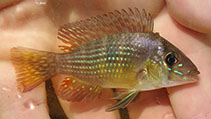 Gymnogeophagus terrapurpura
拍攝者 Petersen, P.
照片 | Google 影像
拍攝者 Petersen, P.
分類 / 名稱 俗名 | 同種異名 | Catalog of Fishes(屬, 種) | ITIS | CoL | WoRMS | Cloffa
Teleostei > Cichliformes (Cichlids, convict blennies) 鱸形目 (Cichlids, convict blennies) > Cichlidae (Cichlids) 慈鯛科魚類 (Cichlids) > Geophaginae
Etymology: Gymnogeophagus: Greek, gymnos = naked + Greek, gea = the earth + Greek, phaegein, to eat (Ref. 45335); terrapurpura: Named for the novel of G. E. Hudson 'La Tierra Purpúrea' (as it is known in the Spanish translation), in which the main character makes a trip through the same region where the new species occurs; noun in apposition.
Etymology: Gymnogeophagus: Greek, gymnos = naked + Greek, gea = the earth + Greek, phaegein, to eat (Ref. 45335); terrapurpura: Named for the novel of G. E. Hudson 'La Tierra Purpúrea' (as it is known in the Spanish translation), in which the main character makes a trip through the same region where the new species occurs; noun in apposition.
環境: 環境 / 氣候帶 / 深度上下限 / 配送範圍 生態學
; 淡水 底中水層性.
分布 領土 | FAO區域 | 生態系 | 發現紀錄 | 分布圖 | 簡介 | Faunafri
South America: Uruguay.
大小 / 重量 / 年齡
成熟度: Lm ? range ? - ? cm
Max length : 9.2 cm SL 雄魚/尚未辨別雌雄; (Ref. )
Max length : 9.2 cm SL 雄魚/尚未辨別雌雄; (Ref. )
簡短描述 檢索表 | 型態特徵 | 形態測量圖
背棘 (總數) : 14 - 15; 背的軟條 (總數) : 8 - 9; 臀棘: 3; 臀鰭軟條: 7 - 9. This species is distinguished from its congeners except for G. rhabdotus, G. meridionalis, G. setequedas, G. che by the number of E1 scales, 23-25 (vs. 26-30), and its substrate-brooding behavior. This species differs from the four species by the unique pigmentation of the dorsal fin: it differs from meridionalis in having diagonal bright blue stripes (light brown in preserved specimens) over a red background (brown in preserved specimens) in the spiny section, and a combination of round, elliptical, and elongated bright blue spots (light brown in preserved specimens) in the soft section versus whitish light blue round spots (white to light brown in preserved specimens) over a red background (brown in preserved specimens) in the whole fin of meridionalis or diagonal whitish light blue stripes (white to light brown in preserved specimens) over a red background in the whole spiny section of the fin and the distal ¾ of the soft section in rhabdotus, setequedas and che; further distinguished from rhabdotus by the termination of the bright blue band that runs above the upper lateral line before reaching a bright blue spot placed above the first perforated scale (vs. band continuous with that spot); differs further from meridionalis, setequedas and che by the anal fin pigmentation pattern which consists of light blue rounded spots (light brown in preserved specimens) over a red to orange background (brown in preserved specimens) versus white irregularly shaped spots over a dark red back ground in meridionalis or diagonal light stripes in setequedas and che; differs from meridionalis by the absence of small clear spots between anal fin rays that reach the distal edge of the fin vs. presence (Ref, 123556).
Cross section: compressed.
Cross section: compressed.
This species is found in a large variety of habitats including shallow lakes, floodplain lakes, rivers, and streams, mainly associated with cobble, sandy or muddy substrates. It is an omnivore, feeding on zooplankton, macroinvertebrates, and periphyton (to a lesser extent). Feeding activity reduces greatly during autumn and winter when water temperature decreases (behavior reported in a low-impacted lowland stream in Florida Department and in a eutrophic shallow lake of Montevideo). It has been observed to brood on the substrate and exhibits substantial parental care, including aggressive territorial behavior in both males and females during the reproductive season which is from November to January (Ref. 123556).
生命週期和交配行為 成熟度 | 繁殖 | 產卵場 | 卵 | 孕卵數 | 仔魚
主要參考資料
上傳您的推薦信 | 參考文獻 | 合作者 : Kullander, Sven O. | 合作者
Loureiro, M., M. Zarucki, L.R. Malabarba and I. González-Bergonzoni, 2016. A new species of Gymnogeophagus Miranda Ribeiro from Uruguay (Teleostei: Cichliformes). Neotropical Ichthyol. 14(1):155-164. (Ref. 123556)
CITES
Not Evaluated
對人類具威脅
人類使用
FAO - Publication: search | FishSource |
更多資訊
解剖學
鰓區
腦部
耳石
鰓區
腦部
耳石
生理學
身體成分
營養素
耗氧量
游泳類型
游泳速度
視覺色素
魚聲
疾病與寄生蟲
毒性 (LC50s)
身體成分
營養素
耗氧量
游泳類型
游泳速度
視覺色素
魚聲
疾病與寄生蟲
毒性 (LC50s)
遺傳學
基因組
遺傳學
異種性
遺傳率
遺傳多樣性
基因組
遺傳學
異種性
遺傳率
遺傳多樣性
工具
特別的報告
下載 XML
網路資源
AFORO (otoliths) | Aquatic Commons | BHL | Cloffa | Websites from users | 檢查 FishWatcher | CISTI | Catalog of Fishes: 屬, 種 | DiscoverLife | ECOTOX | FAO - Publication: search | Faunafri | Fishipedia | Fishtrace | GloBI | Google Books | Google Scholar | Google | IGFA World Record | 國家資料庫 | OneZoom | Open Tree of Life | Otolith Atlas of Taiwan Fishes | PubMed | Reef Life Survey | Socotra Atlas | TreeBase | 樹狀分類階層 | Wikipedia: 去, 搜尋 | World Records Freshwater Fishing | Zoobank | 動物學的記錄
基於模型的估計
系統發育多樣性指數 (參考文獻 82804): PD50 = 0.5000 [Uniqueness, from 0.5 = low to 2.0 = high].
Bayesian length-weight: a=0.02754 (0.01532 - 0.04952), b=3.07 (2.92 - 3.22), in cm total length, based on LWR estimates for this species & (Sub)family-body (Ref. 93245).
營養階層 (參考文獻 69278): 3.3 ±0.5 se; based on size and trophs of closest relatives
回復力 (參考文獻 120179): 高度, 族群倍增時間少於 15個月 (Preliminary K or Fecundity.).