Klassifizierung / Names
Namen | Synonyme | Catalog of Fishes(Gattung, Arten) | ITIS | CoL | WoRMS | Cloffa
>
Petromyzontiformes (Lampreys) >
Petromyzontidae (Northern lampreys) > Lampetrinae
Etymology: Lampetra: lambo (L.), to lick; petra (Gr.), rock or stone, referring to their suctorial behavior (adults attach to rocks during nest building and mating) (See ETYFish); soljani: In honor of Tonko Šoljan (1907-1980), for his contribution to the knowledge and development of ichthyology in Croatia and Bosnia and Herzegovina (See ETYFish).
Eponymy: Tonko Šoljan (1907–1980) was a Croatian ichthyologist, particularly noted for his monograph Ribe Jadrana (Fishes of the Adriatic). [...] (Ref. 128868), visit book page.
Issue
Species information for completion.
Environment: milieu / climate zone / Tiefenbereich / distribution range
Ökologie
; süßwasser demersal. Subtropical
Europe: lower Neretva River in the Adriatic Sea basin.
Size / Gewicht / Alter
Geschlechtsreife: Lm ? range ? - ? cm
Max length : 12.6 cm TL Männchen/unbestimmt; (Ref. 115563)
Kurzbeschreibung
Bestimmungsschlüssel | Morphologie | Morphometrie
This species is distinguished from its congeners by the following characters: marmorate flank pattern in live, fully grown ammocoetes, and in some adults (vs. plain colour pattern); with 3 velar tentacles (vs. most similar species L. lanceolata with 5 and L. ninae with 5-7); without posterial teeth (vs. rarely absent, usually a single incomplete row with up to 23 teeth in L. ninae); with less trunk myomeres between last branchial opening and anus 54-57 (vs. 57-64 in L. lanceolata, 57-61 in L. ninae); less trunk myomeres between last branchial opening and first dorsal fin origin 28-32 (vs. 32-36 in L. lanceolata, 32-35 in L. ninae); less trunk myomeres between last branchial opening and second dorsal-fin origin 42-46 (vs. 46-50 in L. lanceolata, 45-49 in L. ninae); differs from L. zanandreai by lacking posterial teeth (vs. usually present, very rarely absent); differs from L. fluviatilis and L. planeri by having a bicuspid middle endolateral tooth (vs. almost always tricuspid) and the infraoral lamina with 5 teeth (vs. usually 7-9, very rarely 5-6) (Ref. 115563).
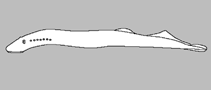
Body shape (shape guide): eel-like; Cross section: circular.
Ammocoetes of this species are found in silt, muddy or fine sandy-muddy sediment in river sections with slow or no current, in shallows at banks or backwaters at water depth of about 10-50 cm. Adults and ammocoetes are often caught together and the first post-metamorphosis individual was found in September (FSJF 2184) (Ref. 115563).
Life cycle and mating behavior
Geschlechtsreife | Fortpflanzung | Ablaichen | Eier | Fecundity | Larven
Tutman, P., J. Freyhif, J. Dulcic, B. Glamuzina and M. Geiger, 2017. Lampetra soljani, a new brook lamprey from the southern Adriatic Sea basin (Petromyzontiformes: Petromyzontidae). Zootaxa 4273(4):531-548. (Ref. 115563)
IUCN Rote Liste Status (Ref. 130435: Version 2025-1)
Bedrohung für Menschen
Harmless
Nutzung durch Menschen
Tools
Zusatzinformationen
Download XML
Internet Quellen
Estimates based on models
Phylogenetic diversity index (Ref.
82804): PD
50 = 0.5010 [Uniqueness, from 0.5 = low to 2.0 = high].
Bayesian length-weight: a=0.00138 (0.00062 - 0.00310), b=2.97 (2.78 - 3.16), in cm total length, based on LWR estimates for this (Sub)family-body shape (Ref.
93245).
Trophic level (Ref.
69278): 3.4 ±0.4 se; based on size and trophs of closest relatives
Widerstandsfähigkeit (Ref.
120179): niedrig, Verdopplung der Population dauert 4,5 - 14 Jahre. (Semelparous species, assuming tm (= tmax) > 4).
Fishing Vulnerability (Ref.
59153): Low vulnerability (10 of 100).
🛈