>
Cypriniformes (Carps) >
Cyprinidae (Minnows or carps) > Barbinae
Etymology: rabatensis: The species name rabatensis has been selected because its distribution area mainly comprises the Bou Regreg basin, which flows through Rabat City (Ref. 107580).
Environment: milieu / climate zone / djupintervall / distribution range
Ekologi
; sötvatten bentopelagisk. Subtropical
Africa: Bou Regreg River basin in north Morocco (Ref. 107580).
Size / Vikt / Age
Könsmognad: Lm ? range ? - ? cm
Max length : 13.0 cm SL hane/ej könsbestämd; (Ref. 107580)
Short description
Bestämningsnycklar | Morfologi | Morfometri
Taggstrålar i ryggfenan (totalt) : 0; Mjukstrålar i ryggfenan (totalt) : 12; Taggstrålar i analfenan: 0; Mjukstrålar i analfenan: 8; Ryggkotor: 41 - 42. Diagnosis: Luciobarbus rabatensis differs from other species of Luciobarbus by the following combination of characters: number of scales on lateral line 45-50; number of scales above lateral line 8.5-10.5; number of scales below lateral line 6.5-7.5; insertion of dorsal and ventral fins is in the same vertical plane; last single fin ray is ossified, with deep denticulations along its length; denticulations at mid-height of the ray are equal to or longer than ray width; in adult specimens, the inferior lip is retracted revealing the dentary; the ethmoid bone is wider than its length; the maxilla showed a large palatine process; vertebrae 41-42; and gill rakers 12-14 (Ref. 107580).
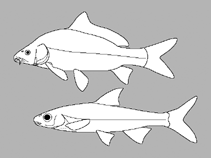
Body shape (shape guide): elongated.
This species inhabits rivers of different typologies and is present in reservoirs (Ref. 107580). Spawning takes place at the end of April and the beginning of May; at that time, individuals migrate upstream for spawning in cold and oxygenated waters where the females excavate a nest in the gravel (Ref. 107580).
Life cycle and mating behavior
Könsmognad | Reproduktion | Lek | Ägg | Fecundity | Larver
Casal-Lopez, M., S. Perea, A. Yahyaoui and I. Doadrio, 2015. Taxonomic review of the genus Luciobarbus Heckel, 1843 (Actinopterygii, Cyprinidae) from northwestern Morocco with the description of three new species. Graellsia 71(2,e27):1-24. (Ref. 107580)
IUCN Red List Status (Ref. 130435: Version 2025-1)
Threat to humans
Harmless
Human uses
Verktyg
Special reports
Download XML
Internet-källor
Estimates based on models
Phylogenetic diversity index (Ref.
82804): PD
50 = 0.5000 [Uniqueness, from 0.5 = low to 2.0 = high].
Bayesian length-weight: a=0.01072 (0.00393 - 0.02918), b=2.97 (2.73 - 3.21), in cm total length, based on LWR estimates for this (Sub)family-body shape (Ref.
93245).
Trofisk nivå (Ref.
69278): 2.9 ±0.3 se; based on size and trophs of closest relatives
Resiliens (Ref.
120179): Hög, lägsta populationsfördubblingstid mindre än 15 månader (Preliminary K or Fecundity.).
Fishing Vulnerability (Ref.
59153): Low vulnerability (10 of 100).
🛈