



Curculionichthys sagarana Roxo, Silva, Ochoa & Oliveira, 2015
Ανεβάστε το φωτογραφίες και Βίντεο
Google image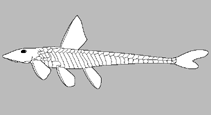 No image available for this species;
drawing shows typical species in Loricariidae.
Google image
drawing shows typical species in Loricariidae.
Ταξινόμηση / Ονόματα Κοινά ονόματα | Συνώνυμα | Catalog of Fishes(Γένος, Είδη) | ITIS | CoL | WoRMS | Cloffa
> Siluriformes (Catfishes) > Loricariidae (Armored catfishes) > Hypoptopomatinae
Etymology: Curculionichthys: Derived from the from the Latin 'curculionem' (elongated snout) and from the Greek 'ichthys' (fishes), in reference to the relatively elongated snouts of the fish species included in this genus; sagarana: The specific name sagarana is derived from two words, 'saga' of Germanic origin, meaning heroic song, and 'rana' from Tupi-Guarani language, meaning similarity. The name is in reference to the book of a Brazilian author João Guimarães Rosa published in 1946 about the history of people from Minas Gerais State living in the region of Rio das Velhas.
Etymology: Curculionichthys: Derived from the from the Latin 'curculionem' (elongated snout) and from the Greek 'ichthys' (fishes), in reference to the relatively elongated snouts of the fish species included in this genus; sagarana: The specific name sagarana is derived from two words, 'saga' of Germanic origin, meaning heroic song, and 'rana' from Tupi-Guarani language, meaning similarity. The name is in reference to the book of a Brazilian author João Guimarães Rosa published in 1946 about the history of people from Minas Gerais State living in the region of Rio das Velhas.
Περιβάλλον: περιβάλλον / κλιματική ζώνη / εύρος βάθους / εύρος διανομής Οικολογία
; Γλυκού νερού βενθικό(ς). Tropical
Κατανομή Εδάφη | Περιοχές FAO | Οικοσυστήματα | Παρουσίες | Σημειακός χάρτης | Εισαγωγές | Faunafri
South America: Rio das Velhas drainage, Rio São Francisco basin in Brazil.
Μέγεθος / Βάρος / Ηλικία
Γεννητική Ωρίμανση: Lm ? range ? - ? cm
Max length : 2.3 cm SL αρσενικό/απροσδιόριστο; (Ref. 113800); 2.4 cm SL (female)
Max length : 2.3 cm SL αρσενικό/απροσδιόριστο; (Ref. 113800); 2.4 cm SL (female)
Σύντομη περιγραφή Κλείδες προσδιορισμού | Μορφολογία | Μορφομετρία
Μαλακές ραχιαίες ακτίνες (συνολικά) : 9; Μαλακές εδρικές ακτίνες: 6; Σπόνδυλοι: 28. Curculionichthys sagarana can be distinguised from all congeners by the possession of one unpaired platelet on the dorsal portion of the caudal peduncle (vs. dorsal por¬tion of caudal peduncle without unpaired platelets). It further differs from all congeners, with the exception of Curculionichthys insperatus and C. luteofrenatus by having the caudal fin hyaline, with dark blotch limited to caudal peduncle base (vs. caudal fin hyaline, with one dark stripe extending from caudal peduncle base to the middle caudal fin rays, and for dark chromatophores irregularly distributed almost forming one or two bands); from C. insperatus, C. paresi and C. sabaji by having 15-19 premaxillary teeth (vs. 10?12 in C. insperatus; 6?10 in C. paresi and 7?12 in C. sabaji) and 12-18 dentary teeth (vs. 8?12 in C. insperatus, 4?7 in C. paresi and 7?12 in C. sabaji); from all congeners, except C. piracanjuba and C. oliveirai, by having all papillae on the lower lip randomly distributed (vs. lower lip with some papillae arranged in a medial longitudinal series extending posterior to dentaries through middle portion of lower lip); from C. oliveirai and C. coxipone by having the anterior profile of the head pointed (vs. rounded); from C. paresi by the absence of contrasting dark-brown geometric spots on the anterodorsal region of the body (vs. presence); from C. piracanjuba by having odontodes forming longitudinally aligned rows on the head and trunk (vs. odontodes not forming longitudinally aligned rows on the head and trunk); from C. sabaji, C. coxipone and C. paresi by having the cleithrum completely covered with odontodes (vs. the cleithrum with an area free of odontodes); from C. insperatus by having small, inconspicuous odontodes forming rows on the head and trunk (vs. large, conspicuous odontodes forming rows on the head and the trunk); from C. oliveirai by having 6?9 lateral abdomen plates (vs. 4?5); from C. piracanjuba by not having hypertrophied odontodes on the snout tip (vs. hypertrophied odontodes on the snout tip). In addition, Curculionichthys sagarana can be diagnosed by the following characters: deeper caudal peduncle (8.4-9.6 % of SL, vs. 10.8-12.5% of SL in C. oliveirai; 10.2-11.3% in C. paresi); greater head length (34.8-40.5% of SL, vs. 28.8-33.3% of SL in C. luteofrenatus; 27.9-32.2% of SL in C. piracanjuba); shorter snout (46.3-52.4% of HL, vs. 67.0-75.3% of HL in C. luteofrenatus; 67.7-72.7% of HL in C. piracanjuba); shorter interorbital width (27.4-33.6% of SL, vs. 33.3-45.4% of HL in C. luteofrenatus; 36.7-40.9% of HL in C. piracanjuba; 33.8-37.8% of HL in C. coxipone); deeper head (41.2-49.1% of HL, vs. 51.6-59.2% of HL in C. oliveirai); shorter dorsal-spine (19.9-24.4% of SL, vs. 25.2-27.0% of SL in C. paresi); and shorter pectoral-spine (21.5-25.2% of SL, vs. 27.0-30.1% of SL in C. paresi) (Ref. 113800).
Body shape (shape guide): elongated.
Body shape (shape guide): elongated.
Κύκλος ζωής και συμπεριφορά ζευγαρώματος Γεννητική Ωρίμανση | Αναπαραγωγή | Γεννοβολία | Αβγά | Γονιμότητα | Προνύμφες
Κύρια αναφορά
Ανεβάστε τις αναφορές σας | Αναφορές | Συντονιστής : Fisch-Muller, Sonia | Συνεργάτες
Roxo, F.F., G.S.C. Silva, L.E. Ochoa and C. Oliveira, 2015. Description of a new genus and three new species of Otothyrinae (Siluriformes, Loricariidae). Zookeys 534:103-134. (Ref. 113800)
Κατάσταση Κόκκινου Καταλόγου IUCN (Ref. 130435: Version 2025-2 (Global))
Least Concern (LC) ; Date assessed: 13 November 2020
CITES
Not Evaluated
Απειλή για τον άνθρωπο
Harmless
Ανθρώπινες χρήσεις
αλιεία: χωρίς ενδιαφέρον
FAO - Publication: search | FishSource |
Περισσότερες πληροφορίες
Τροφική Οικολογία
Τρόφιμα (θηράματα)
Σύσταση δίαιτας
Κατανάλωση τροφής
Μερίδες τροφίμων
Θηρευτές
Τρόφιμα (θηράματα)
Σύσταση δίαιτας
Κατανάλωση τροφής
Μερίδες τροφίμων
Θηρευτές
Πληθυσμιακή δυναμική
Παράμετροι Αύξησης
Μέγιστες ηλικίες / μεγέθη
Μήκος-βάρος σχετ.
Μήκος-μήκος rel.
Μήκος-συχνότητες
Μετατροπή μάζας
Στρατολόγηση
Αφθονία
Παράμετροι Αύξησης
Μέγιστες ηλικίες / μεγέθη
Μήκος-βάρος σχετ.
Μήκος-μήκος rel.
Μήκος-συχνότητες
Μετατροπή μάζας
Στρατολόγηση
Αφθονία
Κύκλος ζωής
Αναπαραγωγή
Γεννητική Ωρίμανση
Ωριμότητα / Gills rel.
Γονιμότητα
Γεννοβολία
Συγκεντρώσεις αναπαραγωγής
Αβγά
Ανάπτυξη αυγών
Προνύμφες
Δυναμική προνυμφών
Αναπαραγωγή
Γεννητική Ωρίμανση
Ωριμότητα / Gills rel.
Γονιμότητα
Γεννοβολία
Συγκεντρώσεις αναπαραγωγής
Αβγά
Ανάπτυξη αυγών
Προνύμφες
Δυναμική προνυμφών
Ανατομία
Επιφάνεια βραγχίων
Εγκέφαλος
Ωτόλιθος
Επιφάνεια βραγχίων
Εγκέφαλος
Ωτόλιθος
Φυσιολογία
Σύνθεση σώματος
Θρεπτικά συστατικά
Κατανάλωση οξυγόνου
Τύπος κολύμβησης
Ταχύτητα κολύμβησης
Οπτικές χρωστικές ουσίες
Ήχος ψαριών
Ασθένειες & παράσιτα
Τοξικότητα (LC50)
Σύνθεση σώματος
Θρεπτικά συστατικά
Κατανάλωση οξυγόνου
Τύπος κολύμβησης
Ταχύτητα κολύμβησης
Οπτικές χρωστικές ουσίες
Ήχος ψαριών
Ασθένειες & παράσιτα
Τοξικότητα (LC50)
Γενετική
Γονιδίωμα
Γενετική
Ετεροζυγωτία
Κληρονομικότητα
Γενετική ποικιλομορφία
Γονιδίωμα
Γενετική
Ετεροζυγωτία
Κληρονομικότητα
Γενετική ποικιλομορφία
Ανθρώπινη σχέση
Συστήματα υδατοκαλλιέργειας
Προφίλ υδατοκαλλιεργειών
Στελέχοι
Περιπτώσεις Ciguatera
Γραμματόσημα, νομίσματα, διάφορα.
Συστήματα υδατοκαλλιέργειας
Προφίλ υδατοκαλλιεργειών
Στελέχοι
Περιπτώσεις Ciguatera
Γραμματόσημα, νομίσματα, διάφορα.
Εργαλεία
Ηλεκτρονικό βιβλίο | Οδηγός πεδίου | Ανάλυση κατά μήκος συνθέσεων | Εργαλείο ιστορίας ζωής | Σημειακός χάρτης |
Catch-MSY |
Ειδικές εκθέσεις
Έλεγχος για συντήρηση ενυδρείου | Ελέγξτε για ενημερωτικά δελτία ειδών | Ελέγξτε για ενημερωτικά δελτία υδατοκαλλιέργειας
Λήψη XML
Διαδικτυακές πηγές
AFORO (otoliths) | Aquatic Commons | BHL | Cloffa | Websites from users | Check FishWatcher | CISTI | Catalog of Fishes: Γένος, Είδη | DiscoverLife | ECOTOX | FAO - Publication: search | Faunafri | Fishipedia | Fishtrace | GloBI | Google Books | Google Scholar | Google | IGFA World Record | OneZoom | Open Tree of Life | Otolith Atlas of Taiwan Fishes | PubMed | Reef Life Survey | Socotra Atlas | TreeBase | Δέντρο Ζωής | Wikipedia: Go, αναζήτηση | World Records Freshwater Fishing | Zoobank | Zoological Record
Εκτιμήσεις βάσει μοντέλων
Δείκτης φυλογενετικής ποικιλότητας (Αναφ. 82804): PD50 = 0.5001 [Uniqueness, from 0.5 = low to 2.0 = high].
Bayesian length-weight: a=0.00977 (0.00434 - 0.02202), b=3.06 (2.87 - 3.25), in cm total length, based on LWR estimates for this (Sub)family-body shape (Ref. 93245).
Τροφικό Επίπεδο (Αναφ. 69278): 2.6 ±0.1 se; based on size and trophs of closest relatives
Ελαστικότητα (Αναφ. 120179): Υψηλό, ελάχιστος χρόνος για διπλασιασμό πληθυσμού < 15 μήνες (Preliminary K or Fecundity.).