



Peckoltia ephippiata Armbruster, Werneke & Tan, 2015
Загрузить свой Фото и Видео
Изображение на Google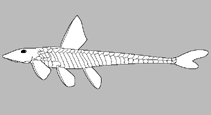 No image available for this species;
drawing shows typical species in Loricariidae.
Изображение на Google
drawing shows typical species in Loricariidae.
Классификация / Имена народные названия | синонимы | Catalog of Fishes(род, виды) | ITIS | CoL | WoRMS | Cloffa
> Siluriformes (Catfishes) > Loricariidae (Armored catfishes) > Hypostominae
Etymology: Peckoltia: Because of Gustavo Peckolt,member of the Natural History Commission of Rondon (Ref. 45335); ephippiata: Name from Latin 'ephippiata' for saddled in reference to the presence of saddles in this species.
Eponymy: Gustavo Peckolt (1861–1923) was a Brazilian-born German botanist and pharmacist. [...] (Ref. 128868), visit book page.
Etymology: Peckoltia: Because of Gustavo Peckolt,member of the Natural History Commission of Rondon (Ref. 45335); ephippiata: Name from Latin 'ephippiata' for saddled in reference to the presence of saddles in this species.
Eponymy: Gustavo Peckolt (1861–1923) was a Brazilian-born German botanist and pharmacist. [...] (Ref. 128868), visit book page.
Окружающая среда: среда / климатическая зона / пределы глубины / диапазон распространения экология
; пресноводный демерсальный. Tropical
распространение Территории | регионы FAO | Экосистемы | места находок | карта точек | интродукции | Faunafri
South America: Rio Leitão, rio Madeira drainage in Brazil.
Размер / Вес / Возраст
Краткое описание определительные ключи | морфология | морфометрия
членистые (мягкие) лучи спинного плавника (общее число) : 9; членистые (мягкие) лучи анального плавника: 5. Peckoltia ephippiata is distinguished from P. pankimpuju by its well developed color and eyes; from all other congeners by the absence of spots or bands in the dorsal fin; from all congeners except P. greedoi by having small, very faint spots on the head (vs. large spots, mottling, short lines, or thick dark areas, always much more intense than the weak spots in P. ephippiata; P. greedoi has a uniformly dark head, but the small faint spots of P. ephippiata can appear uniformly dark without closer inspection); from all congeners except P. furcata, P. greedoi, P. lujani, P. pankimpuju, and P. sabaji by having the dentaries meet at an angle greater than 90°; from P. greedoi and P. lujani by the absence of bands in the dorsal fin, rays light and membranes dark (vs. bands present), by having more teeth, 39-72 dentary, 41-73 premaxillary (vs. 16-39 dentary, 20-38 premaxillary in P. greedoi; and 20-37 dentary, 23-45 premaxillary in P. lujani:), by having slight keels on the lateral plates, particularly the median series (vs. keels absent), and by having platelets on the central region of the abdomen posterior to the pectoral girdle present (vs. platelets maximally present below pectoral girdle and in a narrow, lateral column just posterior to pectoral fin, and below pelvic girdle); and from P. lujani by having the pectoral-fin spine relaxed position angled dorsally, pointing at insertion of dorsal fin (vs. pectoral-fin spine angled only slightly dorsally, pointing maximally to dorsal insertion of caudal fin) and by the pectoral-fin spine reaching two or more plates of the ventral series beyond the pelvic base when adpressed ventral to pelvic fin (vs. less than one plate).
It can be diagnosed from Etsaputu by having greater than six evertible cheek odontodes, the largest of which extends posterior to the eye (vs. six or fewer, the largest not extending beyond the exposed portion of the opercle); from Hemiancistrus (except ‘H.’ landoni) and Ancistomus by having prominent dorsal saddles (vs. dark or light spots or entirely dark); and from all Hemiancistrus and Ancistomus by having bands in the caudal fin and no free spots (vs. bands absent or present with some free spots). It differs rom Peckoltichthys bachi by having small, faint spots on the head (vs. large dark spots or mottling); by having the eyes high on the head with the dorsal rim of the orbit higher than the interorbital space (vs. low on the head, dorsal rim of orbit lower than interorbital space), and by having small plates on the abdomen (vs. relatively large) (Ref. 99824).
Body shape (shape guide): elongated.
Body shape (shape guide): elongated.
Facultative air-breathing in the genus (Ref. 126274)
Жизненный цикл и брачное поведение половая зрелость | размножение | нерест | икра | Плодовитость | личинки
Основная ссылка
Загрузите свои рекомендации | ссылки | координатор : Fisch-Muller, Sonia | соавторы
Armbruster, J.W., D.C. Werneke and M. Tan, 2015. Three new species of saddled loricariid catfishes, and a review of Hemiancistrus, Peckoltia, and allied genera (Siluriformes). Zookeys 480:97-123. (Ref. 99824)
CITES
Not Evaluated
Угроза для людей
Harmless
Использование человеком
FAO - Publication: search | FishSource |
дополнительная информация
Трофическая экология
Пищевые предметы (добыча)
состав пищи
потребление пищи
Продовольственные пайки
хищники
Пищевые предметы (добыча)
состав пищи
потребление пищи
Продовольственные пайки
хищники
Динамика численности населения
Параметры роста
Макс. возраст / размер
Отношение длины к весу.
Отношение длины к длине.
Размерный состав
Преобразование массы
пополнение
численность
Параметры роста
Макс. возраст / размер
Отношение длины к весу.
Отношение длины к длине.
Размерный состав
Преобразование массы
пополнение
численность
Жизненный цикл
размножение
половая зрелость
Зрелость/Жиры относительно.
Плодовитость
нерест
Нерестовые скопления
икра
Развитие икры
личинки
динамика численности личинок
размножение
половая зрелость
Зрелость/Жиры относительно.
Плодовитость
нерест
Нерестовые скопления
икра
Развитие икры
личинки
динамика численности личинок
Анатомия
жаберная область
Мозг
Отолит
жаберная область
Мозг
Отолит
Физиология
Состав тела
Питательные вещества
Потребление кислорода
Тип плавания
Скорость плавания
Зрительные пигменты
Звук рыбы
Болезни и паразиты
Токсичность (LC50s)
Состав тела
Питательные вещества
Потребление кислорода
Тип плавания
Скорость плавания
Зрительные пигменты
Звук рыбы
Болезни и паразиты
Токсичность (LC50s)
генетика
Геном
генетика
Гетерозиготность
наследуемость
Генетическое разнообразие
Геном
генетика
Гетерозиготность
наследуемость
Генетическое разнообразие
Связанные с человеком
Системы аквакультуры
особенности рыбоводства
степень растяжения
Случаи заболевания сигуатерой
Марки, монеты и прочее.
Системы аквакультуры
особенности рыбоводства
степень растяжения
Случаи заболевания сигуатерой
Марки, монеты и прочее.
инструменты
Специальные отчеты
Проверить содержание в аквариумах | Проверить опубликованные видовые данные | Проверить опубликованные данные по аквакультуре
Скачать в формате XML
ресурсы в Интернет
AFORO (otoliths) | Aquatic Commons | BHL | Cloffa | Websites from users | Проверить FishWatcher | CISTI | Catalog of Fishes: род, виды | DiscoverLife | ECOTOX | FAO - Publication: search | Faunafri | Fishipedia | Fishtrace | GloBI | Google Books | Google Scholar | Google | IGFA World Record | OneZoom | Open Tree of Life | Otolith Atlas of Taiwan Fishes | PubMed | Reef Life Survey | Socotra Atlas | TreeBase | Tree of Life | Wikipedia: Вперёд, поиск | World Records Freshwater Fishing | Zoobank | Зоологическая летопись
Оценки, основанные на моделях
Индекс филогенетического разнообразия (ссылка 82804): PD50 = 0.5000 [Uniqueness, from 0.5 = low to 2.0 = high].
Bayesian length-weight: a=0.01549 (0.00726 - 0.03306), b=2.96 (2.79 - 3.13), in cm total length, based on LWR estimates for this (Sub)family-body shape (Ref. 93245).
устойчивость к внешним воздействиям (ссылка 120179): высокий, минимальное время удвоения популяции до 15 месяцев (Preliminary K or Fecundity.).