



分類 / 名稱 俗名 | 同種異名 | Catalog of Fishes(屬, 種) | ITIS | CoL | WoRMS | Cloffa
Teleostei > Beloniformes (Needle fishes) 頜針魚目 (Needle fishes) > Adrianichthyidae (Ricefishes) 異鱂科 (Ricefishes) > Oryziinae
Etymology: Oryzias: Greek, oryza = rice; because of the habitat used by this fish (Ref. 45335); soerotoi: Named for Bambang Soeroto, a systematic ichthyologist at Sam Ratulangi University, Indonesia, in recognition of his enduring contributions to the exploration of fish diversity in Sulawesi.
Eponymy: H R Bambang Soeroto (1929 –2021) was a systematic ichthyologist who was also professor (1986) of geomorphology in the Department of Biology at Sam Ratulangi University, Indonesia. [...] (Ref. 128868), visit book page.
Etymology: Oryzias: Greek, oryza = rice; because of the habitat used by this fish (Ref. 45335); soerotoi: Named for Bambang Soeroto, a systematic ichthyologist at Sam Ratulangi University, Indonesia, in recognition of his enduring contributions to the exploration of fish diversity in Sulawesi.
Eponymy: H R Bambang Soeroto (1929 –2021) was a systematic ichthyologist who was also professor (1986) of geomorphology in the Department of Biology at Sam Ratulangi University, Indonesia. [...] (Ref. 128868), visit book page.
環境: 環境 / 氣候帶 / 深度上下限 / 配送範圍 生態學
; 淡水 底中水層性.
分布 領土 | FAO區域 | 生態系 | 發現紀錄 | 分布圖 | 簡介 | Faunafri
Asia: Lake Tiu in central Sulawesi, Indonesia.
大小 / 重量 / 年齡
簡短描述 檢索表 | 型態特徵 | 形態測量圖
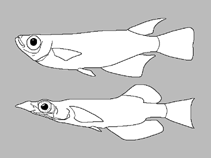
背的軟條 (總數) : 8 - 9; 臀鰭軟條: 18 - 21; 脊椎骨: 29 - 31. Oryzias soerotoi is distinguished from all congeners from Sulawesi by its brilliant orange coloration in the dorsal and ventral margins of the caudal fins of adult males. It differs by fewer scales along lateral midline (30-32) from O. sarasinorum (70-75), O. bonneorum (36-39), O. eversi (33-36), O. orthognathus (45-57), O. nigrimas (34-37), and O. matanensis (41-47). Other character useful to identify O. soerotoi is by having deeper body depth (21.6-24.8 vs. 13-15 in O. sarasinorum; and 17-20 in O. bonneorum). In addition, O. soerotoi has narrower body than O. matanensis (26.0-31.0) and O. profundicola (30.4-35.2); fewer dorsal-fin rays (8-9) than O. sarasinorum (11-12), O. bonneorum (12-13), O. eversi (10-12), and O. profundicola (10-14); fewer vertebrae (29-31) than O. sarasinorum (34), O. orthognathus (33), and O. nigrimas (32-33). It can be diagnosed from O. matanensis, O. marmoratus, O. profundicola, and O. hadiatyae, by the absence of dark brown blotches or bars on the lateral body in adult males. It can be further distinguished by its shorter anal-fin base (23.7-29.7) from O. marmoratus (31.4-36.9) and O. profundicola (37.4-41.4). It is distinct from O. hadiatyae by its short head (21.9-24.9 versus 27.2-37.1) and no pronounced concavity on the snout; from O. celebensis by the absence of distinct black stripes from the posterior midbody onto the caudal fin and of diffuse dark bars extended from dorsal and ventral to the midline; further from O. celebensis by having somewhat fewer pectoral-fin rays (9-10 vs. 10-11); from O. woworae, O. wolasi, and O. asinua by the absence of steel blue body coloration and of brilliant red or orangish coloration in the dorsal and ventral margins of the caudal peduncle; and larger size than O. woworae, O. wolasi, and O. asinua (up to 3.21 cm SL vs. 2.86 cm SL); from O. nebulosus by having a truncate caudal fin (vs. emarginate) and somewhat fewer lateral scales (30-32 vs. 32-36). It differs from O. mekongensis and O. pectoralis, Oryzias outside of Sulawesi having orange or reddish margins on the caudal fins of males by the possession of 8-9 dorsal-fin rays (vs. 5-7 in O. mekongensis and 6-7 in O. pectoralis) and attaining larger size (up to 1.67 cm SL in O. mekongensis and 2.23 cm SL in O. pectoralis) (Ref. 103734).
Body shape (shape guide): elongated.
Body shape (shape guide): elongated.
The type locality, Lake Tiu in central Sulawesi, is surrounded by trees and mountains and
is characterized by a muddy substrate, and calm and transparent water, but darkly stained by decaying vegetation. Juveniles and young fish occurs in shallow habitats with dense vegetation (Ref. 103734).
生命週期和交配行為 成熟度 | 繁殖 | 產卵場 | 卵 | 孕卵數 | 仔魚
Based on aquarium observations, females carry eggs on a genital pore for several hours and deposit them onto submerged yarn (Ref. 103734).
主要參考資料
上傳您的推薦信 | 參考文獻 | 合作者 : Seegers, Lothar | 合作者
Mokodongan, D.F., R. Tanaka and K. Yamahira, 2014. A new ricefish of the genus Oryzias (Beloniformes, Adrianichthyidae) from Lake Tiu, Central Sulawesi, Indonesia. Copeia 2014(3):561-567. (Ref. 103734)
IUCN 瀕危狀態 (Ref. 130435: Version 2025-2 (Global))
極危 (CR) (B1ab(iii)+2ab(iii)); Date assessed: 16 November 2018
CITES
Not Evaluated
對人類具威脅
人類使用
漁業: 沒有興趣
FAO - Publication: search | FishSource |
更多資訊
解剖學
鰓區
腦部
耳石
鰓區
腦部
耳石
生理學
身體成分
營養素
耗氧量
游泳類型
游泳速度
視覺色素
魚聲
疾病與寄生蟲
毒性 (LC50s)
身體成分
營養素
耗氧量
游泳類型
游泳速度
視覺色素
魚聲
疾病與寄生蟲
毒性 (LC50s)
遺傳學
基因組
遺傳學
異種性
遺傳率
遺傳多樣性
基因組
遺傳學
異種性
遺傳率
遺傳多樣性
工具
特別的報告
下載 XML
網路資源
AFORO (otoliths) | Aquatic Commons | BHL | Cloffa | Websites from users | 檢查 FishWatcher | CISTI | Catalog of Fishes: 屬, 種 | DiscoverLife | ECOTOX | FAO - Publication: search | Faunafri | Fishipedia | Fishtrace | GloBI | Google Books | Google Scholar | Google | IGFA World Record | OneZoom | Open Tree of Life | Otolith Atlas of Taiwan Fishes | PubMed | Reef Life Survey | Socotra Atlas | TreeBase | 樹狀分類階層 | Wikipedia: 去, 搜尋 | World Records Freshwater Fishing | Zoobank | 動物學的記錄
基於模型的估計
系統發育多樣性指數 (參考文獻 82804): PD50 = 0.5000 [Uniqueness, from 0.5 = low to 2.0 = high].
Bayesian length-weight: a=0.00479 (0.00190 - 0.01207), b=3.13 (2.91 - 3.35), in cm total length, based on LWR estimates for this (Sub)family-body shape (Ref. 93245).
營養階層 (參考文獻 69278): 3.3 ±0.4 se; based on size and trophs of closest relatives