



ارفع صور و مقاطع فيديو
صور قوقل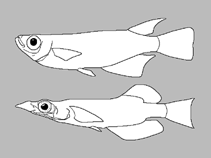 No image available for this species;
drawing shows typical species in Adrianichthyidae.
صور قوقل
drawing shows typical species in Adrianichthyidae.
التصنيف / الأسماء الأسماء الشائعة | مرادفات | Catalog of Fishes(جنس, الانواع) | ITIS | CoL | WoRMS | Cloffa
> Beloniformes (Needle fishes) > Adrianichthyidae (Ricefishes) > Oryziinae
Etymology: Oryzias: Greek, oryza = rice; because of the habitat used by this fish (Ref. 45335); soerotoi: Named for Bambang Soeroto, a systematic ichthyologist at Sam Ratulangi University, Indonesia, in recognition of his enduring contributions to the exploration of fish diversity in Sulawesi.
Eponymy: H R Bambang Soeroto (1929 –2021) was a systematic ichthyologist who was also professor (1986) of geomorphology in the Department of Biology at Sam Ratulangi University, Indonesia. [...] (Ref. 128868), visit book page.
Etymology: Oryzias: Greek, oryza = rice; because of the habitat used by this fish (Ref. 45335); soerotoi: Named for Bambang Soeroto, a systematic ichthyologist at Sam Ratulangi University, Indonesia, in recognition of his enduring contributions to the exploration of fish diversity in Sulawesi.
Eponymy: H R Bambang Soeroto (1929 –2021) was a systematic ichthyologist who was also professor (1986) of geomorphology in the Department of Biology at Sam Ratulangi University, Indonesia. [...] (Ref. 128868), visit book page.
البيئة: الوسط / المنطقة المناخية / نطاق العمق / نطاق التوزيع البيئة
; المياه العذبة قاعية التغذية و المعيشة. Tropical
التوزيع الأقاليم | مناطق الفاو | النظام البيئي | الظهور | نقطة علي الخريطة | مقدمة | Faunafri
Asia: Lake Tiu in central Sulawesi, Indonesia.
الحجم / وزن / العمر
النضج: Lm ? range ? - ? cm
Max length : 2.9 cm SL ذكر/ مختلط الجنس; (Ref. 103734); 3.2 cm SL (female)
Max length : 2.9 cm SL ذكر/ مختلط الجنس; (Ref. 103734); 3.2 cm SL (female)
وصف مختصر مفاتيح التعريف | الوصف الخارجي | قياسات المظهر الخارجي
الأشعة الظهرية الناعمة (المجموع) : 8 - 9; أشعه شرجية لينه: 18 - 21; فقرات: 29 - 31. Oryzias soerotoi is distinguished from all congeners from Sulawesi by its brilliant orange coloration in the dorsal and ventral margins of the caudal fins of adult males. It differs by fewer scales along lateral midline (30-32) from O. sarasinorum (70-75), O. bonneorum (36-39), O. eversi (33-36), O. orthognathus (45-57), O. nigrimas (34-37), and O. matanensis (41-47). Other character useful to identify O. soerotoi is by having deeper body depth (21.6-24.8 vs. 13-15 in O. sarasinorum; and 17-20 in O. bonneorum). In addition, O. soerotoi has narrower body than O. matanensis (26.0-31.0) and O. profundicola (30.4-35.2); fewer dorsal-fin rays (8-9) than O. sarasinorum (11-12), O. bonneorum (12-13), O. eversi (10-12), and O. profundicola (10-14); fewer vertebrae (29-31) than O. sarasinorum (34), O. orthognathus (33), and O. nigrimas (32-33). It can be diagnosed from O. matanensis, O. marmoratus, O. profundicola, and O. hadiatyae, by the absence of dark brown blotches or bars on the lateral body in adult males. It can be further distinguished by its shorter anal-fin base (23.7-29.7) from O. marmoratus (31.4-36.9) and O. profundicola (37.4-41.4). It is distinct from O. hadiatyae by its short head (21.9-24.9 versus 27.2-37.1) and no pronounced concavity on the snout; from O. celebensis by the absence of distinct black stripes from the posterior midbody onto the caudal fin and of diffuse dark bars extended from dorsal and ventral to the midline; further from O. celebensis by having somewhat fewer pectoral-fin rays (9-10 vs. 10-11); from O. woworae, O. wolasi, and O. asinua by the absence of steel blue body coloration and of brilliant red or orangish coloration in the dorsal and ventral margins of the caudal peduncle; and larger size than O. woworae, O. wolasi, and O. asinua (up to 3.21 cm SL vs. 2.86 cm SL); from O. nebulosus by having a truncate caudal fin (vs. emarginate) and somewhat fewer lateral scales (30-32 vs. 32-36). It differs from O. mekongensis and O. pectoralis, Oryzias outside of Sulawesi having orange or reddish margins on the caudal fins of males by the possession of 8-9 dorsal-fin rays (vs. 5-7 in O. mekongensis and 6-7 in O. pectoralis) and attaining larger size (up to 1.67 cm SL in O. mekongensis and 2.23 cm SL in O. pectoralis) (Ref. 103734).
Body shape (shape guide): elongated.
Body shape (shape guide): elongated.
The type locality, Lake Tiu in central Sulawesi, is surrounded by trees and mountains and
is characterized by a muddy substrate, and calm and transparent water, but darkly stained by decaying vegetation. Juveniles and young fish occurs in shallow habitats with dense vegetation (Ref. 103734).
دورة الحياة وسلوك التزاوج النضج | التكاثر | وضع البيض | بيض | الخصوبة | اليرقات
Based on aquarium observations, females carry eggs on a genital pore for several hours and deposit them onto submerged yarn (Ref. 103734).
المرجع الرئيسي
قم بتحميل مراجعك | مراجع | المنظم : Seegers, Lothar | المتعاونين
Mokodongan, D.F., R. Tanaka and K. Yamahira, 2014. A new ricefish of the genus Oryzias (Beloniformes, Adrianichthyidae) from Lake Tiu, Central Sulawesi, Indonesia. Copeia 2014(3):561-567. (Ref. 103734)
حالة القائمة الحمراء للاتحاد الدولي لحفظ الطبيعة والموارد الطبيعية (Ref. 130435: Version 2025-2 (Global))
معرضه للخطر بشكل حرج (CR) (B1ab(iii)+2ab(iii)); Date assessed: 16 November 2018
CITES
Not Evaluated
خطر للأنسان
Harmless
استخدامات بشرية
مصائد: غير ذات اهمية
FAO - Publication: search | FishSource |
مزيد من المعلومات
علم البيئة الغذائية
المواد الغذائية (الفرائس)
التركيبة الغذائية
استهلاك الأغذية
الحصص الغذائية
مفتريسات
المواد الغذائية (الفرائس)
التركيبة الغذائية
استهلاك الأغذية
الحصص الغذائية
مفتريسات
الديناميكيات السكانية
معاملات النمو
الحد الأقصى للأعمار/الأحجام
علاقة الطول بالوزن.
علاقة الطول بالطول.
الطول- الترددات
التحويل الجماعي
توظيف
الوفرة
معاملات النمو
الحد الأقصى للأعمار/الأحجام
علاقة الطول بالوزن.
علاقة الطول بالطول.
الطول- الترددات
التحويل الجماعي
توظيف
الوفرة
دورة الحياة
التكاثر
النضج
النضج/الخياشيم المتعلقة.
الخصوبة
وضع البيض
تجمعات التفريخ
بيض
تطور البيضة
اليرقات
حركة انتقال اليرقات
التكاثر
النضج
النضج/الخياشيم المتعلقة.
الخصوبة
وضع البيض
تجمعات التفريخ
بيض
تطور البيضة
اليرقات
حركة انتقال اليرقات
التشريح
منطقة الخياشيم
الدماغ
الأوتوليث
منطقة الخياشيم
الدماغ
الأوتوليث
علم وظائف الأعضاء
تكوين الجسم
المغذيات
استهلاك الأوكسجين
نوع السباحة
سرعة السباحة
الأصباغ البصرية
صوت السمك
الأمراض والطفيليات
السمية (LC50s)
تكوين الجسم
المغذيات
استهلاك الأوكسجين
نوع السباحة
سرعة السباحة
الأصباغ البصرية
صوت السمك
الأمراض والطفيليات
السمية (LC50s)
جيني
الوراثة
جيني
التغاير
التوريث
التنوع الوراثي
الوراثة
جيني
التغاير
التوريث
التنوع الوراثي
ذات الصلة بالبشر
أنظمة الاستزراع المائي
ملامح تربية الأحياء المائية
سلالات
حالات سيغواتيرا
طوابع بريدية وعملات معدنية ومتنوعة
أنظمة الاستزراع المائي
ملامح تربية الأحياء المائية
سلالات
حالات سيغواتيرا
طوابع بريدية وعملات معدنية ومتنوعة
أدوات
كتاب إلكتروني | دليل الميدان | معالج تردد الطول-التردد | أداة تاريخ الحياة | نقطة علي الخريطة |
Catch-MSY |
تقارير خاصة
البحث عن صيانت الأحواض المائيه | التحقق من وجود صفحات حقائق الأنواع | البحث عنا حقائق حول الأحواض المائيه
تنزيل XML
مصادر علي الأنترنت
AFORO (otoliths) | Aquatic Commons | BHL | Cloffa | Websites from users | البحث في مراقبي الأسماك | CISTI | Catalog of Fishes: جنس, الانواع | DiscoverLife | ECOTOX | FAO - Publication: search | Faunafri | Fishipedia | Fishtrace | GloBI | Google Books | Google Scholar | Google | IGFA World Record | OneZoom | Open Tree of Life | Otolith Atlas of Taiwan Fishes | PubMed | Reef Life Survey | Socotra Atlas | TreeBase | شجرة الحياة | Wikipedia: ذهب, بحث | World Records Freshwater Fishing | Zoobank | سجلات علم الحيوانات
تقديرات تستند إلى النماذج
مؤشر التنوع الشُعبي الوراثي (مرجع 82804): PD50 = 0.5000 [Uniqueness, from 0.5 = low to 2.0 = high].
Bayesian length-weight: a=0.00479 (0.00190 - 0.01207), b=3.13 (2.91 - 3.35), in cm total length, based on LWR estimates for this (Sub)family-body shape (Ref. 93245).
مستوى غذائي (مرجع 69278): 3.3 ±0.4 se; based on size and trophs of closest relatives