



Hypostomus jaguar Zanata, Sardeiro & Zawadzki, 2013
Carregue seu(sua) Fotos e vídeos
Imagem do Google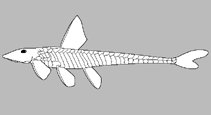 No image available for this species;
drawing shows typical species in Loricariidae.
Imagem do Google
drawing shows typical species in Loricariidae.
Classificação / Nomes Nomes comuns | Sinônimos | Catalog of Fishes(Gênero, Espécies) | ITIS | CoL | WoRMS | Cloffa
> Siluriformes (Catfishes) > Loricariidae (Armored catfishes) > Hypostominae
Etymology: Hypostomus: Greek, hypo = under + Greek, stoma = mouth (Ref. 45335); jaguar: Derived from 'îagûara' in the indigenous language Tupi- Guarani, which means panther, in reference to the black dotted color pattern on a clear background. A noun in apposition.
Etymology: Hypostomus: Greek, hypo = under + Greek, stoma = mouth (Ref. 45335); jaguar: Derived from 'îagûara' in the indigenous language Tupi- Guarani, which means panther, in reference to the black dotted color pattern on a clear background. A noun in apposition.
Meio ambiente: milieu / Zona climática / intervalo de profundidade / faixa de distribuição Ecologia
; Água doce demersal. Tropical
Distribuição Territórios | Áreas da FAO | Ecossistemas | Ocorrências | Mapa de pontos | Introduções | Faunafri
South America: Rio Paraguaçu basin in Bahia State, Brazil.
Tamanho / Peso / Idade
Descrição suscinta Chaves de identificação | Morfologia | Morfometria
Espinhos dorsais (total) : 2; Raios dorsais (total) : 7; Raios anais : 4 - 5; Vértebras: 29. This species is distinguished from its syntopic congener Hypostomus chrysostiktos by having dorsal fin with 7 unbranched rays (vs. 10-11), large dark dots on a clear background (vs. small yellow dots on a dark background); and median plates 25 or 26 (vs. 27-29). It differs from H. brevicauda and H. wuchereri by possessing the following characters: head and trunk covered by conspicuous dark dots similar in size, ranging from half to approximately one eye diameter (vs. dots smaller than the pupil); interradial membranes of anteriormost dorsal-fin rays with one series of dots (vs. membranes with two or three series of dots); and ventral surface of body comparatively weakly covered by plates, with coverage when present restricted to anterior portion of abdomen (vs. ventral surface almost or completely covered by plates, including the central area between pelvic fins). It can be diagnosed from H. unae by the presence of conspicuous dots on head, trunk, and fins similar in size (vs. dots on lateral of trunk inconspicuous and, when visible, much larger than those on the head and fins), pectoral spine not distinctly strong with a few elongated odontodes on its distal third (vs. pectoral spine distinctly strong with many elongated and curved odontodes on its distal half), dorsal fin with tip of last ray, usually reaching preadipose plate or adipose spine when adpressed (adpressed fin 36.6-44.3% vs. 29.6-38.7% and tip of last rays not reaching adipose plate or spine), 47-86 teeth on premaxilla (vs. 29-70), and 50-81 dentary teeth (vs. 34-89). It differs from its congeners from coastal northeastern rivers (H. carvalhoi, H. eptingi, H. jaguribensis, H. nudiventris, H. papariae, and H. pusarum) by a series of characters, including the dark conspicuous dotted color pattern of the body and fins, ventral surface of the belly comparatively weakly covered by plates, and lobes of the caudal fin relatively similarly elongated (Ref. 93813).
Body shape (shape guide): elongated.
Body shape (shape guide): elongated.
Facultative air-breathing in the genus (Ref. 126274); Occurs in rio Paraguaçu and its tributaries, in stretches of up to 60 m wide and 1.5 m deep, with rocky bottom, dark colored water, mild to fast water current, and at altitudes ranging from 143 to 350 meters above sea level. Sympatric with Hypostomus chrysostiktos (Ref. 93813).
Ciclo de vida ou comportamento de acasalamento Maturidade | Reprodução | Desova | Ovos | Fecundidade | Larvas
Referência principal
Carregar suas referências | Referências | Coordenador : Fisch-Muller, Sonia | Colaboradores
Zanata, A.M., B. Sardeiro and C.H. Zawadzki, 2013. A new dark-dotted species of Hypostomus Lacépède (Siluriformes: Loricariidae) from rio Paraguaçu, Bahia State, Brazil. Neotrop. Ichthyol. 11(2):247-256. (Ref. 93813)
Status na Lista Vermelha da UICN (Ref. 130435: Version 2025-2 (Global))
Segura ou pouco preocupante (LC) ; Date assessed: 07 November 2018
CITES
Not Evaluated
Ameaça para os humanos
Harmless
Uso pelos humanos
Pescarias: sem interesse
FAO - Publication: search | FishSource |
Mais informação
Ecologia Trófica
Itens alimentares (presas)
Composição da dieta
Consumo alimentar
Rações alimentares
Predadores
Itens alimentares (presas)
Composição da dieta
Consumo alimentar
Rações alimentares
Predadores
Dinâmica populacional
Parâmetros de crescimento
Idade máxima / tamanhos
Relação comprimento-peso.
Relação comprimento-comprimento.
Frequências de comprimento
Conversão de massa
Recrutamento
Abundância
Parâmetros de crescimento
Idade máxima / tamanhos
Relação comprimento-peso.
Relação comprimento-comprimento.
Frequências de comprimento
Conversão de massa
Recrutamento
Abundância
Ciclo de vida
Reprodução
Maturidade
Maturidade/Rel. das guelras
Fecundidade
Desova
Agregações de desova
Ovos
Desenvolvimento dos ovos
Larvas
Dinâmica larval
Reprodução
Maturidade
Maturidade/Rel. das guelras
Fecundidade
Desova
Agregações de desova
Ovos
Desenvolvimento dos ovos
Larvas
Dinâmica larval
Anatomia
Área branquial
Cérebro
Otólito
Área branquial
Cérebro
Otólito
Fisiologia
Composição corporal
Nutrientes
Consumo de oxigênio
Tipo de natação
Velocidade de natação
Pigmentos visuais
Som de peixe
Doenças e Parasitas
Toxicidade (LC50s)
Composição corporal
Nutrientes
Consumo de oxigênio
Tipo de natação
Velocidade de natação
Pigmentos visuais
Som de peixe
Doenças e Parasitas
Toxicidade (LC50s)
Genética
genoma
Genética
Heterozigosidade
Hereditariedade
Diversidade genética
genoma
Genética
Heterozigosidade
Hereditariedade
Diversidade genética
Relacionado a humanos
Sistemas de aquicultura
Perfis para aquacultura
Estirpes
Casos de Ciguatera
Selos, moedas, diversos.
Sistemas de aquicultura
Perfis para aquacultura
Estirpes
Casos de Ciguatera
Selos, moedas, diversos.
Ferramentas
Livro eletrônico | Guia de campo | Ferramenta auxiliar de frequências de comprimento | Ferramenta sobre a história de vida | Mapa de pontos |
Catch-MSY |
Relatórios especiais
Checar Manutenção em Aquário | Checar Planilhas de Fatos sobre as Espécies | Checar Planilhas de Fatos sobre Aquicultura
Baixar XML
Fontes da internet
AFORO (otoliths) | Aquatic Commons | BHL | Cloffa | Websites from users | Checar Observador de Peixes (FishWatcher) | CISTI | Catalog of Fishes: Gênero, Espécies | DiscoverLife | ECOTOX | FAO - Publication: search | Faunafri | Fishipedia | Fishtrace | GloBI | Google Books | Google Scholar | Google | IGFA World Record | OneZoom | Open Tree of Life | Otolith Atlas of Taiwan Fishes | PubMed | Reef Life Survey | Socotra Atlas | TreeBase | Árvore da vida | Wikipedia: Ir para, procura | World Records Freshwater Fishing | Zoobank | Registro zoológico
Estimativas baseadas em modelos
Índice de diversidade filogenética (Ref. 82804): PD50 = 0.5000 [Uniqueness, from 0.5 = low to 2.0 = high].
Bayesian length-weight: a=0.01585 (0.00726 - 0.03460), b=2.95 (2.78 - 3.12), in cm total length, based on LWR estimates for this Genus-body shape (Ref. 93245).
Resiliência (Ref. 120179): médio(a), tempo mínimo de duplicação da população 1,4 - 4,4 anos (Preliminary K or Fecundity.).