



Hypostomus jaguar Zanata, Sardeiro & Zawadzki, 2013
Uploaden van uw Foto's en video's
Google afbeelding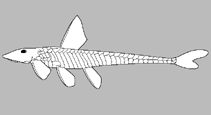 No image available for this species;
drawing shows typical species in Loricariidae.
Google afbeelding
drawing shows typical species in Loricariidae.
Classificatie / Namen Lokale namen | Synoniemen | Catalog of Fishes(Genus, Soort(en)) | ITIS | CoL | WoRMS | Cloffa
> Siluriformes (Catfishes) > Loricariidae (Armored catfishes) > Hypostominae
Etymology: Hypostomus: Greek, hypo = under + Greek, stoma = mouth (Ref. 45335); jaguar: Derived from 'îagûara' in the indigenous language Tupi- Guarani, which means panther, in reference to the black dotted color pattern on a clear background. A noun in apposition.
Etymology: Hypostomus: Greek, hypo = under + Greek, stoma = mouth (Ref. 45335); jaguar: Derived from 'îagûara' in the indigenous language Tupi- Guarani, which means panther, in reference to the black dotted color pattern on a clear background. A noun in apposition.
Milieu: milieu / Klimaatzone / Diepte / verspreidingsgebied Ecologie
; zoet water demersaal. Tropical
Verspreiding Gebieden | FAO regio's | Ecosystemen | Voorkomen | Verspreidingskaart | Introducties | Faunafri
South America: Rio Paraguaçu basin in Bahia State, Brazil.
Grootte / Gewicht / Leeftijd
Korte beschrijving Determinatiesleutels | Morfologie | Morfometrie
Dorsale stekels (totaal) : 2; Dorsale zachte stralen (totaal) : 7; Anale zachte stralen: 4 - 5; Wervels: 29. This species is distinguished from its syntopic congener Hypostomus chrysostiktos by having dorsal fin with 7 unbranched rays (vs. 10-11), large dark dots on a clear background (vs. small yellow dots on a dark background); and median plates 25 or 26 (vs. 27-29). It differs from H. brevicauda and H. wuchereri by possessing the following characters: head and trunk covered by conspicuous dark dots similar in size, ranging from half to approximately one eye diameter (vs. dots smaller than the pupil); interradial membranes of anteriormost dorsal-fin rays with one series of dots (vs. membranes with two or three series of dots); and ventral surface of body comparatively weakly covered by plates, with coverage when present restricted to anterior portion of abdomen (vs. ventral surface almost or completely covered by plates, including the central area between pelvic fins). It can be diagnosed from H. unae by the presence of conspicuous dots on head, trunk, and fins similar in size (vs. dots on lateral of trunk inconspicuous and, when visible, much larger than those on the head and fins), pectoral spine not distinctly strong with a few elongated odontodes on its distal third (vs. pectoral spine distinctly strong with many elongated and curved odontodes on its distal half), dorsal fin with tip of last ray, usually reaching preadipose plate or adipose spine when adpressed (adpressed fin 36.6-44.3% vs. 29.6-38.7% and tip of last rays not reaching adipose plate or spine), 47-86 teeth on premaxilla (vs. 29-70), and 50-81 dentary teeth (vs. 34-89). It differs from its congeners from coastal northeastern rivers (H. carvalhoi, H. eptingi, H. jaguribensis, H. nudiventris, H. papariae, and H. pusarum) by a series of characters, including the dark conspicuous dotted color pattern of the body and fins, ventral surface of the belly comparatively weakly covered by plates, and lobes of the caudal fin relatively similarly elongated (Ref. 93813).
Body shape (shape guide): elongated.
Body shape (shape guide): elongated.
Facultative air-breathing in the genus (Ref. 126274); Occurs in rio Paraguaçu and its tributaries, in stretches of up to 60 m wide and 1.5 m deep, with rocky bottom, dark colored water, mild to fast water current, and at altitudes ranging from 143 to 350 meters above sea level. Sympatric with Hypostomus chrysostiktos (Ref. 93813).
Levenscyclus en paargedrag Maturiteit | Voortplanting | Paaien | Eieren | Fecunditeit | Larven
Hoofdreferentie
Upload uw referenties | Referenties | Coördinator : Fisch-Muller, Sonia | Medewerkers
Zanata, A.M., B. Sardeiro and C.H. Zawadzki, 2013. A new dark-dotted species of Hypostomus Lacépède (Siluriformes: Loricariidae) from rio Paraguaçu, Bahia State, Brazil. Neotrop. Ichthyol. 11(2):247-256. (Ref. 93813)
Status op de Rode Lijst van het IUCN (Ref. 130435: Version 2025-2 (Global))
Niet bedreigd (LC) ; Date assessed: 07 November 2018
CITES
Not Evaluated
Gevaar voor de mens
Harmless
Gebruik door de mens
Visserij: van geen belang
FAO - Publication: search | FishSource |
Meer informatie
Trofische ecologie
Voedsel (prooien)
Dieetsamenstelling
Voedselconsumptie
Voedselrantsoenen
Predatoren
Voedsel (prooien)
Dieetsamenstelling
Voedselconsumptie
Voedselrantsoenen
Predatoren
Populatiedynamica
Groeiparameters
Max. leeftijden / maten
Lengte-gewicht rel.
Lengte-lengte rel.
Lengtefrequenties
Massaconversie
Rekrutering
Abundantie
Groeiparameters
Max. leeftijden / maten
Lengte-gewicht rel.
Lengte-lengte rel.
Lengtefrequenties
Massaconversie
Rekrutering
Abundantie
Levenscyclus
Voortplanting
Maturiteit
Rijpheid/kieuwen rel.
Fecunditeit
Paaien
Paaibestanden
Eieren
Ontwikkeling van de eieren
Larven
Larvale populatiedynamiek
Voortplanting
Maturiteit
Rijpheid/kieuwen rel.
Fecunditeit
Paaien
Paaibestanden
Eieren
Ontwikkeling van de eieren
Larven
Larvale populatiedynamiek
Anatomie
Kieuwoppervlak
Hersenen
Otoliet
Kieuwoppervlak
Hersenen
Otoliet
Fysiologie
Lichaamssamenstelling
Voedingsstoffen
Zuurstofverbruik
Type zwemmen
Zwemsnelheid
Visuele pigmenten
Vis geluid
Ziekten en parasieten
Toxiciteit (LC50)
Lichaamssamenstelling
Voedingsstoffen
Zuurstofverbruik
Type zwemmen
Zwemsnelheid
Visuele pigmenten
Vis geluid
Ziekten en parasieten
Toxiciteit (LC50)
Genetica
genoom
Genetica
Heterozygositeit
Erfelijkheid
Genetische diversiteit
genoom
Genetica
Heterozygositeit
Erfelijkheid
Genetische diversiteit
Menselijk gerelateerd
Aquacultuursystemen
Aquacultuurprofielen
Kweeklijnen
Ciguatera gevallen
Postzegels, munten, diversen.
Aquacultuursystemen
Aquacultuurprofielen
Kweeklijnen
Ciguatera gevallen
Postzegels, munten, diversen.
Tools
Speciale rapporten
Bekijk gegevens voor het houden in een aquarium | Bekijk Fact Sheets voor de soort | Bekijk Aquacultuur Fact Sheets
Download XML
Internetbronnen
AFORO (otoliths) | Aquatic Commons | BHL | Cloffa | Websites from users | Bekijk FishWatcher | CISTI | Catalog of Fishes: Genus, Soort(en) | DiscoverLife | ECOTOX | FAO - Publication: search | Faunafri | Fishipedia | Fishtrace | GloBI | Google Books | Google Scholar | Google | IGFA World Record | OneZoom | Open Tree of Life | Otolith Atlas of Taiwan Fishes | PubMed | Reef Life Survey | Socotra Atlas | TreeBase | Tree of Life | Wikipedia: ga naar, zoek | World Records Freshwater Fishing | Zoobank | Zoological Record
Schattingen op basis van modellen
Fylogenetische diversiteitsindex (Ref. 82804): PD50 = 0.5000 [Uniqueness, from 0.5 = low to 2.0 = high].
Bayesian length-weight: a=0.01585 (0.00726 - 0.03460), b=2.95 (2.78 - 3.12), in cm total length, based on LWR estimates for this Genus-body shape (Ref. 93245).
Weerstandsvermogen (Ref. 120179): Gemiddeld, minimale populatieverdubbelingstijd 1,4-4,4 jaar (Preliminary K or Fecundity.).