



Channichthys richardsoni Shandikov, 2011
Robust icefish
Carica il tuo foto e Video
Immagini | Google image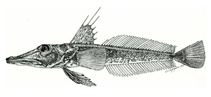 Channichthys richardsoni
Female Immagine di Shandikov, G.A.
Immagini | Google image
Female Immagine di Shandikov, G.A.
Classificazione / Nomi Nomi Comuni | Sinonimi | Catalog of Fishes(Genere, Specie) | ITIS | CoL | WoRMS | Cloffa
> Perciformes/Notothenioidei (Icefishes) > Channichthyidae (Crocodile icefishes)
Etymology: Channichthys: Greek, channe, -es = an anchovy + Greek, ichthys = fish (Ref. 45335); richardsoni: Named for the Scottish naturalist John Richardson, who described the first species of icefishes C. rhinoceratus and established the genus Channichthys.
Eponymy: Sir John Richardson (1787–1865) was a Scottish naval surgeon, naturalist and Arctic explorer. [...] (Ref. 128868), visit book page.
Etymology: Channichthys: Greek, channe, -es = an anchovy + Greek, ichthys = fish (Ref. 45335); richardsoni: Named for the Scottish naturalist John Richardson, who described the first species of icefishes C. rhinoceratus and established the genus Channichthys.
Eponymy: Sir John Richardson (1787–1865) was a Scottish naval surgeon, naturalist and Arctic explorer. [...] (Ref. 128868), visit book page.
Ambiente: milieu / zona climatica / distribuzione batimetrica / gamma di distribuzione Ecologia
marino demersale; distribuzione batimetrica 126 - 310 m (Ref. 90862), usually 126 - ? m (Ref. 90862). Deep-water
Distribuzione Territories | Aree FAO | Ecosistemi | Presenze | Mappa dei ritrovamenti | Introduzioni | Faunafri
Southern Ocean, Sub-Antarctic: Kerguelen Islands.
Dimensione / Peso / Età
Maturità: Lm ? range ? - ? cm
Max length : 37.4 cm TL (female)
Max length : 37.4 cm TL (female)
Breve descrizione Chiavi di identificazione | Morfologia | Morfometria
Spine dorsali (totale) : 7 - 8; Raggi dorsali molli (totale) : 31 - 34; Spine anali: 0; Raggi anali molli: 29 - 32. This species is characterized by the following D1 VII-VIII, D2 31-34; A 29-32; pectoral 19-20; bony tubular plates (scales) of the dorsal lateral line 61-78 and of the median lateral line 9-23, rounded separated bony plates in the anterior part of the median lateral line 4-28, as a rule, more than 10; number of gill-rakers on the outer side of the lower part of the 1st arch 6-15. This species is further distinguished by the following: interorbital width narrow, 1.0-1.4 times in horizontal orbit diameter, 5.8-7.5 in HL and 2.0-2.4 in head height at level of middle of eye; eye moderate in size, its diameter 5.2-6.3 times in HL and 2.6-3.0 in snout length; supraorbital outer bony edges of frontals noticeably elevated; snout relatively long, approximately equal to or somewhat shorter than half the head length, 2.1-2.2 in HL; tips of jaws aligned or lower jaw slightly protruding, teeth on symphysis not visible; posterior edge of maxillary extending below 1/3-1/2 of the orbit diameter; a row of rakers on lower part of first gill arch on the outer side of ceratobranchial; pectoral fin extending above to anus or origin of first anal fin ray; first dorsal fin high, 3.3-4.7 times in SL, second and third rays longest; fin membrane of D1 not reaching tips of longest rays, its height about 1.4-1.7 times in height of D1; dorsal fins well separated, posterior edge of D1 fin membrane not reaching first ray base of D2; interdorsal distance wide, 10.9-16.4 times in SL or 1.0-1.9 times in length of D1; bony tuberculation well developed on frontals and lacrimals, D1 flexible spines, branchiostegals, pelvic fins and on bony structures of both lateral lines; absent on maxillary and on anterior part of lower jaw (Ref. 90862).
Body shape (shape guide): elongated.
Body shape (shape guide): elongated.
Found on shelf waters of islands and caught in 2 bottom trawls at depths of 126 and 270-310 m, together with C. rhinoceratus, C. rugosus, C. panticapaei, C. bospori, C. irinae and C. mithridatis. Most specimens were caught at depth of 126 m in an area with abundant benthic fauna and the alga Macrocystis pyrifera. Apparently a primarily piscivorous predator (inferred from the single row of gill-rakers and similar to its congeners). Females mature at about 29-31 cm TL (25-27 cm SL); the post-spawning SGM VI-III is clearly detected in females larger than 31 cm TL and the SGM III - in the smaller, firstly maturing ones. The SGM of the males examined varied from stage II to early stage III in the specimen of 32.5 cm TL. Spawning and pre-spawning SGM were absent. Spawning period apparently takes a place from autumn to the beginning of winter (Ref. 90862).
Ciclo vitale e comportamento di accoppiamento Maturità | Riproduzione | Deposizione | Uova | Fecondità | Larve
Riferimento principale
Caricare le referenze | Bibliografia | Coordinatore | Collaboratori
Shandikov, G.A., 2011. Channichthys richardsoni sp. n., a new Antarctic icefish (Perciformes: Notothenioidei: Channichthyidae) from the Kerguelen Islands area, Indian sector of the Southern Ocean. Journal of V.N. Karazin Kharkiv National University, Series: Biology 2008, 7(814):125-134. (Ref. 90862)
CITES
Not Evaluated
Minaccia per l'uomo
Harmless
Usi umani
Pesca: bycatch
FAO - Publication: search | FishSource |
Informazioni ulteriori
Ecologia trofica
Articoli alimentari (prede)
Alimentazione
Consumo di cibo
Razioni alimentari
Predatori
Articoli alimentari (prede)
Alimentazione
Consumo di cibo
Razioni alimentari
Predatori
Ecologia
Ecologia
Ecologia
Dinamica della popolazione
Parametri di crescita
Età massima / dimensioni massime
Rapporto lunghezza-peso.
Lunghezza-lunghezza rel.
Lunghezza-frequenze
Conversione di massa
Reclutamento
Abbondanza
Parametri di crescita
Età massima / dimensioni massime
Rapporto lunghezza-peso.
Lunghezza-lunghezza rel.
Lunghezza-frequenze
Conversione di massa
Reclutamento
Abbondanza
Ciclo di vita
Riproduzione
Maturità
Maturità/Gli occhielli sono relativi.
Fecondità
Deposizione
Aggregazioni riproduttive
Uova
Sviluppo delle uova
Larve
Dinamica popolazioni larvali
Riproduzione
Maturità
Maturità/Gli occhielli sono relativi.
Fecondità
Deposizione
Aggregazioni riproduttive
Uova
Sviluppo delle uova
Larve
Dinamica popolazioni larvali
Anatomia
Area branchiale
Cervello
Otolite
Area branchiale
Cervello
Otolite
Fisiologia
Composizione corporea
Nutrienti
Consumo di ossigeno
Tipo di nuoto
Velocità di nuoto
Pigmenti visivi
Suono del pesce
Malattie e parassiti
Tossicità (LC50)
Composizione corporea
Nutrienti
Consumo di ossigeno
Tipo di nuoto
Velocità di nuoto
Pigmenti visivi
Suono del pesce
Malattie e parassiti
Tossicità (LC50)
Genetica
Genome
Genetica
Eterozigosi
Ereditarietà
Diversità genetica
Genome
Genetica
Eterozigosi
Ereditarietà
Diversità genetica
Legato all'uomo
Sistemi di acquacoltura
Profili di acquacoltura
Varietà
Casi di Ciguatera
Francobolli, monete, materiale vario.
Sistemi di acquacoltura
Profili di acquacoltura
Varietà
Casi di Ciguatera
Francobolli, monete, materiale vario.
Strumenti
Libro elettronico | Giuda pratica | Generatore frequenze di lunghezza | Strumento Parametri Biologici | Mappa dei ritrovamenti |
Cattura-MSY |
Rapporti speciali
Controllo della manutenzione dell'acquario | Verificare la presenza di schede informative sulle specie | Verifica delle schede informative sull'acquacoltura
Scarica XML
Fonti Internet
AFORO (otoliths) | Aquatic Commons | BHL | Cloffa | Websites from users | Check FishWatcher | CISTI | Catalog of Fishes: Genere, Specie | DiscoverLife | ECOTOX | FAO - Publication: search | Faunafri | Fishipedia | Fishtrace | GloBI | Google Books | Google Scholar | Google | IGFA World Record | OneZoom | Open Tree of Life | Otolith Atlas of Taiwan Fishes | PubMed | Reef Life Survey | Socotra Atlas | TreeBase | Tree of Life | Wikipedia: Go, ricerca | World Records Freshwater Fishing | Zoobank | Record zoologico
Stime basate su modelli
Indice di diversità filogenetica (Fonte Biblio. 82804): PD50 = 0.5020 [Uniqueness, from 0.5 = low to 2.0 = high].
Bayesian length-weight: a=0.00129 (0.00059 - 0.00280), b=3.46 (3.28 - 3.64), in cm total length, based on LWR estimates for this (Sub)family-body shape (Ref. 93245).
Livello trofico (Fonte Biblio. 69278): 3.7 ±0.6 se; based on size and trophs of closest relatives
Resilienza (Fonte Biblio. 120179): Medio, tempo minimo di raddoppiamento della popolazione 1.4 - 4.4 anni (Preliminary K or Fecundity.).