



Channichthys richardsoni Shandikov, 2011
Robust icefish
Hochladen Photos und videos
Bilder | Google Bild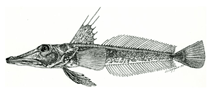 Channichthys richardsoni
Female Photo von Shandikov, G.A.
Bilder | Google Bild
Female Photo von Shandikov, G.A.
Klassifizierung / Names Namen | Synonyme | Catalog of Fishes(Gattung, Arten) | ITIS | CoL | WoRMS | Cloffa
> Perciformes/Notothenioidei (Icefishes) > Channichthyidae (Crocodile icefishes)
Etymology: Channichthys: Greek, channe, -es = an anchovy + Greek, ichthys = fish (Ref. 45335); richardsoni: Named for the Scottish naturalist John Richardson, who described the first species of icefishes C. rhinoceratus and established the genus Channichthys.
Eponymy: Sir John Richardson (1787–1865) was a Scottish naval surgeon, naturalist and Arctic explorer. [...] (Ref. 128868), visit book page.
Etymology: Channichthys: Greek, channe, -es = an anchovy + Greek, ichthys = fish (Ref. 45335); richardsoni: Named for the Scottish naturalist John Richardson, who described the first species of icefishes C. rhinoceratus and established the genus Channichthys.
Eponymy: Sir John Richardson (1787–1865) was a Scottish naval surgeon, naturalist and Arctic explorer. [...] (Ref. 128868), visit book page.
Umwelt: Milieu / Klimazone / Tiefenbereich / Verbreitungsgebiet Ökologie
seewasser demersal; tiefenbereich 126 - 310 m (Ref. 90862), usually 126 - ? m (Ref. 90862). Deep-water
Verbreitung Territorien | FAO Gebiete | Ökosysteme | Vorkommen | Punkt Karte | Einführungen | Faunafri
Southern Ocean, Sub-Antarctic: Kerguelen Islands.
Größe / Gewicht / Alter
Geschlechtsreife: Lm ? range ? - ? cm
Max length : 37.4 cm TL (female)
Max length : 37.4 cm TL (female)
Kurzbeschreibung Bestimmungsschlüssel | Morphologie | Morphometrie
Rückenflossenstacheln (insgesamt) : 7 - 8; Rückenflossenweichstrahlen (insgesamt) : 31 - 34; Afterflossenstacheln: 0; Afterflossenweichstrahlen: 29 - 32. This species is characterized by the following D1 VII-VIII, D2 31-34; A 29-32; pectoral 19-20; bony tubular plates (scales) of the dorsal lateral line 61-78 and of the median lateral line 9-23, rounded separated bony plates in the anterior part of the median lateral line 4-28, as a rule, more than 10; number of gill-rakers on the outer side of the lower part of the 1st arch 6-15. This species is further distinguished by the following: interorbital width narrow, 1.0-1.4 times in horizontal orbit diameter, 5.8-7.5 in HL and 2.0-2.4 in head height at level of middle of eye; eye moderate in size, its diameter 5.2-6.3 times in HL and 2.6-3.0 in snout length; supraorbital outer bony edges of frontals noticeably elevated; snout relatively long, approximately equal to or somewhat shorter than half the head length, 2.1-2.2 in HL; tips of jaws aligned or lower jaw slightly protruding, teeth on symphysis not visible; posterior edge of maxillary extending below 1/3-1/2 of the orbit diameter; a row of rakers on lower part of first gill arch on the outer side of ceratobranchial; pectoral fin extending above to anus or origin of first anal fin ray; first dorsal fin high, 3.3-4.7 times in SL, second and third rays longest; fin membrane of D1 not reaching tips of longest rays, its height about 1.4-1.7 times in height of D1; dorsal fins well separated, posterior edge of D1 fin membrane not reaching first ray base of D2; interdorsal distance wide, 10.9-16.4 times in SL or 1.0-1.9 times in length of D1; bony tuberculation well developed on frontals and lacrimals, D1 flexible spines, branchiostegals, pelvic fins and on bony structures of both lateral lines; absent on maxillary and on anterior part of lower jaw (Ref. 90862).
Body shape (shape guide): elongated.
Body shape (shape guide): elongated.
Found on shelf waters of islands and caught in 2 bottom trawls at depths of 126 and 270-310 m, together with C. rhinoceratus, C. rugosus, C. panticapaei, C. bospori, C. irinae and C. mithridatis. Most specimens were caught at depth of 126 m in an area with abundant benthic fauna and the alga Macrocystis pyrifera. Apparently a primarily piscivorous predator (inferred from the single row of gill-rakers and similar to its congeners). Females mature at about 29-31 cm TL (25-27 cm SL); the post-spawning SGM VI-III is clearly detected in females larger than 31 cm TL and the SGM III - in the smaller, firstly maturing ones. The SGM of the males examined varied from stage II to early stage III in the specimen of 32.5 cm TL. Spawning and pre-spawning SGM were absent. Spawning period apparently takes a place from autumn to the beginning of winter (Ref. 90862).
Lebenszyklus und Paarungsverhalten Geschlechtsreife | Fortpflanzung | Ablaichen | Eier | Fruchtbarkeit | Larven
Hauptreferenz
Laden Sie Ihre Referenzen hoch | Referenzen | Koordinator | Partner
Shandikov, G.A., 2011. Channichthys richardsoni sp. n., a new Antarctic icefish (Perciformes: Notothenioidei: Channichthyidae) from the Kerguelen Islands area, Indian sector of the Southern Ocean. Journal of V.N. Karazin Kharkiv National University, Series: Biology 2008, 7(814):125-134. (Ref. 90862)
CITES
Not Evaluated
Bedrohung für Menschen
Harmless
Nutzung durch Menschen
Fischereien: bycatch
FAO - Publication: search | FishSource |
Mehr Information
Trophische Ökologie
Lebensmittel (Beutetiere)
Nahrungszusammensetzung
Nahrungsaufnahme
Lebensmittelrationen
Räuber
Lebensmittel (Beutetiere)
Nahrungszusammensetzung
Nahrungsaufnahme
Lebensmittelrationen
Räuber
Ökologie
Ökologie
Ökologie
Populationsdynamik
Wachstumsparameter
Max. Alter/Größen
Länge-Gewicht-Rel.
Länge-Länge-Verhältnis.
Längenhäufigkeiten
Massenkonvertierung
Rekrutierung
Dichte
Wachstumsparameter
Max. Alter/Größen
Länge-Gewicht-Rel.
Länge-Länge-Verhältnis.
Längenhäufigkeiten
Massenkonvertierung
Rekrutierung
Dichte
Lebenszyklus
Fortpflanzung
Geschlechtsreife
Reifung/Kiemen rel.
Fruchtbarkeit
Ablaichen
Laichaggregationen
Eier
Eientwicklung
Larven
Larven Pop.Dyn.
Fortpflanzung
Geschlechtsreife
Reifung/Kiemen rel.
Fruchtbarkeit
Ablaichen
Laichaggregationen
Eier
Eientwicklung
Larven
Larven Pop.Dyn.
Anatomie
Kiemenoberfläche
Gehirn
Otolith
Kiemenoberfläche
Gehirn
Otolith
Physiologie
Körperliche Zusammensetzung
Nährstoffe
Sauerstoffverbrauch
Schwimmart
Schwimmgeschwindigkeit
Visuelle Pigmente
Fischgeräusche
Krankheiten und Parasiten
Toxizität (LC50s)
Körperliche Zusammensetzung
Nährstoffe
Sauerstoffverbrauch
Schwimmart
Schwimmgeschwindigkeit
Visuelle Pigmente
Fischgeräusche
Krankheiten und Parasiten
Toxizität (LC50s)
Genetik
Genom
Genetik
Heterozygotie
Vererbbarkeit
Genetische Vielfalt
Genom
Genetik
Heterozygotie
Vererbbarkeit
Genetische Vielfalt
Menschenbezogen
Aquakultur-Systeme
Aquakultur Profile
Zuchtlinien
Ciguatera-Fälle
Briefmarken, Münzen, Verschiedenes.
Aquakultur-Systeme
Aquakultur Profile
Zuchtlinien
Ciguatera-Fälle
Briefmarken, Münzen, Verschiedenes.
Tools
Zusatzinformationen
Download XML
Zusammenfassung | Punktdaten | Namen | Photos
Internet Quellen
AFORO (otoliths) | Aquatic Commons | BHL | Cloffa | Websites from users | FishWatcher Einträge suchen | CISTI | Catalog of Fishes: Gattung, Arten | DiscoverLife | ECOTOX | FAO - Publication: search | Faunafri | Fishipedia | Fishtrace | GloBI | Google Books | Google Scholar | Google | IGFA World Record | OneZoom | Open Tree of Life | Otolith Atlas of Taiwan Fishes | PubMed | Reef Life Survey | Socotra Atlas | TreeBase | Tree of Life | Wikipedia: Gehe zu, Suchen | World Records Freshwater Fishing | Zoobank | Zoologischer Rekord
Schätzungen auf der Grundlage von Modellen
Phylogenetischer Diversitätsindex (Ref. 82804): PD50 = 0.5020 [Uniqueness, from 0.5 = low to 2.0 = high].
Bayesian length-weight: a=0.00129 (0.00059 - 0.00280), b=3.46 (3.28 - 3.64), in cm total length, based on LWR estimates for this (Sub)family-body shape (Ref. 93245).
Trophische Ebene (Ref. 69278): 3.7 ±0.6 se; based on size and trophs of closest relatives
Widerstandsfähigkeit (Ref. 120179): mittel, Verdopplung der Population dauert 1,4 - 4,4 Jahre. (Preliminary K or Fecundity.).