Klassifizierung / Names
Namen | Synonyme | Catalog of Fishes(Gattung, Arten) | ITIS | CoL | WoRMS | Cloffa
>
Ovalentaria/misc (Various families in series Ovalentaria) >
Pseudochromidae (Dottybacks) > Pseudochrominae
Etymology: Pseudochromis: Greek, pseudes = false + Greek, chromis = a fish, perhaps a perch (Ref. 45335); chrysospilus: The specific epithet is from the Greek chrysos, gold, and spilos, spot, and alludes to the distinctive gold spots on the body (Ref. 88695).
More on authors: Gill & Zajonz.
Environment: milieu / climate zone / Tiefenbereich / distribution range
Ökologie
seewasser riff-verbunden; tiefenbereich 3 - 11 m (Ref. 88695). Tropical
Indian Ocean: Socotra Archipelago.
Size / Gewicht / Alter
Geschlechtsreife: Lm ? range ? - ? cm
Max length : 5.6 cm SL Männchen/unbestimmt; (Ref. 88695)
Kurzbeschreibung
Bestimmungsschlüssel | Morphologie | Morphometrie
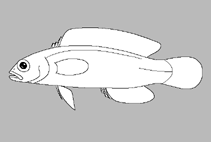
Rückenflossenstacheln (insgesamt) : 3; Rückenflossenweichstrahlen (insgesamt) : 28 - 31; Afterflossenstacheln: 3; Afterflossenweichstrahlen: 18 - 19; Wirbelzahl: 26. This species is distinguished by the following set of characters: D III,28-31; A III,18-19; scales in lateral series 47-52, below lateral-line 12-15 (usually 13-14); scales on upper flank each with dark blue to dark purple basal spot; scales on posterior part of body with gold basal spots (Ref. 88695).
Body shape (shape guide): elongated; Cross section: oval.
Apparently prefer harsh, monsoon and upwelling impacted habitats in the south and west of Socotra Island. It was also collected from a macroalgae dominated biotope with large sponges and very sparse encrusting hard coral on rock platform with gravelly sand; in sparse hard coral and filter feeder community on rock outcrops; and additional visual records were made in from a Porites dominated community on rock platform (Ref. 88695).
Life cycle and mating behavior
Geschlechtsreife | Fortpflanzung | Ablaichen | Eier | Fecundity | Larven
Gill, A.C. and U. Zajonz, 2011. Pseudochromine and pseudoplesiopine dottyback fishes from the Socotra Archipelago, Indian Ocean, with descriptions of two new species of Pseudochromis Rüppell (Perciformes: Pseudochromidae). Zootaxa 3106:1-23. (Ref. 88695)
IUCN Rote Liste Status (Ref. 130435: Version 2025-1)
Bedrohung für Menschen
Harmless
Nutzung durch Menschen
Tools
Zusatzinformationen
Download XML
Internet Quellen
Estimates based on models
Phylogenetic diversity index (Ref.
82804): PD
50 = 0.5000 [Uniqueness, from 0.5 = low to 2.0 = high].
Bayesian length-weight: a=0.00501 (0.00193 - 0.01299), b=3.10 (2.88 - 3.32), in cm total length, based on LWR estimates for this (Sub)family-body shape (Ref.
93245).
Trophic level (Ref.
69278): 3.4 ±0.5 se; based on size and trophs of closest relatives
Fishing Vulnerability (Ref.
59153): Low vulnerability (10 of 100).
🛈