Classification / Names
ชื่อสามัญ | ชื่อพ้อง | Catalog of Fishes(สกุล, ชนิด) | ITIS | CoL | WoRMS | Cloffa
>
Gobiiformes (Gobies) >
Gobiidae (Gobies) > Gobiinae
Etymology: Trimma: Greek, trimma, -atos = something crushed (Ref. 45335); maiandros: Named for Maiandros, the god of the winding Maeander River in Phrygia (currently known as the Büyük Menderes River in Turkey), son of Oceanus and his sister Tethys. The English word 'meander', a winding, crooked, or involved course, is in allusion to the zigzag pattern of
grey to blue lines on the body; a noun in apposition.
More on authors: Hoese, Winterbottom & Reader.
Environment: milieu / climate zone / ระดับความลึก / distribution range
นิเวศวิทยา
เกี่ยวกับทะเล,น้ำเค็ม เกี่ยวกับหินโสโครก; ระดับความลึก 1 - 55 m (Ref. 86820). Tropical
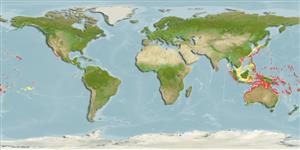
Indo-Pacific: Cocos (Keeling) Islands in the Indian Ocean and from Japan, Marshall and Mariana Islands to Samoa and Australia in the Pacific.
ขนาด / น้ำหนัก / Age
วัยเจริญพันธุ์: Lm ? range ? - ? cm
Max length : 2.7 cm SL เพศผู้/กระเทย; (Ref. 86820)
Short description
เครื่องมือที่ใช้ในการแยกชนิดสัตว์,สิ่งมีชีวิตออกจากกัน | สัณฐานวิทยา | ความยาวต่างๆ
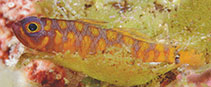
เงี่ยงครีบหลัง (รวม) : 6 - 8; ก้านครีบอ่อนที่หาง (รวม) : 8 - 10; เงี่ยงครีบก้น: 1; ก้านครีบอ่อนที่ก้น: 7 - 9; สัตว์มีกระดูกสันหลัง: 26. This species is characterized by the following: reduced predorsal scales, usually not crossing the midline (midline naked or partly naked); cycloid scales at sides of nape reaching to above a point between posterior margin of operculum and eyes; no scales on cheeks nor opercles; pectoral base usually fully scaled, posterodorsal 2 scales slightly enlarged; prepelvic covered with small cycloid scales in 5-6 rows; interorbital narrow, with moderate groove; groove absent or very shallow behind eyes (shallow between eyes and absent behind eyes in juveniles); a low distinct ridge at posterior end of interorbital; gill opening extending forward to below posterior margin of pupil; nape crest low from first dorsal origin to above posterior opercular margin, reaching to the shallow median groove; groove extending to just behind eyes; pectoral rays unbranched or with 1-5 rays branched at extreme tips; fifth pelvic ray unbranched, rest of rays with 2 terminal tips; D2 usually I,9; A usually I,8; pelvic fins largely separate, connected only at base; fins widely separate, distance between 2 fins greater than base of single pelvic fin; pelvic scale covering membrane, with fifth ray about one-fourth to one-half length of fourth ray; dark brown spot or bar extending posteroventrally from eye, body with irregular brown interconnecting bars, forming zigzag pattern (Ref. 86884).
Body shape (shape guide): fusiform / normal; Cross section: compressed.
Occurs in mid to outer barrier reefs, but much more common on outer barrier islands (Ref. 86820). Also found in caves and crevices (Ref. 90102).
Life cycle and mating behavior
วัยเจริญพันธุ์ | การสืบพันธุ์ | การวางไข่ | เซลสืบพันธ์ของเพศเมีย(ไข่) | ความดกของไข่ | ตัวอ่อน
Hoese, D.F., R. Winterbottom and S. Reader, 2011. Trimma maiandros, a new species of pygmy goby (Gobiidae) from the Indo-west Pacific. aqua, Int. J. Ichthyol. 17(2):103-110. (Ref. 86820)
IUCN Red List Status (Ref. 130435: Version 2025-1)
Threat to humans
Harmless
Human uses
การประมง: ไม่มีผลประโยชน์
เครื่องมือ
Special reports
Download XML
แหล่งที่มาจากอินเตอร์เน็ต
Estimates based on models
Preferred temperature (อ้างอิง
123201): 24.3 - 28.8, mean 27.5 °C (based on 344 cells).
Phylogenetic diversity index (อ้างอิง
82804): PD
50 = 0.5000 [Uniqueness, from 0.5 = low to 2.0 = high].
Bayesian length-weight: a=0.01023 (0.00477 - 0.02194), b=3.01 (2.83 - 3.19), in cm total length, based on LWR estimates for this (Sub)family-body shape (Ref.
93245).
Fishing Vulnerability (Ref.
59153): Low vulnerability (10 of 100).
🛈
Nutrients (Ref.
124155): Calcium = 324 [142, 907] mg/100g; Iron = 1.54 [0.71, 3.20] mg/100g; Protein = 18.1 [16.0, 19.9] %; Omega3 = 0.182 [0.066, 0.460] g/100g; Selenium = 31.9 [11.5, 78.9] μg/100g; VitaminA = 129 [30, 535] μg/100g; Zinc = 3.81 [2.21, 6.09] mg/100g (wet weight);