



Trimma maiandros Hoese, Winterbottom & Reader, 2011
Zigzag pygmygoby
Adicionar as suas observações no Fish Watcher
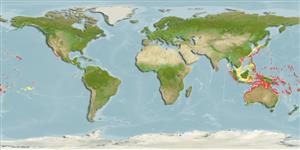
| Native range | All suitable habitat | Point map | Year 2050 |
|
| This map was computer-generated and has not yet been reviewed. |
| Trimma maiandros AquaMaps Data sources: GBIF OBIS |
Adicionar o seu Fotografias e vídeos
Fotografias | Imagem do Google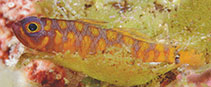 Trimma maiandros
Fotografia de Allen, G.R.
Fotografias | Imagem do Google
Fotografia de Allen, G.R.
Classificação / Nomes Nomes comuns | Sinónimos | Catalog of Fishes(Género, Espécies) | ITIS | CoL | WoRMS | Cloffa
> Gobiiformes (Gobies) > Gobiidae (Gobies) > Gobiinae
Etymology: Trimma: Greek, trimma, -atos = something crushed (Ref. 45335); maiandros: Named for Maiandros, the god of the winding Maeander River in Phrygia (currently known as the Büyük Menderes River in Turkey), son of Oceanus and his sister Tethys. The English word 'meander', a winding, crooked, or involved course, is in allusion to the zigzag pattern of grey to blue lines on the body; a noun in apposition.
More on authors: Hoese, Winterbottom & Reader.
Etymology: Trimma: Greek, trimma, -atos = something crushed (Ref. 45335); maiandros: Named for Maiandros, the god of the winding Maeander River in Phrygia (currently known as the Büyük Menderes River in Turkey), son of Oceanus and his sister Tethys. The English word 'meander', a winding, crooked, or involved course, is in allusion to the zigzag pattern of grey to blue lines on the body; a noun in apposition.
More on authors: Hoese, Winterbottom & Reader.
Ambiente: milieu / zona climática / intervalo de profundidade / gama de distribuição Ecologia
marinhas associadas(os) a recifes; intervalo de profundidade 1 - 55 m (Ref. 86820). Tropical
Distribuição Territórios | Áreas FAO | Ecossistemas | Ocorrências | Mapa dos pontos | Introduções | Faunafri
Indo-Pacific: Cocos (Keeling) Islands in the Indian Ocean and from Japan, Marshall and Mariana Islands to Samoa and Australia in the Pacific.
Tamanho / Peso / Idade
Descrição breve Chaves de identificação | Morfologia | Morfometria
Espinhos dorsais (total) : 6 - 8; Raios dorsais moles (total) : 8 - 10; Espinhos anais: 1; Raios anais moles: 7 - 9; Vértebras: 26. This species is characterized by the following: reduced predorsal scales, usually not crossing the midline (midline naked or partly naked); cycloid scales at sides of nape reaching to above a point between posterior margin of operculum and eyes; no scales on cheeks nor opercles; pectoral base usually fully scaled, posterodorsal 2 scales slightly enlarged; prepelvic covered with small cycloid scales in 5-6 rows; interorbital narrow, with moderate groove; groove absent or very shallow behind eyes (shallow between eyes and absent behind eyes in juveniles); a low distinct ridge at posterior end of interorbital; gill opening extending forward to below posterior margin of pupil; nape crest low from first dorsal origin to above posterior opercular margin, reaching to the shallow median groove; groove extending to just behind eyes; pectoral rays unbranched or with 1-5 rays branched at extreme tips; fifth pelvic ray unbranched, rest of rays with 2 terminal tips; D2 usually I,9; A usually I,8; pelvic fins largely separate, connected only at base; fins widely separate, distance between 2 fins greater than base of single pelvic fin; pelvic scale covering membrane, with fifth ray about one-fourth to one-half length of fourth ray; dark brown spot or bar extending posteroventrally from eye, body with irregular brown interconnecting bars, forming zigzag pattern (Ref. 86884).
Body shape (shape guide): fusiform / normal; Cross section: compressed.
Body shape (shape guide): fusiform / normal; Cross section: compressed.
Occurs in mid to outer barrier reefs, but much more common on outer barrier islands (Ref. 86820). Also found in caves and crevices (Ref. 90102).
Ciclo de vida e comportamento de acasalamento Maturidade | Reprodução | Desova | Ovos | Fecundidade | Larvas
Referência principal
Carregar as suas referências | Referências | Coordenador | Colaboradores
Hoese, D.F., R. Winterbottom and S. Reader, 2011. Trimma maiandros, a new species of pygmy goby (Gobiidae) from the Indo-west Pacific. aqua, Int. J. Ichthyol. 17(2):103-110. (Ref. 86820)
Categoria na Lista Vermelha da IUCN (Ref. 130435: Version 2025-2 (Global))
Preocupação menor (LC) ; Date assessed: 11 March 2015
CITES
Not Evaluated
Ameaça para o homem
Harmless
Utilização humana
Pescarias: sem interesse
FAO - Publication: search | FishSource |
Mais informação
Ecologia Trófica
Produtos alimentares (presas)
Composição da dieta
Consumo alimentar
Rações alimentares
Predadores
Produtos alimentares (presas)
Composição da dieta
Consumo alimentar
Rações alimentares
Predadores
Dinâmica das populações
Parâmetros de crescimento
Idades / tamanhos máximos
Comprimento-peso rel.
Comprimento-comprimento rel.
Frequência de comprimento
Conversão de massa
Recrutamento
Abundância
Parâmetros de crescimento
Idades / tamanhos máximos
Comprimento-peso rel.
Comprimento-comprimento rel.
Frequência de comprimento
Conversão de massa
Recrutamento
Abundância
Ciclo de vida
Reprodução
Maturidade
Maturidade/Rel. das guelras
Fecundidade
Desova
Agregações de desova
Ovos
Desenvolvimento dos ovos
Larvas
Dinâmica larvar
Reprodução
Maturidade
Maturidade/Rel. das guelras
Fecundidade
Desova
Agregações de desova
Ovos
Desenvolvimento dos ovos
Larvas
Dinâmica larvar
Anatomia
Área branquial
Cérebro
Otólitos
Área branquial
Cérebro
Otólitos
Fisiologia
Composição corporal
Nutrientes
Consumo de oxigénio
Tipo de natação
Velocidade de natação
Pigmentos visuais
Som de peixe
Doenças e Parasitas
Toxicidade (LC50s)
Composição corporal
Nutrientes
Consumo de oxigénio
Tipo de natação
Velocidade de natação
Pigmentos visuais
Som de peixe
Doenças e Parasitas
Toxicidade (LC50s)
Genética
genoma
Genética
Heterozigotia
Hereditariedade
Diversidade genética
genoma
Genética
Heterozigotia
Hereditariedade
Diversidade genética
Relacionado com o ser humano
Sistemas de aquacultura
Perfis para aquacultura
Estirpes
Casos de Ciguatera
Selos, moedas, diversos.
Sistemas de aquacultura
Perfis para aquacultura
Estirpes
Casos de Ciguatera
Selos, moedas, diversos.
Ferramentas
E-book | Guia de campo | Ferramenta auxiliar de frequências de comprimento | Ferramenta sobre a história de vida | Mapa dos pontos |
Captura-MSY |
Relatórios especiais
Descarregue XML
Fontes da internet
AFORO (otoliths) | Aquatic Commons | BHL | Cloffa | Websites from users | Consultar FishWatcher | CISTI | Catalog of Fishes: Género, Espécies | DiscoverLife | ECOTOX | FAO - Publication: search | Faunafri | Fishipedia | Fishtrace | GloBI | Google Books | Google Scholar | Google | IGFA World Record | OneZoom | Open Tree of Life | Otolith Atlas of Taiwan Fishes | PubMed | Reef Life Survey | Socotra Atlas | TreeBase | Árvore da vida | Wikipedia: ir para, procurar | World Records Freshwater Fishing | Zoobank | Registo zoológico
Estimativas baseadas em modelos
Temperatura preferida (Ref. 123201): 24.3 - 28.8, mean 27.5 °C (based on 344 cells).
Índice de diversidade filogenética (Ref. 82804): PD50 = 0.5000 [Uniqueness, from 0.5 = low to 2.0 = high].
Bayesian length-weight: a=0.01023 (0.00477 - 0.02194), b=3.01 (2.83 - 3.19), in cm total length, based on LWR estimates for this (Sub)family-body shape (Ref. 93245).
Nutrientes (Ref. 124155): Calcium = 324 [142, 907] mg/100g; Iron = 1.54 [0.71, 3.20] mg/100g; Protein = 18.1 [16.0, 19.9] %; Omega3 = 0.182 [0.066, 0.460] g/100g; Selenium = 31.9 [11.5, 78.9] μg/100g; VitaminA = 129 [30, 535] μg/100g; Zinc = 3.81 [2.21, 6.09] mg/100g (wet weight);