



Epinephelus polyphekadion (Bleeker, 1849)
Camouflage grouper
Lägg till din observation i Fish Watcher
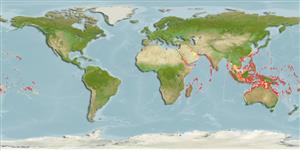
| Native range | All suitable habitat | Point map | Year 2050 |
|
| This map was computer-generated and has not yet been reviewed. |
| Epinephelus polyphekadion AquaMaps Data sources: GBIF OBIS |
Ladda upp din foton och Videor
Bilder | Videor | Google image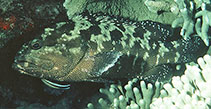 Epinephelus polyphekadion
Bild av Randall, J.E.
Bilder | Videor | Google image
Bild av Randall, J.E.
Klassificering / Namn Populärnamn | synonymer | Catalog of Fishes(Släkte, Arter) | ITIS | CoL | WoRMS | Cloffa
> Perciformes/Serranoidei (Groupers) > Epinephelidae (Groupers)
Etymology: Epinephelus: Greek, epinephelos = cloudy (Ref. 45335).
More on author: Bleeker.
Etymology: Epinephelus: Greek, epinephelos = cloudy (Ref. 45335).
More on author: Bleeker.
Miljö: miljö / Klimatzon / djupintervall / distributionsområde Ekologi
marina revassocierade; havsvandrande (Ref. 51243); djupintervall 0 - 50 m (Ref. 128797). Tropical; 30°N - 34°S, 27°E - 134°W (Ref. 5222)
Utbredning Territorier | FAO områden | Ekosystem | Förekomster | Prickkarta | Utplanteringar | Faunafri
Indo-Pacific: Red Sea and east coast of Africa to French Polynesia. In the western Pacific it ranges from southern Japan to southern Queensland and Lord Howe Island. Often confused with Epinephelus fuscoguttatus.
Längd vid första mognad / Storlek / Vikt / Ålder
Könsmognad: Lm ?, range 58 - ? cm
Max length : 90.0 cm SL hane/ej könsbestämd; (Ref. 4319); common length : 90.0 cm TL hane/ej könsbestämd; (Ref. 5450)
Max length : 90.0 cm SL hane/ej könsbestämd; (Ref. 4319); common length : 90.0 cm TL hane/ej könsbestämd; (Ref. 5450)
Kort beskrivning Bestämningsnycklar | Morfologi | Morfometri
Taggstrålar i ryggfenan (totalt) : 11; Mjukstrålar i ryggfenan (totalt) : 14 - 15; Taggstrålar i analfenan: 3; Mjukstrålar i analfenan: 8. This species is distinguished by the following characters: body depth 2.7-3.1 in SL; preopercle rounded, finely serrate; upper edge of operculum distinctly convex; rear nostril diameter about twice that of anterior nostril; gill rakers of first gill arch 8-10 + 15-1= 24-27; dorsal-fin spines third or fourth longest, 2.7-3.3 in HL and distinctly shorter than longest dorsal-fin ray; 2-3 rows of teeth on midlateral part of lower jaw; front of jaws with inconspicuous fixed canines; body scales ctenoid in broad zone on side from beneath pectoral fin to caudal peduncle, the rest cycloid; caudal fin rounded; pectoral-fin rays 16-18, fin length 1.7-2.1 in HL; short pelvic fins, 1.9-2.4 in HL; lateral-line scales 47-52, in series 95-110. Colour of head, body, and fins pale brown, covered with small dark brown spots; upper half whitish, head and body with irregular dark blotches (more distinct on live specimens) superimposed over the dark spots; prominent black saddle blotch on caudal peduncle; dark spots extend all over head, including lower jaw, lips, branchiostegal membranes, gular area, and inside of mouth; numerous small white spots on fins (more distinct on live fish). a few on head and body; juveniles with a pair of blackish spots on each side of snout and a black spot at margin of second and third interspinous dorsal membranes (Ref. 39231, 89707, 90102).
Body shape (shape guide): fusiform / normal; Cross section: compressed.
Body shape (shape guide): fusiform / normal; Cross section: compressed.
Often found in coral-rich areas of lagoon and outer reefs; in caves and large crevices to swim through (Ref. 48635). Most abundant around islands, particularly atolls. Usually in small schools but may be solitary (Ref 90102). Feeds mainly on crustaceans (portunid crabs) and fishes, sometimes on cephalopods and gastropods. In the Hong Kong live fish markets (Ref. 27253). This species is important in artisanal fisheries, but occasionally implicated in cases of ciguatera (frequently ciguatoxic in the Marshall Is., Ref. 37816). It is now uncommon at localities with heavy spearfishing, but popular in the aquaculture industry of Singapore, where it is known as 'marble grouper'. It is caught with hook-and-line, spear, and traps (Ref. 39231).
Livscykel och parningsbeteende Könsmognad | Reproduktion | Lek | Ägg | Fekunditet | Larver
Huvudreferens
Ladda upp dina referenser | referenser | Koordinator | Medarbetare
Heemstra, P.C. and J.E. Randall, 1993. FAO Species Catalogue. Vol. 16. Groupers of the world (family Serranidae, subfamily Epinephelinae). An annotated and illustrated catalogue of the grouper, rockcod, hind, coral grouper and lyretail species known to date. Rome: FAO. FAO Fish. Synop. 125(16):382 p. (Ref. 5222)
Status på IUCN:s rödlista (Ref. 130435: Version 2025-2 (Global))
Sårbar (VU) (A2bd); Date assessed: 20 November 2016
CITES
Not Evaluated
Hot mot människor
Reports of ciguatera poisoning (Ref. 1602)
Mänskliga användningsområden
Fiskeri: kommersiell; Vattenbruk: experimentell
FAO - fiskeri: landningar; Publication: search | FishSource | Havet omkring oss
Ytterligare information
Populationsdynamik
Tillväxtparametrar
Max. åldrar / storlekar
Längd-vikt rel.
Längd-längd rel.
Längd-frekvenser
Massakonvertering
Rekrytering
Abundans
Tillväxtparametrar
Max. åldrar / storlekar
Längd-vikt rel.
Längd-längd rel.
Längd-frekvenser
Massakonvertering
Rekrytering
Abundans
Livscykel
Reproduktion
Könsmognad
Mognad/Gills rel.
Fekunditet
Lek
Lekande aggregat
Ägg
Utveckling av ägg
Larver
Larvdynamik
Reproduktion
Könsmognad
Mognad/Gills rel.
Fekunditet
Lek
Lekande aggregat
Ägg
Utveckling av ägg
Larver
Larvdynamik
Fysiologi
Kroppssammansättning
Näringsämnen
Syreförbrukning
Typ av simning
Simhastighet
Visuella pigment
Ljud från fisk
Sjukdomar & Parasiter
Toxicitet (LC50)
Kroppssammansättning
Näringsämnen
Syreförbrukning
Typ av simning
Simhastighet
Visuella pigment
Ljud från fisk
Sjukdomar & Parasiter
Toxicitet (LC50)
Människorelaterad
Vattenbrukssystem
Vattenbruksprofiler
Avelslinjer
Ciguatera-fall
Frimärken, mynt, diverse.
Vattenbrukssystem
Vattenbruksprofiler
Avelslinjer
Ciguatera-fall
Frimärken, mynt, diverse.
Verktyg
Organisk frågesport | E-bok | Fälthandbok | Bestämningsnycklar | Längdfördelnings-verktyg | Livshistorie-verktyg | Prickkarta |
Fångst-MSY |
Särskilda rapporter
Kontrollera för underhåll av akvarium | Kontrollera om det finns faktablad om arter | Kontrollera om det finns faktablad om vattenbruk
Ladda ner XML
Internet-källor
AFORO (otoliths) | Aquatic Commons | BHL | Cloffa | Websites from users | Check FishWatcher | CISTI | Catalog of Fishes: Släkte, Arter | DiscoverLife | ECOTOX | FAO - fiskeri: landningar; Publication: search | Faunafri | Fishipedia | Fishtrace | GloBI | Google Books | Google Scholar | Google | IGFA World Record | Nationella databaser | OneZoom | Open Tree of Life | Otolith Atlas of Taiwan Fishes | PubMed | Reef Life Survey | Socotra Atlas | TreeBase | Tree of Life | Wikipedia: Go, sök | World Records Freshwater Fishing | Zoologiskt register
Uppskattningar baserade på modeller
Önskad temperatur (Ref. 123201): 24.5 - 28.9, mean 27.6 °C (based on 698 cells).
Index för fylogenetisk mångfald (Ref. 82804): PD50 = 0.5000 [Uniqueness, from 0.5 = low to 2.0 = high].
Bayesian length-weight: a=0.01148 (0.01005 - 0.01312), b=3.04 (3.02 - 3.06), in cm total length, based on LWR estimates for this species (Ref. 93245).
Trofisk nivå (Ref. 69278): 4.0 ±0.5 se; based on diet studies.
Generation time: 11.4 ( na - na) years. Estimated as median ln(3)/K based on 2 growth studies.
Resiliens (Ref. 120179): Låg, lägsta populationsfördubblingstid 4,5-14 år (Preliminary K or Fecundity.).
Näringsämnen (Ref. 124155): Calcium = 20.2 [10.0, 44.3] mg/100g; Iron = 0.434 [0.232, 0.894] mg/100g; Protein = 18.7 [17.2, 20.1] %; Omega3 = 0.11 [0.07, 0.18] g/100g; Selenium = 37.6 [22.1, 68.3] μg/100g; VitaminA = 137 [38, 494] μg/100g; Zinc = 1.1 [0.8, 1.6] mg/100g (wet weight);