



Epinephelus polyphekadion (Bleeker, 1849)
Camouflage grouper
Waarneming toevoegen in Fish Watcher
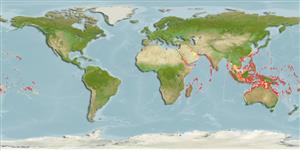
| Native range | All suitable habitat | Point map | Year 2050 |
|
| This map was computer-generated and has not yet been reviewed. |
| Epinephelus polyphekadion AquaMaps Data sources: GBIF OBIS |
Uploaden van uw Foto's en video's
Afbeeldingen | video's | Google afbeelding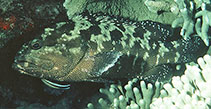 Epinephelus polyphekadion
Afbeelding van Randall, J.E.
Afbeeldingen | video's | Google afbeelding
Afbeelding van Randall, J.E.
Classificatie / Namen Lokale namen | Synoniemen | Catalog of Fishes(Genus, Soort(en)) | ITIS | CoL | WoRMS | Cloffa
> Perciformes/Serranoidei (Groupers) > Epinephelidae (Groupers)
Etymology: Epinephelus: Greek, epinephelos = cloudy (Ref. 45335).
More on author: Bleeker.
Etymology: Epinephelus: Greek, epinephelos = cloudy (Ref. 45335).
More on author: Bleeker.
Milieu: milieu / Klimaatzone / Diepte / verspreidingsgebied Ecologie
marien rifbewoner; oceanodroom (Ref. 51243); diepte 0 - 50 m (Ref. 128797). Tropical; 30°N - 34°S, 27°E - 134°W (Ref. 5222)
Verspreiding Gebieden | FAO regio's | Ecosystemen | Voorkomen | Verspreidingskaart | Introducties | Faunafri
Indo-Pacific: Red Sea and east coast of Africa to French Polynesia. In the western Pacific it ranges from southern Japan to southern Queensland and Lord Howe Island. Often confused with Epinephelus fuscoguttatus.
Lengte bij maturiteit / Grootte / Gewicht / Leeftijd
Maturiteit: Lm ?, range 58 - ? cm
Max length : 90.0 cm SL mannelijk / geslacht onbekend; (Ref. 4319); common length : 90.0 cm TL mannelijk / geslacht onbekend; (Ref. 5450)
Max length : 90.0 cm SL mannelijk / geslacht onbekend; (Ref. 4319); common length : 90.0 cm TL mannelijk / geslacht onbekend; (Ref. 5450)
Korte beschrijving Determinatiesleutels | Morfologie | Morfometrie
Dorsale stekels (totaal) : 11; Dorsale zachte stralen (totaal) : 14 - 15; Anale stekels: 3; Anale zachte stralen: 8. This species is distinguished by the following characters: body depth 2.7-3.1 in SL; preopercle rounded, finely serrate; upper edge of operculum distinctly convex; rear nostril diameter about twice that of anterior nostril; gill rakers of first gill arch 8-10 + 15-1= 24-27; dorsal-fin spines third or fourth longest, 2.7-3.3 in HL and distinctly shorter than longest dorsal-fin ray; 2-3 rows of teeth on midlateral part of lower jaw; front of jaws with inconspicuous fixed canines; body scales ctenoid in broad zone on side from beneath pectoral fin to caudal peduncle, the rest cycloid; caudal fin rounded; pectoral-fin rays 16-18, fin length 1.7-2.1 in HL; short pelvic fins, 1.9-2.4 in HL; lateral-line scales 47-52, in series 95-110. Colour of head, body, and fins pale brown, covered with small dark brown spots; upper half whitish, head and body with irregular dark blotches (more distinct on live specimens) superimposed over the dark spots; prominent black saddle blotch on caudal peduncle; dark spots extend all over head, including lower jaw, lips, branchiostegal membranes, gular area, and inside of mouth; numerous small white spots on fins (more distinct on live fish). a few on head and body; juveniles with a pair of blackish spots on each side of snout and a black spot at margin of second and third interspinous dorsal membranes (Ref. 39231, 89707, 90102).
Body shape (shape guide): fusiform / normal; Cross section: compressed.
Body shape (shape guide): fusiform / normal; Cross section: compressed.
Often found in coral-rich areas of lagoon and outer reefs; in caves and large crevices to swim through (Ref. 48635). Most abundant around islands, particularly atolls. Usually in small schools but may be solitary (Ref 90102). Feeds mainly on crustaceans (portunid crabs) and fishes, sometimes on cephalopods and gastropods. In the Hong Kong live fish markets (Ref. 27253). This species is important in artisanal fisheries, but occasionally implicated in cases of ciguatera (frequently ciguatoxic in the Marshall Is., Ref. 37816). It is now uncommon at localities with heavy spearfishing, but popular in the aquaculture industry of Singapore, where it is known as 'marble grouper'. It is caught with hook-and-line, spear, and traps (Ref. 39231).
Levenscyclus en paargedrag Maturiteit | Voortplanting | Paaien | Eieren | Fecunditeit | Larven
Hoofdreferentie
Upload uw referenties | Referenties | Coördinator | Medewerkers
Heemstra, P.C. and J.E. Randall, 1993. FAO Species Catalogue. Vol. 16. Groupers of the world (family Serranidae, subfamily Epinephelinae). An annotated and illustrated catalogue of the grouper, rockcod, hind, coral grouper and lyretail species known to date. Rome: FAO. FAO Fish. Synop. 125(16):382 p. (Ref. 5222)
Status op de Rode Lijst van het IUCN (Ref. 130435: Version 2025-2 (Global))
Kwetsbaar (VU) (A2bd); Date assessed: 20 November 2016
CITES
Not Evaluated
Gevaar voor de mens
Reports of ciguatera poisoning (Ref. 1602)
Gebruik door de mens
Visserij: commercieel; Aquacultuur: experimenteel
FAO - visserij: aanvoer; Publication: search | FishSource | Sea Around Us
Meer informatie
Trofische ecologie
Voedsel (prooien)
Dieetsamenstelling
Voedselconsumptie
Voedselrantsoenen
Predatoren
Voedsel (prooien)
Dieetsamenstelling
Voedselconsumptie
Voedselrantsoenen
Predatoren
Populatiedynamica
Groeiparameters
Max. leeftijden / maten
Lengte-gewicht rel.
Lengte-lengte rel.
Lengtefrequenties
Massaconversie
Rekrutering
Abundantie
Groeiparameters
Max. leeftijden / maten
Lengte-gewicht rel.
Lengte-lengte rel.
Lengtefrequenties
Massaconversie
Rekrutering
Abundantie
Levenscyclus
Voortplanting
Maturiteit
Rijpheid/kieuwen rel.
Fecunditeit
Paaien
Paaibestanden
Eieren
Ontwikkeling van de eieren
Larven
Larvale populatiedynamiek
Voortplanting
Maturiteit
Rijpheid/kieuwen rel.
Fecunditeit
Paaien
Paaibestanden
Eieren
Ontwikkeling van de eieren
Larven
Larvale populatiedynamiek
Fysiologie
Lichaamssamenstelling
Voedingsstoffen
Zuurstofverbruik
Type zwemmen
Zwemsnelheid
Visuele pigmenten
Vis geluid
Ziekten en parasieten
Toxiciteit (LC50)
Lichaamssamenstelling
Voedingsstoffen
Zuurstofverbruik
Type zwemmen
Zwemsnelheid
Visuele pigmenten
Vis geluid
Ziekten en parasieten
Toxiciteit (LC50)
Menselijk gerelateerd
Aquacultuursystemen
Aquacultuurprofielen
Kweeklijnen
Ciguatera gevallen
Postzegels, munten, diversen.
Aquacultuursystemen
Aquacultuurprofielen
Kweeklijnen
Ciguatera gevallen
Postzegels, munten, diversen.
Tools
Biologische quiz | E-boek | Veldgids | Determinatiesleutels | Lengtefrequentie Tool | Levenscyclus tool | Verspreidingskaart |
Vangst-MSY |
Speciale rapporten
Bekijk gegevens voor het houden in een aquarium | Bekijk Fact Sheets voor de soort | Bekijk Aquacultuur Fact Sheets
Download XML
Internetbronnen
AFORO (otoliths) | Aquatic Commons | BHL | Cloffa | Websites from users | Bekijk FishWatcher | CISTI | Catalog of Fishes: Genus, Soort(en) | DiscoverLife | ECOTOX | FAO - visserij: aanvoer; Publication: search | Faunafri | Fishipedia | Fishtrace | GloBI | Google Books | Google Scholar | Google | IGFA World Record | Nationale databanken | OneZoom | Open Tree of Life | Otolith Atlas of Taiwan Fishes | PubMed | Reef Life Survey | Socotra Atlas | TreeBase | Tree of Life | Wikipedia: ga naar, zoek | World Records Freshwater Fishing | Zoological Record
Schattingen op basis van modellen
Gewenste temperatuur (Ref. 123201): 24.5 - 28.9, mean 27.6 °C (based on 698 cells).
Fylogenetische diversiteitsindex (Ref. 82804): PD50 = 0.5000 [Uniqueness, from 0.5 = low to 2.0 = high].
Bayesian length-weight: a=0.01148 (0.01005 - 0.01312), b=3.04 (3.02 - 3.06), in cm total length, based on LWR estimates for this species (Ref. 93245).
Trofisch niveau (Ref. 69278): 4.0 ±0.5 se; based on diet studies.
Generation time: 11.4 ( na - na) years. Estimated as median ln(3)/K based on 2 growth studies.
Weerstandsvermogen (Ref. 120179): laag, minimale populatieverdubbelingstijd 4,5-14 jaar (Preliminary K or Fecundity.).
Voedingsstoffen (Ref. 124155): Calcium = 20.2 [10.0, 44.3] mg/100g; Iron = 0.434 [0.232, 0.894] mg/100g; Protein = 18.7 [17.2, 20.1] %; Omega3 = 0.11 [0.07, 0.18] g/100g; Selenium = 37.6 [22.1, 68.3] μg/100g; VitaminA = 137 [38, 494] μg/100g; Zinc = 1.1 [0.8, 1.6] mg/100g (wet weight);