



Rhonciscus bayanus (Jordan & Evermann, 1898)
Purplemouth grunt
Envoyez vos Photos et vidéos
Images | Images Google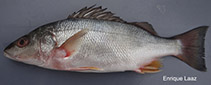 Rhonciscus bayanus
Photo de Laaz, E.
Images | Images Google
Photo de Laaz, E.
Classification / Noms Noms communs | Synonymes | Catalog of Fishes(Genre, Espèce) | ITIS | CoL | WoRMS | Cloffa
> Eupercaria/misc (Various families in series Eupercaria) > Haemulidae (Grunts) > Haemulinae
Etymology: Rhonciscus: Diminutive of ρογκοζ (snoring).
More on authors: Jordan & Evermann.
Etymology: Rhonciscus: Diminutive of ρογκοζ (snoring).
More on authors: Jordan & Evermann.
Environnement : milieu / zone climatique / profondeur / gamme de distribution Écologie
marin; eau douce; saumâtre benthopélagique. Tropical; 21°C - 30°C (Ref. 36880); 37°N -
Distribution Territoires | Zones FAO | Écosystèmes | Occurrences | Carte par point | Introductions | Faunafri
Central and South America: Pacific drainages from Baja California, Mexico to Peru.
Taille / Poids / Âge
Maturité: Lm ? range ? - ? cm
Max length : 51.0 cm TL mâle / non sexé; (Ref. 40637); common length : 33.0 cm TL mâle / non sexé; (Ref. 9114); poids max. publié: 1.6 kg (Ref. 4699)
Max length : 51.0 cm TL mâle / non sexé; (Ref. 40637); common length : 33.0 cm TL mâle / non sexé; (Ref. 9114); poids max. publié: 1.6 kg (Ref. 4699)
Description synthétique Clés d'identification | Morphologie | Morphométrie
Body oblong, somewhat compressed, and not deep (depth contained 3.1 to 3.8 times in standard length); mouth large, terminal, and almost horizontal, its posterior edge located at the same level as the anterior rim of the eye; first gill arch with 7 to 9 gill rakers; dorsal fin notched, with 12 to 13 spines and 12 soft rays (XII-XIII, 12); pectoral fins short, not reaching distal edge of pelvic fins; second anal spine longer and thicker than third; back olive green; belly silvery; entire body iridescent (Ref. 55763).
Body shape (shape guide): fusiform / normal.
Body shape (shape guide): fusiform / normal.
Benthic-pelagic species of coastal waters which may enter rivers (Ref. 55763). Apparently confined to fresh waters, ascending rivers with moderate currents (Ref. 9114). More abundant near the outlets of rivers and creeks, but not in brackish or marine waters. Reaches at least 640 m elevation and inhabits currents of low to moderate velocity. Feed on crustaceans and fish (Ref. 36880). Marketed fresh (Ref. 9114).
Cycle de vie et comportement reproducteur Maturité | Reproduction | Frai | Œufs | Fécondité | Larves
Oviparous, distinct pairing during breeding (Ref. 205).
Référence principale
Téléchargez vos références | Références | Coordinateur | Collaborateurs
McKay, R.J. and M. Schneider, 1995. Haemulidae. Burros, corocoros, chulas, gallinazos, roncos. p. 1136-1173. In W. Fischer, F. Krupp, W. Schneider, C. Sommer, K.E. Carpenter and V. Niem (eds.) Guia FAO para Identification de Especies para lo Fines de la Pesca. Pacifico Centro-Oriental. 3 Vols. FAO, Rome. (Ref. 9114)
Statut dans la liste rouge de l'IUCN (Ref. 130435: Version 2025-2 (Global))
Préoccupation mineure (LC) ; Date assessed: 07 February 2020
CITES
Not Evaluated
Menace pour l'homme
Harmless
Utilisations par l'homme
Pêcheries: intérêt commercial mineur; pêche sportive: oui
FAO - Publication: search | FishSource |
Plus d'informations
Écologie trophique
Aliments (proies)
Composition du régime alimentaire
Consommation alimentaire
Rations alimentaires
Prédateurs
Aliments (proies)
Composition du régime alimentaire
Consommation alimentaire
Rations alimentaires
Prédateurs
Dynamique des populations
Paramètres de croissance
Âges / tailles maximales
Longueur-poids rel.
Rel. longueur-longueur.
Fréquences de longueurs
Conversion de masse
Recrutement
Abondance
Paramètres de croissance
Âges / tailles maximales
Longueur-poids rel.
Rel. longueur-longueur.
Fréquences de longueurs
Conversion de masse
Recrutement
Abondance
Cycle de vie
Reproduction
Maturité
Maturité/épines rel.
Fécondité
Frai
Agrégats de frai
Œufs
Développement de l'œuf
Larves
Dynamique des populations larvaires
Reproduction
Maturité
Maturité/épines rel.
Fécondité
Frai
Agrégats de frai
Œufs
Développement de l'œuf
Larves
Dynamique des populations larvaires
Anatomie
Surface branchiale
Cerveau
Otolithe
Surface branchiale
Cerveau
Otolithe
Physiologie
Composition corporelle
Nutriments
Consommation d'oxygène
Type de natation
Vitesse de nage
Pigments visuels
Son de poisson
Maladies et parasites
Toxicité (CL50)
Composition corporelle
Nutriments
Consommation d'oxygène
Type de natation
Vitesse de nage
Pigments visuels
Son de poisson
Maladies et parasites
Toxicité (CL50)
Génétique
génôme
Génétique
Hétérozygotie
Héritabilité
Diversité génétique
génôme
Génétique
Hétérozygotie
Héritabilité
Diversité génétique
Liées à l'homme
Systèmes d'aquaculture
Profils d'aquaculture
Souches
Cas de ciguatera
Timbres, pièces de monnaie, divers
Systèmes d'aquaculture
Profils d'aquaculture
Souches
Cas de ciguatera
Timbres, pièces de monnaie, divers
Outils
E-book | Guide de terrain | Générateur de fréquences de longueur | Outil de dynamique de population | Carte par point |
Capture-MSY |
Articles particuliers
Télécharger en XML
Sources Internet
AFORO (otoliths) | Aquatic Commons | BHL | Cloffa | Websites from users | FishWatcher | CISTI | Catalog of Fishes: Genre, Espèce | DiscoverLife | ECOTOX | FAO - Publication: search | Faunafri | Fishipedia | Fishtrace | GloBI | Google Books | Google Scholar | Google | IGFA World Record | OneZoom | Open Tree of Life | Otolith Atlas of Taiwan Fishes | PubMed | Reef Life Survey | Socotra Atlas | TreeBase | Arbre de Vie | Wikipedia: aller à, chercher | World Records Freshwater Fishing | Zoological Record
Estimations basées sur des modèles
Température préférée (Réf. 123201): 24.6 - 27.1, mean 25.9 °C (based on 10 cells).
Indice de diversité phylogénétique (Réf. 82804): PD50 = 0.5625 [Uniqueness, from 0.5 = low to 2.0 = high].
Bayesian length-weight: a=0.00933 (0.00538 - 0.01619), b=2.91 (2.76 - 3.06), in cm total length, based on LWR estimates for this species & (Sub)family-body (Ref. 93245).
Niveau trophique (Réf. 69278): 4.0 ±0.66 se; based on food items.
Résilience (Réf. 120179): Milieu, temps minimum de doublement de population : 1,4 à 4,4 années (Preliminary K or Fecundity.).