



Rhonciscus bayanus (Jordan & Evermann, 1898)
Purplemouth grunt
Uploaden van uw Foto's en video's
Afbeeldingen | Google afbeelding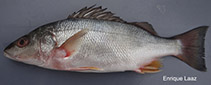 Rhonciscus bayanus
Afbeelding van Laaz, E.
Afbeeldingen | Google afbeelding
Afbeelding van Laaz, E.
Classificatie / Namen Lokale namen | Synoniemen | Catalog of Fishes(Genus, Soort(en)) | ITIS | CoL | WoRMS | Cloffa
> Eupercaria/misc (Various families in series Eupercaria) > Haemulidae (Grunts) > Haemulinae
Etymology: Rhonciscus: Diminutive of ρογκοζ (snoring).
More on authors: Jordan & Evermann.
Etymology: Rhonciscus: Diminutive of ρογκοζ (snoring).
More on authors: Jordan & Evermann.
Milieu: milieu / Klimaatzone / Diepte / verspreidingsgebied Ecologie
marien; zoet water; brak water benthopelagisch. Tropical; 21°C - 30°C (Ref. 36880); 37°N -
Verspreiding Gebieden | FAO regio's | Ecosystemen | Voorkomen | Verspreidingskaart | Introducties | Faunafri
Central and South America: Pacific drainages from Baja California, Mexico to Peru.
Grootte / Gewicht / Leeftijd
Maturiteit: Lm ? range ? - ? cm
Max length : 51.0 cm TL mannelijk / geslacht onbekend; (Ref. 40637); common length : 33.0 cm TL mannelijk / geslacht onbekend; (Ref. 9114); max. gepubliceerd gewicht: 1.6 kg (Ref. 4699)
Max length : 51.0 cm TL mannelijk / geslacht onbekend; (Ref. 40637); common length : 33.0 cm TL mannelijk / geslacht onbekend; (Ref. 9114); max. gepubliceerd gewicht: 1.6 kg (Ref. 4699)
Korte beschrijving Determinatiesleutels | Morfologie | Morfometrie
Body oblong, somewhat compressed, and not deep (depth contained 3.1 to 3.8 times in standard length); mouth large, terminal, and almost horizontal, its posterior edge located at the same level as the anterior rim of the eye; first gill arch with 7 to 9 gill rakers; dorsal fin notched, with 12 to 13 spines and 12 soft rays (XII-XIII, 12); pectoral fins short, not reaching distal edge of pelvic fins; second anal spine longer and thicker than third; back olive green; belly silvery; entire body iridescent (Ref. 55763).
Body shape (shape guide): fusiform / normal.
Body shape (shape guide): fusiform / normal.
Benthic-pelagic species of coastal waters which may enter rivers (Ref. 55763). Apparently confined to fresh waters, ascending rivers with moderate currents (Ref. 9114). More abundant near the outlets of rivers and creeks, but not in brackish or marine waters. Reaches at least 640 m elevation and inhabits currents of low to moderate velocity. Feed on crustaceans and fish (Ref. 36880). Marketed fresh (Ref. 9114).
Levenscyclus en paargedrag Maturiteit | Voortplanting | Paaien | Eieren | Fecunditeit | Larven
Oviparous, distinct pairing during breeding (Ref. 205).
Hoofdreferentie
Upload uw referenties | Referenties | Coördinator | Medewerkers
McKay, R.J. and M. Schneider, 1995. Haemulidae. Burros, corocoros, chulas, gallinazos, roncos. p. 1136-1173. In W. Fischer, F. Krupp, W. Schneider, C. Sommer, K.E. Carpenter and V. Niem (eds.) Guia FAO para Identification de Especies para lo Fines de la Pesca. Pacifico Centro-Oriental. 3 Vols. FAO, Rome. (Ref. 9114)
Status op de Rode Lijst van het IUCN (Ref. 130435: Version 2025-2 (Global))
Niet bedreigd (LC) ; Date assessed: 07 February 2020
CITES
Not Evaluated
Gevaar voor de mens
Harmless
Gebruik door de mens
Visserij: van minder commercieel belang; sportvis: ja
FAO - Publication: search | FishSource |
Meer informatie
Trofische ecologie
Voedsel (prooien)
Dieetsamenstelling
Voedselconsumptie
Voedselrantsoenen
Predatoren
Voedsel (prooien)
Dieetsamenstelling
Voedselconsumptie
Voedselrantsoenen
Predatoren
Populatiedynamica
Groeiparameters
Max. leeftijden / maten
Lengte-gewicht rel.
Lengte-lengte rel.
Lengtefrequenties
Massaconversie
Rekrutering
Abundantie
Groeiparameters
Max. leeftijden / maten
Lengte-gewicht rel.
Lengte-lengte rel.
Lengtefrequenties
Massaconversie
Rekrutering
Abundantie
Levenscyclus
Voortplanting
Maturiteit
Rijpheid/kieuwen rel.
Fecunditeit
Paaien
Paaibestanden
Eieren
Ontwikkeling van de eieren
Larven
Larvale populatiedynamiek
Voortplanting
Maturiteit
Rijpheid/kieuwen rel.
Fecunditeit
Paaien
Paaibestanden
Eieren
Ontwikkeling van de eieren
Larven
Larvale populatiedynamiek
Anatomie
Kieuwoppervlak
Hersenen
Otoliet
Kieuwoppervlak
Hersenen
Otoliet
Fysiologie
Lichaamssamenstelling
Voedingsstoffen
Zuurstofverbruik
Type zwemmen
Zwemsnelheid
Visuele pigmenten
Vis geluid
Ziekten en parasieten
Toxiciteit (LC50)
Lichaamssamenstelling
Voedingsstoffen
Zuurstofverbruik
Type zwemmen
Zwemsnelheid
Visuele pigmenten
Vis geluid
Ziekten en parasieten
Toxiciteit (LC50)
Genetica
genoom
Genetica
Heterozygositeit
Erfelijkheid
Genetische diversiteit
genoom
Genetica
Heterozygositeit
Erfelijkheid
Genetische diversiteit
Menselijk gerelateerd
Aquacultuursystemen
Aquacultuurprofielen
Kweeklijnen
Ciguatera gevallen
Postzegels, munten, diversen.
Aquacultuursystemen
Aquacultuurprofielen
Kweeklijnen
Ciguatera gevallen
Postzegels, munten, diversen.
Tools
Speciale rapporten
Bekijk gegevens voor het houden in een aquarium | Bekijk Fact Sheets voor de soort | Bekijk Aquacultuur Fact Sheets
Download XML
Internetbronnen
AFORO (otoliths) | Aquatic Commons | BHL | Cloffa | Websites from users | Bekijk FishWatcher | CISTI | Catalog of Fishes: Genus, Soort(en) | DiscoverLife | ECOTOX | FAO - Publication: search | Faunafri | Fishipedia | Fishtrace | GloBI | Google Books | Google Scholar | Google | IGFA World Record | OneZoom | Open Tree of Life | Otolith Atlas of Taiwan Fishes | PubMed | Reef Life Survey | Socotra Atlas | TreeBase | Tree of Life | Wikipedia: ga naar, zoek | World Records Freshwater Fishing | Zoological Record
Schattingen op basis van modellen
Gewenste temperatuur (Ref. 123201): 24.6 - 27.1, mean 25.9 °C (based on 10 cells).
Fylogenetische diversiteitsindex (Ref. 82804): PD50 = 0.5625 [Uniqueness, from 0.5 = low to 2.0 = high].
Bayesian length-weight: a=0.00933 (0.00538 - 0.01619), b=2.91 (2.76 - 3.06), in cm total length, based on LWR estimates for this species & (Sub)family-body (Ref. 93245).
Trofisch niveau (Ref. 69278): 4.0 ±0.66 se; based on food items.
Weerstandsvermogen (Ref. 120179): Gemiddeld, minimale populatieverdubbelingstijd 1,4-4,4 jaar (Preliminary K or Fecundity.).