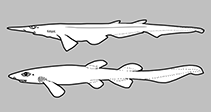
Lớp phụ Cá sụn (cá mập và cá đuối) (sharks and rays) >
Carcharhiniformes (Ground sharks) >
Pentanchidae (Deepwater catsharks)
Etymology: Apristurus: a-, Latin privative, i.e., without; pristis, from pristes (Gr.), sawyer (but here meaning saw); oura (Gr.), tail, referring to absence of saw-toothed crest of enlarged dermal denticles along upper edge of caudal fin as found in the closely related Pristiurus (=Galeus) (See ETYFish); ampliceps: amplus (L.), large; ceps (New Latin), head, 21.8-25.5% TL) (See ETYFish).
Environment: milieu / climate zone / Mức độ sâu / distribution range
Sinh thái học
Biển Tầng đáy biển sâu; Mức độ sâu 800 - 1503 m (Ref. 76941). Temperate
Southwest Pacific: New Zealand and Australia.
Bộ gần gũi / Khối lượng (Trọng lượng) / Age
Chín muồi sinh dục: Lm ? range ? - ? cm
Max length : 85.5 cm TL con đực/không giới tính; (Ref. 76941); 79.6 cm TL (female)
Short description
Khóa để định loại | Hình thái học | Sinh trắc học
This species has the following characters: upper labial furrows about equal to, or slightly shorter than the lower ones; length of pre-outer nostril 4.5-6.6% TL; semicircular upper jaw; continuous supraorbital sensory canal; first dorsal fin is slightly smaller than second; anal fin is rounded in shape; narrow dermal denticles, leaf-like and sparse in distribution; enlarged dermal denticles absent along the dorsal margin of caudal fin; 8-11 spiral valves in intestine; size at maturity 65.0-75.0 cm TL; uniformly brown or blackish brown body and fins (Ref. 76941).
Body shape (shape guide): elongated.
Claspers of males are short and less than 2.0% TL in specimens less than 52.7 cm TL, which is ranked as maturity stage 1 (immature); 73.3-76.5 cm TL have long but soft claspers (3.9-4.2% TL, maturity stage 2; greater than 78 cm TL have long, well developed and hardened
claspers (3.6-5.6% TL, maturity stage 3). Immature males are less than 52.7 cm TL and for females 37.4 cm TL (maturity stage 1); adolescent in males of 73.3-76.5 cm TL and females of 57.8-65.6 cm TL are (maturity stage 2); and adult in males with greater than 78 cm TL and females greater than 67.8 cm TL (maturity stage 3) (Ref. 76941).
Life cycle and mating behavior
Chín muồi sinh dục | Sự tái sinh sản | Đẻ trứng | Các trứng | Sự sinh sản | Ấu trùng
Sasahara, R., K. Sato and K. Nakaya, 2008. A new species of deepwater catshark, Apristurus ampliceps sp. nov., (Chondrichthyes: Carcharhiniformes: Scyliorhinidae), from New Zealand and Australia. In Last, P.R., White, W.T. & Pogonoski, J.J. (eds.): Descriptions of New Australian Chondrichthyans. CSIRO Marine and Atmospheric Research Paper no. 22, pp. 93-104. (Ref. 76941)
IUCN Red List Status (Ref. 130435: Version 2025-1)
Threat to humans
Harmless
Human uses
Các công cụ
Special reports
Download XML
Các nguồn internet
Estimates based on models
Preferred temperature (Tài liệu tham khảo
123201): 3.5 - 6.4, mean 4.6 °C (based on 20 cells).
Phylogenetic diversity index (Tài liệu tham khảo
82804): PD
50 = 0.5000 [Uniqueness, from 0.5 = low to 2.0 = high].
Bayesian length-weight: a=0.00355 (0.00175 - 0.00721), b=3.08 (2.90 - 3.26), in cm total length, based on LWR estimates for this (Sub)family-body shape (Ref.
93245).
Mức dinh dưỡng (Tài liệu tham khảo
69278): 4.0 ±0.7 se; based on size and trophs of closest relatives
Thích nghi nhanh (Tài liệu tham khảo
120179): Rất thấp, thời gian nhân đôi của chủng quần tối thiểu là hơn 14 năm (Fec assumed to be < 10).
Fishing Vulnerability (Ref.
59153): Moderate to high vulnerability (54 of 100).
🛈