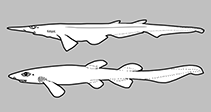
Klassifizierung / Names
Namen | Synonyme | Catalog of Fishes(Gattung, Arten) | ITIS | CoL | WoRMS | Cloffa
Elasmobranchii (Haie und Rochen) (sharks and rays) >
Carcharhiniformes (Ground sharks) >
Pentanchidae (Deepwater catsharks)
Etymology: Apristurus: a-, Latin privative, i.e., without; pristis, from pristes (Gr.), sawyer (but here meaning saw); oura (Gr.), tail, referring to absence of saw-toothed crest of enlarged dermal denticles along upper edge of caudal fin as found in the closely related Pristiurus (=Galeus) (See ETYFish); ampliceps: amplus (L.), large; ceps (New Latin), head, 21.8-25.5% TL) (See ETYFish).
Environment: milieu / climate zone / Tiefenbereich / distribution range
Ökologie
seewasser bathydemersal; tiefenbereich 800 - 1503 m (Ref. 76941). Temperate
Southwest Pacific: New Zealand and Australia.
Size / Gewicht / Alter
Geschlechtsreife: Lm ? range ? - ? cm
Max length : 85.5 cm TL Männchen/unbestimmt; (Ref. 76941); 79.6 cm TL (female)
Kurzbeschreibung
Bestimmungsschlüssel | Morphologie | Morphometrie
This species has the following characters: upper labial furrows about equal to, or slightly shorter than the lower ones; length of pre-outer nostril 4.5-6.6% TL; semicircular upper jaw; continuous supraorbital sensory canal; first dorsal fin is slightly smaller than second; anal fin is rounded in shape; narrow dermal denticles, leaf-like and sparse in distribution; enlarged dermal denticles absent along the dorsal margin of caudal fin; 8-11 spiral valves in intestine; size at maturity 65.0-75.0 cm TL; uniformly brown or blackish brown body and fins (Ref. 76941).
Body shape (shape guide): elongated.
Claspers of males are short and less than 2.0% TL in specimens less than 52.7 cm TL, which is ranked as maturity stage 1 (immature); 73.3-76.5 cm TL have long but soft claspers (3.9-4.2% TL, maturity stage 2; greater than 78 cm TL have long, well developed and hardened
claspers (3.6-5.6% TL, maturity stage 3). Immature males are less than 52.7 cm TL and for females 37.4 cm TL (maturity stage 1); adolescent in males of 73.3-76.5 cm TL and females of 57.8-65.6 cm TL are (maturity stage 2); and adult in males with greater than 78 cm TL and females greater than 67.8 cm TL (maturity stage 3) (Ref. 76941).
Life cycle and mating behavior
Geschlechtsreife | Fortpflanzung | Ablaichen | Eier | Fecundity | Larven
Sasahara, R., K. Sato and K. Nakaya, 2008. A new species of deepwater catshark, Apristurus ampliceps sp. nov., (Chondrichthyes: Carcharhiniformes: Scyliorhinidae), from New Zealand and Australia. In Last, P.R., White, W.T. & Pogonoski, J.J. (eds.): Descriptions of New Australian Chondrichthyans. CSIRO Marine and Atmospheric Research Paper no. 22, pp. 93-104. (Ref. 76941)
IUCN Rote Liste Status (Ref. 130435: Version 2025-1)
Bedrohung für Menschen
Harmless
Nutzung durch Menschen
Tools
Zusatzinformationen
Download XML
Internet Quellen
Estimates based on models
Preferred temperature (Ref.
123201): 3.5 - 6.4, mean 4.6 °C (based on 20 cells).
Phylogenetic diversity index (Ref.
82804): PD
50 = 0.5000 [Uniqueness, from 0.5 = low to 2.0 = high].
Bayesian length-weight: a=0.00355 (0.00175 - 0.00721), b=3.08 (2.90 - 3.26), in cm total length, based on LWR estimates for this (Sub)family-body shape (Ref.
93245).
Trophic level (Ref.
69278): 4.0 ±0.7 se; based on size and trophs of closest relatives
Widerstandsfähigkeit (Ref.
120179): sehr niedrig, Verdopplung der Population dauert mehr als 14 Jahre. (Fec assumed to be < 10).
Fishing Vulnerability (Ref.
59153): Moderate to high vulnerability (54 of 100).
🛈