



Parapercis katoi Randall, Senou & Yoshino, 2008
Добавить Ваши наблюдения в Fish Watcher
| Native range | All suitable habitat | Point map | Year 2050 |

|
| This map was computer-generated and has not yet been reviewed. |
| Parapercis katoi AquaMaps Data sources: GBIF OBIS |
Загрузить свой Фото и Видео
Изображение на Google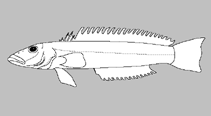 No image available for this species;
drawing shows typical species in Pinguipedidae.
Изображение на Google
drawing shows typical species in Pinguipedidae.
Классификация / Имена народные названия | синонимы | Catalog of Fishes(род, виды) | ITIS | CoL | WoRMS | Cloffa
> Perciformes/Uranoscopoidei (Sand dwellers) > Pinguipedidae (Sandperches)
Etymology: Parapercis: Greek, para = the side of + Greek, perke = perch (Ref. 45335); katoi: Named for Kenji Kato, who caught and provided the color photographs of the holotype.
Eponymy: Kenji Kato of the Tokyo Metropolitan Fisheries Experiment Station caught the holotype (1991) with hook and line in the Ogasawara Islands. [...] (Ref. 128868), visit book page.
More on authors: Randall, Senou & Yoshino.
Etymology: Parapercis: Greek, para = the side of + Greek, perke = perch (Ref. 45335); katoi: Named for Kenji Kato, who caught and provided the color photographs of the holotype.
Eponymy: Kenji Kato of the Tokyo Metropolitan Fisheries Experiment Station caught the holotype (1991) with hook and line in the Ogasawara Islands. [...] (Ref. 128868), visit book page.
More on authors: Randall, Senou & Yoshino.
Окружающая среда: среда / климатическая зона / пределы глубины / диапазон распространения экология
морской донно-пелагический; пределы глубины 100 - 200 m (Ref. 75205). Temperate
распространение Территории | регионы FAO | Экосистемы | места находок | карта точек | интродукции | Faunafri
Northwest Pacific: Japan.
Размер / Вес / Возраст
Краткое описание определительные ключи | морфология | морфометрия
колючие лучи спинного плавника (общее число) : 5; членистые (мягкие) лучи спинного плавника (общее число) : 21; колючие лучи анального плавника: 1; членистые (мягкие) лучи анального плавника: 17; позвонки: 30. This species is distinguished by the following characters: D V, 21; A I, 17; pectoral-fin rays 18; lateral-line scales 56/58; canine teeth 4 pairs anteriorly in lower jaw; without palatine teeth; vomer has a row of about 9 stout conical teeth, often followed by a few much smaller teeth; ctenoid scales on body, becoming cycloid on prepelvic but not prepectoral area; cycloid scales on opercle and cheek, those on cheek very small, mainly non-imbricate ventrally; preopercle with smooth margin; body depth 4.85-5.3 in SL; head length 3.15-3.25 in SL; snout length 2.5-2.9 in HL; orbit diameter 3.75-4.45 in HL; interorbital width 5.2-6.9 in HL; fourth dorsal spine is the longest, 4.5-5.35 in HL; caudal fin slightly rounded on ventral half, truncate on dorsal half, has a pointed upper lobe extending about an orbit diameter posterior to central margin of fin; pectoral fins 4.3-5.05 in SL; pelvic fins nearly or just reaching origin of anal fin, 4.7–5.0 in SL; preserved color in alcohol pale yellowish gray, 5 square dusky bars from dark pigment on scale edges on about upper one-fourth of body, a dark brown spot at each lower corner (except first bar with only 1); translucent pale yellowish fins with pale yellow rays, the caudal with a very small dusky spot dorsally on base; fresh color pale orange dorsally, white ventrally, with 5 broad pink bars on body, becoming red ventrally, each with brown spots as described; a broad, oblique red bar on cheek; fins pale yellowish, the dorsal with a faint longitudinal yellow band about half way out in fin; caudal fin with a narrow magenta bar at base containing a small deep purple spot dorsally and a red spot ventrally; pectoral fins has a white bar at base containing an elongate magenta spot; pelvic fins are nearly white (Ref. 75205).
Body shape (shape guide): elongated.
Body shape (shape guide): elongated.
The gonad of the smallest paratype, 12.74 cm SL, appears to contain both ovarian and testicular tissue, indicating sex change from female to male. The lack of females is probably due to the larger males being able to take a larger baited hook (Ref. 75205)..
Жизненный цикл и брачное поведение половая зрелость | размножение | нерест | икра | Плодовитость | личинки
Основная ссылка
Загрузите свои рекомендации | ссылки | координатор : Ho, Hsuan-Ching | соавторы
Randall, J.E., H. Senou and T. Yoshino, 2008. Three new pinguipedid fishes of the genus Parapercis from Japan. Bull. Natl. Mus. Nat. Sci. Ser. A. Suppl. 2:69-84. (Ref. 75205)
CITES
Not Evaluated
Угроза для людей
Harmless
Использование человеком
FAO - Publication: search | FishSource |
дополнительная информация
Трофическая экология
Пищевые предметы (добыча)
состав пищи
потребление пищи
Продовольственные пайки
хищники
Пищевые предметы (добыча)
состав пищи
потребление пищи
Продовольственные пайки
хищники
экология
экология
экология
Динамика численности населения
Параметры роста
Макс. возраст / размер
Отношение длины к весу.
Отношение длины к длине.
Размерный состав
Преобразование массы
пополнение
численность
Параметры роста
Макс. возраст / размер
Отношение длины к весу.
Отношение длины к длине.
Размерный состав
Преобразование массы
пополнение
численность
Жизненный цикл
размножение
половая зрелость
Зрелость/Жиры относительно.
Плодовитость
нерест
Нерестовые скопления
икра
Развитие икры
личинки
динамика численности личинок
размножение
половая зрелость
Зрелость/Жиры относительно.
Плодовитость
нерест
Нерестовые скопления
икра
Развитие икры
личинки
динамика численности личинок
Анатомия
жаберная область
Мозг
Отолит
жаберная область
Мозг
Отолит
Физиология
Состав тела
Питательные вещества
Потребление кислорода
Тип плавания
Скорость плавания
Зрительные пигменты
Звук рыбы
Болезни и паразиты
Токсичность (LC50s)
Состав тела
Питательные вещества
Потребление кислорода
Тип плавания
Скорость плавания
Зрительные пигменты
Звук рыбы
Болезни и паразиты
Токсичность (LC50s)
генетика
Геном
генетика
Гетерозиготность
наследуемость
Генетическое разнообразие
Геном
генетика
Гетерозиготность
наследуемость
Генетическое разнообразие
Связанные с человеком
Системы аквакультуры
особенности рыбоводства
степень растяжения
Случаи заболевания сигуатерой
Марки, монеты и прочее.
Системы аквакультуры
особенности рыбоводства
степень растяжения
Случаи заболевания сигуатерой
Марки, монеты и прочее.
инструменты
Специальные отчеты
Проверить содержание в аквариумах | Проверить опубликованные видовые данные | Проверить опубликованные данные по аквакультуре
Скачать в формате XML
ресурсы в Интернет
AFORO (otoliths) | Aquatic Commons | BHL | Cloffa | Websites from users | Проверить FishWatcher | CISTI | Catalog of Fishes: род, виды | DiscoverLife | ECOTOX | FAO - Publication: search | Faunafri | Fishipedia | Fishtrace | GloBI | Google Books | Google Scholar | Google | IGFA World Record | OneZoom | Open Tree of Life | Otolith Atlas of Taiwan Fishes | PubMed | Reef Life Survey | Socotra Atlas | TreeBase | Tree of Life | Wikipedia: Вперёд, поиск | World Records Freshwater Fishing | Zoobank | Зоологическая летопись
Оценки, основанные на моделях
Предпочтительная температура (ссылка 123201): 5.7 - 20.5, mean 16.4 °C (based on 38 cells).
Индекс филогенетического разнообразия (ссылка 82804): PD50 = 0.5000 [Uniqueness, from 0.5 = low to 2.0 = high].
Bayesian length-weight: a=0.00692 (0.00314 - 0.01524), b=3.06 (2.88 - 3.24), in cm total length, based on LWR estimates for this Genus-body shape (Ref. 93245).
Трофический уровень (ссылка 69278): 3.6 ±0.4 se; based on size and trophs of closest relatives
устойчивость к внешним воздействиям (ссылка 120179): высокий, минимальное время удвоения популяции до 15 месяцев (Preliminary K or Fecundity.).