



Parapercis katoi Randall, Senou & Yoshino, 2008
Waarneming toevoegen in Fish Watcher
| Native range | All suitable habitat | Point map | Year 2050 |

|
| This map was computer-generated and has not yet been reviewed. |
| Parapercis katoi AquaMaps Data sources: GBIF OBIS |
Uploaden van uw Foto's en video's
Google afbeelding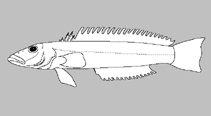 No image available for this species;
drawing shows typical species in Pinguipedidae.
Google afbeelding
drawing shows typical species in Pinguipedidae.
Classificatie / Namen Lokale namen | Synoniemen | Catalog of Fishes(Genus, Soort(en)) | ITIS | CoL | WoRMS | Cloffa
> Perciformes/Uranoscopoidei (Sand dwellers) > Pinguipedidae (Sandperches)
Etymology: Parapercis: Greek, para = the side of + Greek, perke = perch (Ref. 45335); katoi: Named for Kenji Kato, who caught and provided the color photographs of the holotype.
Eponymy: Kenji Kato of the Tokyo Metropolitan Fisheries Experiment Station caught the holotype (1991) with hook and line in the Ogasawara Islands. [...] (Ref. 128868), visit book page.
More on authors: Randall, Senou & Yoshino.
Etymology: Parapercis: Greek, para = the side of + Greek, perke = perch (Ref. 45335); katoi: Named for Kenji Kato, who caught and provided the color photographs of the holotype.
Eponymy: Kenji Kato of the Tokyo Metropolitan Fisheries Experiment Station caught the holotype (1991) with hook and line in the Ogasawara Islands. [...] (Ref. 128868), visit book page.
More on authors: Randall, Senou & Yoshino.
Milieu: milieu / Klimaatzone / Diepte / verspreidingsgebied Ecologie
marien benthopelagisch; diepte 100 - 200 m (Ref. 75205). Temperate
Verspreiding Gebieden | FAO regio's | Ecosystemen | Voorkomen | Verspreidingskaart | Introducties | Faunafri
Northwest Pacific: Japan.
Grootte / Gewicht / Leeftijd
Korte beschrijving Determinatiesleutels | Morfologie | Morfometrie
Dorsale stekels (totaal) : 5; Dorsale zachte stralen (totaal) : 21; Anale stekels: 1; Anale zachte stralen: 17; Wervels: 30. This species is distinguished by the following characters: D V, 21; A I, 17; pectoral-fin rays 18; lateral-line scales 56/58; canine teeth 4 pairs anteriorly in lower jaw; without palatine teeth; vomer has a row of about 9 stout conical teeth, often followed by a few much smaller teeth; ctenoid scales on body, becoming cycloid on prepelvic but not prepectoral area; cycloid scales on opercle and cheek, those on cheek very small, mainly non-imbricate ventrally; preopercle with smooth margin; body depth 4.85-5.3 in SL; head length 3.15-3.25 in SL; snout length 2.5-2.9 in HL; orbit diameter 3.75-4.45 in HL; interorbital width 5.2-6.9 in HL; fourth dorsal spine is the longest, 4.5-5.35 in HL; caudal fin slightly rounded on ventral half, truncate on dorsal half, has a pointed upper lobe extending about an orbit diameter posterior to central margin of fin; pectoral fins 4.3-5.05 in SL; pelvic fins nearly or just reaching origin of anal fin, 4.7–5.0 in SL; preserved color in alcohol pale yellowish gray, 5 square dusky bars from dark pigment on scale edges on about upper one-fourth of body, a dark brown spot at each lower corner (except first bar with only 1); translucent pale yellowish fins with pale yellow rays, the caudal with a very small dusky spot dorsally on base; fresh color pale orange dorsally, white ventrally, with 5 broad pink bars on body, becoming red ventrally, each with brown spots as described; a broad, oblique red bar on cheek; fins pale yellowish, the dorsal with a faint longitudinal yellow band about half way out in fin; caudal fin with a narrow magenta bar at base containing a small deep purple spot dorsally and a red spot ventrally; pectoral fins has a white bar at base containing an elongate magenta spot; pelvic fins are nearly white (Ref. 75205).
Body shape (shape guide): elongated.
Body shape (shape guide): elongated.
The gonad of the smallest paratype, 12.74 cm SL, appears to contain both ovarian and testicular tissue, indicating sex change from female to male. The lack of females is probably due to the larger males being able to take a larger baited hook (Ref. 75205)..
Levenscyclus en paargedrag Maturiteit | Voortplanting | Paaien | Eieren | Fecunditeit | Larven
Hoofdreferentie
Upload uw referenties | Referenties | Coördinator : Ho, Hsuan-Ching | Medewerkers
Randall, J.E., H. Senou and T. Yoshino, 2008. Three new pinguipedid fishes of the genus Parapercis from Japan. Bull. Natl. Mus. Nat. Sci. Ser. A. Suppl. 2:69-84. (Ref. 75205)
CITES
Not Evaluated
Gevaar voor de mens
Harmless
Gebruik door de mens
FAO - Publication: search | FishSource |
Meer informatie
Trofische ecologie
Voedsel (prooien)
Dieetsamenstelling
Voedselconsumptie
Voedselrantsoenen
Predatoren
Voedsel (prooien)
Dieetsamenstelling
Voedselconsumptie
Voedselrantsoenen
Predatoren
Ecologie
Ecologie
Ecologie
Populatiedynamica
Groeiparameters
Max. leeftijden / maten
Lengte-gewicht rel.
Lengte-lengte rel.
Lengtefrequenties
Massaconversie
Rekrutering
Abundantie
Groeiparameters
Max. leeftijden / maten
Lengte-gewicht rel.
Lengte-lengte rel.
Lengtefrequenties
Massaconversie
Rekrutering
Abundantie
Levenscyclus
Voortplanting
Maturiteit
Rijpheid/kieuwen rel.
Fecunditeit
Paaien
Paaibestanden
Eieren
Ontwikkeling van de eieren
Larven
Larvale populatiedynamiek
Voortplanting
Maturiteit
Rijpheid/kieuwen rel.
Fecunditeit
Paaien
Paaibestanden
Eieren
Ontwikkeling van de eieren
Larven
Larvale populatiedynamiek
Anatomie
Kieuwoppervlak
Hersenen
Otoliet
Kieuwoppervlak
Hersenen
Otoliet
Fysiologie
Lichaamssamenstelling
Voedingsstoffen
Zuurstofverbruik
Type zwemmen
Zwemsnelheid
Visuele pigmenten
Vis geluid
Ziekten en parasieten
Toxiciteit (LC50)
Lichaamssamenstelling
Voedingsstoffen
Zuurstofverbruik
Type zwemmen
Zwemsnelheid
Visuele pigmenten
Vis geluid
Ziekten en parasieten
Toxiciteit (LC50)
Genetica
genoom
Genetica
Heterozygositeit
Erfelijkheid
Genetische diversiteit
genoom
Genetica
Heterozygositeit
Erfelijkheid
Genetische diversiteit
Menselijk gerelateerd
Aquacultuursystemen
Aquacultuurprofielen
Kweeklijnen
Ciguatera gevallen
Postzegels, munten, diversen.
Aquacultuursystemen
Aquacultuurprofielen
Kweeklijnen
Ciguatera gevallen
Postzegels, munten, diversen.
Tools
Speciale rapporten
Bekijk gegevens voor het houden in een aquarium | Bekijk Fact Sheets voor de soort | Bekijk Aquacultuur Fact Sheets
Download XML
Internetbronnen
AFORO (otoliths) | Aquatic Commons | BHL | Cloffa | Websites from users | Bekijk FishWatcher | CISTI | Catalog of Fishes: Genus, Soort(en) | DiscoverLife | ECOTOX | FAO - Publication: search | Faunafri | Fishipedia | Fishtrace | GloBI | Google Books | Google Scholar | Google | IGFA World Record | OneZoom | Open Tree of Life | Otolith Atlas of Taiwan Fishes | PubMed | Reef Life Survey | Socotra Atlas | TreeBase | Tree of Life | Wikipedia: ga naar, zoek | World Records Freshwater Fishing | Zoobank | Zoological Record
Schattingen op basis van modellen
Gewenste temperatuur (Ref. 123201): 5.7 - 20.5, mean 16.4 °C (based on 38 cells).
Fylogenetische diversiteitsindex (Ref. 82804): PD50 = 0.5000 [Uniqueness, from 0.5 = low to 2.0 = high].
Bayesian length-weight: a=0.00692 (0.00314 - 0.01524), b=3.06 (2.88 - 3.24), in cm total length, based on LWR estimates for this Genus-body shape (Ref. 93245).
Trofisch niveau (Ref. 69278): 3.6 ±0.4 se; based on size and trophs of closest relatives
Weerstandsvermogen (Ref. 120179): Hoog, minimale populatieverdubbelingstijd minder dan 15 maanden (Preliminary K or Fecundity.).