Klassifizierung / Names
Namen | Synonyme | Catalog of Fishes(Gattung, Arten) | ITIS | CoL | WoRMS | Cloffa
>
Cichliformes (Cichlids, convict blennies) >
Cichlidae (Cichlids) > Cichlinae
Etymology: Cichla: Greek, kichle = wrasse (Ref. 45335); pleiozona: Name from the Greek 'pleios' meaning more, and 'zona' for girdle, for the additional vertical bar on the caudal peduncle and also for also the usually distinct occipital bar; noun in apposition.
More on authors: Kullander & Ferreira.
Environment: milieu / climate zone / Tiefenbereich / distribution range
Ökologie
; süßwasser benthopelagisch. Tropical
South America: Bolivian Amazon basin including the Rio Madre de Dios, Beni, Mamoré, and Guaporé river drainages of Bolivia and Brazil; and in Rio Jamari, a tributary of the Rio Madeira.
Size / Gewicht / Alter
Geschlechtsreife: Lm ? range ? - ? cm
Max length : 44.2 cm SL Männchen/unbestimmt; (Ref. 111115); max. veröff. Gewicht: 2.4 kg (Ref. 111115)
Kurzbeschreibung
Bestimmungsschlüssel | Morphologie | Morphometrie
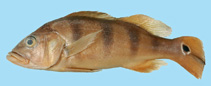
Diagnosis. Similar to C. kelberi and C. monoculus and distinct from all remaining species of Cichla in possessing three dark vertical bars on side, presence of pronounced occipital bar in large specimens, absence of black or ocellated markings laterally on head, and presence of irregular dark blotches on anterior abdominal side. Cichla pleiozona have more scales in lateral row 84-93 (vs. 76-83 in kelberi and 68-87 in monoculus) ) and presence (with occasional exceptions) of dark vertical bar (bar 4) anteriorly on caudal peduncle which is typically absent in both kelberi and monoculus, and from kelberi by absence of light spots on anal and pelvic fins and lower lobe of caudal fin (Ref. 57716).
Body shape (shape guide): fusiform / normal.
Life cycle and mating behavior
Geschlechtsreife | Fortpflanzung | Ablaichen | Eier | Fecundity | Larven
Kullander, S.O. and E.J.G. Ferreira, 2006. A review of the South American cichlid genus Cichla, with descriptions of nine new species. Ichthyol. Explor. Freshwat. 17(4):289-398. (Ref. 57716)
IUCN Rote Liste Status (Ref. 130435: Version 2025-1)
Bedrohung für Menschen
Harmless
Nutzung durch Menschen
Tools
Zusatzinformationen
Download XML
Internet Quellen
Estimates based on models
Phylogenetic diversity index (Ref.
82804): PD
50 = 0.5000 [Uniqueness, from 0.5 = low to 2.0 = high].
Bayesian length-weight: a=0.01288 (0.00750 - 0.02214), b=3.08 (2.93 - 3.23), in cm total length, based on LWR estimates for this species & Genus-body shape (Ref.
93245).
Trophic level (Ref.
69278): 4.3 ±0.5 se; based on size and trophs of closest relatives
Widerstandsfähigkeit (Ref.
120179): mittel, Verdopplung der Population dauert 1,4 - 4,4 Jahre. (Preliminary K or Fecundity.).
Fishing Vulnerability (Ref.
59153): Moderate vulnerability (42 of 100).
🛈