>
Eupercaria/misc (Various families in series Eupercaria) >
Labridae (Wrasses) > Corinae
Etymology: Thalassoma: Greek, thalassa = the sea + Greek, soma = body; the colour of the sea (Ref. 45335); nigrofasciatum: Name from Latin, referring to the presence of black bars on the body.
More on author: Randall.
Environment: milieu / climate zone / djupintervall / distribution range
Ekologi
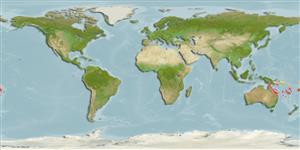
marina revassocierade; djupintervall 0 - 15 m (Ref. 57555). Tropical; 7°S - 32°S, 142°E - 173°W
Western Pacific.
Size / Vikt / Age
Könsmognad: Lm ? range ? - ? cm
Max length : 20.0 cm SL hane/ej könsbestämd; (Ref. 57555)
Short description
Bestämningsnycklar | Morfologi | Morfometri
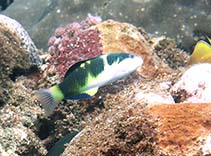
Taggstrålar i ryggfenan (totalt) : 8; Mjukstrålar i ryggfenan (totalt) : 13; Taggstrålar i analfenan: 3; Mjukstrålar i analfenan: 11; Ryggkotor: 25. Diagnosis: Dorsal rays VIII,13. Anal rays III,11, the first spine, when detectable is very slender and short. Pectoral rays 15-16 (usually 15). Lateral line scales 26-27. Head naked, except for a small patch of scales dorsally on opercle. Gill rakers 20-23. Body depth 5.9-3.6 in SL; head length (HL) 3.1-3.4 in SL; snout length 8.4-9.8 in SL; caudal peduncle depth 6.2-6.65 in SL; pectoral fins 4.0-4.3 in SL; pelvic fins 6.3-6.9 in SL. The caudal fin is truncate in young individuals, becoming strongly lunate with filamentous lobes in adult males. The initial phase is white with postorbital head and anterior body above pectoral-fin base black with an oblique yellow band above dorsal edge of opercle, a black bar over last 4 or 5 dorsal spines continuing ventrally across body, its posterior edge vertical, and a broader black bar over last 9 soft rays of dorsal fin, across the body, and posterior anal fin; a black spot on first 2 membranes of dorsal fin; the terminal males with yellow partly replacing the white, a salmon pink patch on chin, and blue ventrally on head and chest (Ref. 57555).
Body shape (shape guide): fusiform / normal.
Found solitary or in groups, most commonly on outer reef areas, and also found in coastal reefs, lagoons and tide pools (Ref. 57555, 90102).
Life cycle and mating behavior
Könsmognad | Reproduktion | Lek | Ägg | Fecundity | Larver
Oviparous, distinct pairing during breeding (Ref. 205).
Randall, J.E., 2003. Thalassoma nigrofasciatum, a new species of labrid fish from the south-west Pacific. aqua, J. Ichthyol. Aquat. Biol. 7(1):1-8. (Ref. 57555)
IUCN Red List Status (Ref. 130435: Version 2025-1)
Threat to humans
Harmless
Human uses
Verktyg
Special reports
Download XML
Internet-källor
Estimates based on models
Preferred temperature (Ref.
123201): 24.6 - 28.5, mean 26.6 °C (based on 405 cells).
Phylogenetic diversity index (Ref.
82804): PD
50 = 0.5000 [Uniqueness, from 0.5 = low to 2.0 = high].
Bayesian length-weight: a=0.00977 (0.00430 - 0.02222), b=3.05 (2.88 - 3.22), in cm total length, based on LWR estimates for this Genus-body shape (Ref.
93245).
Trofisk nivå (Ref.
69278): 3.5 ±0.4 se; based on size and trophs of closest relatives
Resiliens (Ref.
120179): Mellan, lägsta populationsfördubblingstid 1,4-4,4 år (Preliminary K or Fecundity.).
Fishing Vulnerability (Ref.
59153): Low vulnerability (14 of 100).
🛈
Nutrients (Ref.
124155): Calcium = 72.3 [42.9, 120.5] mg/100g; Iron = 0.646 [0.373, 1.205] mg/100g; Protein = 18.5 [15.6, 20.7] %; Omega3 = 0.138 [0.088, 0.214] g/100g; Selenium = 20.6 [12.2, 37.3] μg/100g; VitaminA = 145 [44, 526] μg/100g; Zinc = 1.63 [1.14, 2.59] mg/100g (wet weight);