



Romanogobio parvus Naseka & Freyhof, 2004
Ladda upp din foton och Videor
Google image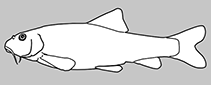 No image available for this species;
drawing shows typical species in Gobionidae.
Google image
drawing shows typical species in Gobionidae.
Klassificering / Namn Populärnamn | synonymer | Catalog of Fishes(Släkte, Arter) | ITIS | CoL | WoRMS | Cloffa
> Cypriniformes (Carps) > Gobionidae (Gudgeons)
Etymology: parvus: From the Latin adjective parvus, meaning small, in reference to the size of the species compared to other gudgeons.
More on authors: Naseka & Freyhof.
Etymology: parvus: From the Latin adjective parvus, meaning small, in reference to the size of the species compared to other gudgeons.
More on authors: Naseka & Freyhof.
Miljö: miljö / Klimatzon / djupintervall / distributionsområde Ekologi
; sötvatten bottenlevande; djupintervall 0 - 1 m (Ref. 52363). Temperate
Utbredning Territorier | FAO områden | Ekosystem | Förekomster | Prickkarta | Utplanteringar | Faunafri
Europe: River Kuban in Russia.
Storlek / Vikt / Ålder
Kort beskrivning Bestämningsnycklar | Morfologi | Morfometri
Mjukstrålar i ryggfenan (totalt) : 10; Mjukstrålar i analfenan: 9; Ryggkotor: 40 - 42. Branched anal rays 6 1/2; branched dorsal rays 7 1/2; longitudinal epithelial crests on predorsal scales; lateral line scales 40-42 + 1-2; circumpeduncular scale rows 10-12; caudal peduncle depth larger than its width at base of last anal rays; caudal peduncle depth 2.9-4.3 times in its length; eye diameter 1.1-1.6 times in interorbital distance; dorsal fin behind middle of body, postdorsal distance 87-97% of predorsal distance; anus midway between pelvic and anal origins; snout 80-98% of postorbital distance; supraorbital and infraorbital sensory canals connected; posterior neurocranium width 59.6-68.6% of cranium roof length; anterior neurocranium width 22.8-29.3% of cranium roof length (Ref. 52363). Aside for these characters, other diagnostic characters to separate this species from its congeners in Black and Caspian Sea basin include eye diameter 1.0-1.4 times in interorbital distance and greatest head width 52-59% of dorsal head length (Ref. 59043).
Body shape (shape guide): elongated.
Body shape (shape guide): elongated.
Found in turbid waters with very strong current (Ref. 52363). Occurs in large, high-gradient river stretches with fast but not turbulent current and gravel or sand bottom. Active at night where it stays near shore on mud or sand bottom. Feeds on benthic invertebrates, mainly Trichoptera larvae. Appears to spawn late and to have a long spawning period. Many small juveniles are observed in July (Ref. 59043).
Livscykel och parningsbeteende Könsmognad | Reproduktion | Lek | Ägg | Fekunditet | Larver
Huvudreferens
Ladda upp dina referenser | referenser | Koordinator | Medarbetare
Naseka, A.M. and J. Freyhof, 2004. Romanogobio parvus, a new gudgeon from River Kuban, southern Russia (Cyprinidae, Gobioninae). Ichthyol. Explor. Freshwat. 15(1):17-23. (Ref. 52363)
Status på IUCN:s rödlista (Ref. 130435: Version 2025-2 (Global))
Least Concern (LC) ; Date assessed: 01 January 2008
CITES
Not Evaluated
Hot mot människor
Harmless
Mänskliga användningsområden
Fiskeri: saknar intresse
FAO - Publication: search | FishSource |
Ytterligare information
Ekologi
Ekologi
Ekologi
Populationsdynamik
Tillväxtparametrar
Max. åldrar / storlekar
Längd-vikt rel.
Längd-längd rel.
Längd-frekvenser
Massakonvertering
Rekrytering
Abundans
Tillväxtparametrar
Max. åldrar / storlekar
Längd-vikt rel.
Längd-längd rel.
Längd-frekvenser
Massakonvertering
Rekrytering
Abundans
Livscykel
Reproduktion
Könsmognad
Mognad/Gills rel.
Fekunditet
Lek
Lekande aggregat
Ägg
Utveckling av ägg
Larver
Larvdynamik
Reproduktion
Könsmognad
Mognad/Gills rel.
Fekunditet
Lek
Lekande aggregat
Ägg
Utveckling av ägg
Larver
Larvdynamik
Anatomi
Gälyta
Hjärna
Otolit
Gälyta
Hjärna
Otolit
Fysiologi
Kroppssammansättning
Näringsämnen
Syreförbrukning
Typ av simning
Simhastighet
Visuella pigment
Ljud från fisk
Sjukdomar & Parasiter
Toxicitet (LC50)
Kroppssammansättning
Näringsämnen
Syreförbrukning
Typ av simning
Simhastighet
Visuella pigment
Ljud från fisk
Sjukdomar & Parasiter
Toxicitet (LC50)
Genetik
Genom
Genetik
Heterozygositet
Ärftlighet
Genetisk mångfald
Genom
Genetik
Heterozygositet
Ärftlighet
Genetisk mångfald
Människorelaterad
Vattenbrukssystem
Vattenbruksprofiler
Avelslinjer
Ciguatera-fall
Frimärken, mynt, diverse.
Vattenbrukssystem
Vattenbruksprofiler
Avelslinjer
Ciguatera-fall
Frimärken, mynt, diverse.
Verktyg
Särskilda rapporter
Kontrollera för underhåll av akvarium | Kontrollera om det finns faktablad om arter | Kontrollera om det finns faktablad om vattenbruk
Ladda ner XML
Internet-källor
AFORO (otoliths) | Aquatic Commons | BHL | Cloffa | Websites from users | Check FishWatcher | CISTI | Catalog of Fishes: Släkte, Arter | DiscoverLife | ECOTOX | FAO - Publication: search | Faunafri | Fishipedia | Fishtrace | GloBI | Google Books | Google Scholar | Google | IGFA World Record | OneZoom | Open Tree of Life | Otolith Atlas of Taiwan Fishes | PubMed | Reef Life Survey | Socotra Atlas | TreeBase | Tree of Life | Wikipedia: Go, sök | World Records Freshwater Fishing | Zoobank | Zoologiskt register
Uppskattningar baserade på modeller
Index för fylogenetisk mångfald (Ref. 82804): PD50 = 0.5000 [Uniqueness, from 0.5 = low to 2.0 = high].
Bayesian length-weight: a=0.00617 (0.00301 - 0.01264), b=3.12 (2.95 - 3.29), in cm total length, based on LWR estimates for this (Sub)family-body shape (Ref. 93245).
Trofisk nivå (Ref. 69278): 3.3 ±0.4 se; based on size and trophs of closest relatives
Resiliens (Ref. 120179): Hög, lägsta populationsfördubblingstid mindre än 15 månader (Preliminary K or Fecundity.).