>
Cypriniformes (Carps) >
Gobionidae (Gudgeons)
Etymology: parvus: From the Latin adjective parvus, meaning small, in reference to the size of the species compared to other gudgeons.
More on authors: Naseka & Freyhof.
Environment: milieu / climate zone / пределы глубины / distribution range
экология
; пресноводный демерсальный; пределы глубины 0 - 1 m (Ref. 52363). Temperate
Europe: River Kuban in Russia.
Size / Вес / Возраст
половая зрелость: Lm ? range ? - ? cm
Max length : 7.5 cm SL самец/пол неопределен; (Ref. 52363)
Краткое описание
определительные ключи | морфология | морфометрия
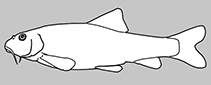
членистые (мягкие) лучи спинного плавника (общее число) : 10; членистые (мягкие) лучи анального плавника: 9; позвонки: 40 - 42. Branched anal rays 6 1/2; branched dorsal rays 7 1/2; longitudinal epithelial crests on predorsal scales; lateral line scales 40-42 + 1-2; circumpeduncular scale rows 10-12; caudal peduncle depth larger than its width at base of last anal rays; caudal peduncle depth 2.9-4.3 times in its length; eye diameter 1.1-1.6 times in interorbital distance; dorsal fin behind middle of body, postdorsal distance 87-97% of predorsal distance; anus midway between pelvic and anal origins; snout 80-98% of postorbital distance; supraorbital and infraorbital sensory canals connected; posterior neurocranium width 59.6-68.6% of cranium roof length; anterior neurocranium width 22.8-29.3% of cranium roof length (Ref. 52363). Aside for these characters, other diagnostic characters to separate this species from its congeners in Black and Caspian Sea basin include eye diameter 1.0-1.4 times in interorbital distance and greatest head width 52-59% of dorsal head length (Ref. 59043).
Body shape (shape guide): elongated.
Found in turbid waters with very strong current (Ref. 52363). Occurs in large, high-gradient river stretches with fast but not turbulent current and gravel or sand bottom. Active at night where it stays near shore on mud or sand bottom. Feeds on benthic invertebrates, mainly Trichoptera larvae. Appears to spawn late and to have a long spawning period. Many small juveniles are observed in July (Ref. 59043).
Life cycle and mating behavior
половая зрелость | размножение | нерест | икра | Fecundity | личинки
Naseka, A.M. and J. Freyhof, 2004. Romanogobio parvus, a new gudgeon from River Kuban, southern Russia (Cyprinidae, Gobioninae). Ichthyol. Explor. Freshwat. 15(1):17-23. (Ref. 52363)
Статус Красного Списка МСОП (Ref. 130435: Version 2025-1)
Угроза для людей
Harmless
Использование человеком
рыболовство: интереса не представляет
дополнительная информация
инструменты
Специальные отчеты
Скачать в формате XML
ресурсы в Интернет
Estimates based on models
Phylogenetic diversity index (ссылка
82804): PD
50 = 0.5000 [Uniqueness, from 0.5 = low to 2.0 = high].
Bayesian length-weight: a=0.00603 (0.00294 - 0.01235), b=3.12 (2.95 - 3.29), in cm total length, based on LWR estimates for this (Sub)family-body shape (Ref.
93245).
Trophic level (ссылка
69278): 3.3 ±0.4 se; based on size and trophs of closest relatives
устойчивость к внешним воздействиям (ссылка
120179): высокий, минимальное время удвоения популяции до 15 месяцев (Preliminary K or Fecundity.).
Fishing Vulnerability (Ref.
59153): Low vulnerability (10 of 100).
🛈