



Hydrolagus matallanasi Soto & Vooren, 2004
Striped rabbitfish
Beobachtung melden im Fish Watcher
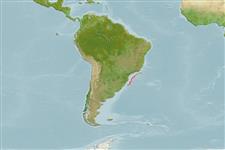
| Native range | All suitable habitat | Point map | Year 2050 |
|
| This map was computer-generated and has not yet been reviewed. |
| Hydrolagus matallanasi AquaMaps Data sources: GBIF OBIS |
Hochladen Photos und videos
Bilder | Google Bild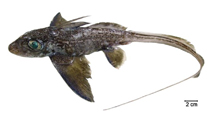 Hydrolagus matallanasi
Photo von Fischer, L.G.
Bilder | Google Bild
Photo von Fischer, L.G.
Klassifizierung / Names Namen | Synonyme | Catalog of Fishes(Gattung, Arten) | ITIS | CoL | WoRMS | Cloffa
Holocephali (Chimären, Seekatzen) (chimaeras) > Chimaeriformes (Chimaeras) > Chimaeridae (Shortnose chimaeras or ratfishes)
Etymology: Hydrolagus: hydro-, combining form of hydor (Gr.), water; lagos (Gr.), hare, i.e., “water rabbit,” probably referring to three pairs of tooth plates, which tend to protrude from the mouth like a rabbit’s incisors (See ETYFish); matallanasi: In honor of Jesús Matallanas Garcia, University of Barcelona (Spain), for his “extensive work and tireless dedication to ichthyology” (See ETYFish).
Eponymy: Jesús Matallanas Garcia is a Spanish ichthyologist and Professor in the Faculty of Biosciences at the University of Barcelona. [...] (Ref. 128868), visit book page.
Etymology: Hydrolagus: hydro-, combining form of hydor (Gr.), water; lagos (Gr.), hare, i.e., “water rabbit,” probably referring to three pairs of tooth plates, which tend to protrude from the mouth like a rabbit’s incisors (See ETYFish); matallanasi: In honor of Jesús Matallanas Garcia, University of Barcelona (Spain), for his “extensive work and tireless dedication to ichthyology” (See ETYFish).
Eponymy: Jesús Matallanas Garcia is a Spanish ichthyologist and Professor in the Faculty of Biosciences at the University of Barcelona. [...] (Ref. 128868), visit book page.
Umwelt: Milieu / Klimazone / Tiefenbereich / Verbreitungsgebiet Ökologie
seewasser bathydemersal; tiefenbereich 416 - 736 m (Ref. 52554). Subtropical; 23°S - 31°S (Ref. 52554)
Verbreitung Territorien | FAO Gebiete | Ökosysteme | Vorkommen | Punkt Karte | Einführungen | Faunafri
Southwestern Atlantic: Brazil.
Länge bei der ersten Reifung / Größe / Gewicht / Alter
Geschlechtsreife: Lm ?, range 30 - ? cm
Max length : 69.5 cm TL Männchen/unbestimmt; (Ref. 52554); 37.8 cm OT (female)
Max length : 69.5 cm TL Männchen/unbestimmt; (Ref. 52554); 37.8 cm OT (female)
Kurzbeschreibung Bestimmungsschlüssel | Morphologie | Morphometrie
Diagnosis: Differs from its congeners in having an irregular brown coloration with reticulations and spots over the body; ventral surface whitish, including pectoral bases; proximal margin of the second dorsal fin whitish; tooth plates striped and bicolor, yellowish and gray; length of dorsal fin spine equal to or slightly greater than head length; pectoral fin notably long, its tip extending beyond posterior margin of pectoral fin base; upper margin of second dorsal fin notably concave at middle region of second dorsal fin base; minimum height of second dorsal fin less than half of maximum height (located at points anterior and posterior to middle region of fin); eye length slightly smaller than preorbital length (Ref. 52554).
Body shape (shape guide): elongated.
Body shape (shape guide): elongated.
Female maximum length given as precaudal length (PCL). Inhabits deep-reefs on the continental slope, usually deeper than 400 meters; with gorgonians, hard corals, tube sponges, crinoids, and ophiuroids. It also shares this habitat with other sharks Heptranchias perlo, Scyliorhinus haeckelii, Galeus mincaronei, Schroederichthys saurisqualus, Squalus sp., and the skate Gurgesiella dorsalifera (Ref. 52554).
Lebenszyklus und Paarungsverhalten Geschlechtsreife | Fortpflanzung | Ablaichen | Eier | Fruchtbarkeit | Larven
Hauptreferenz
Laden Sie Ihre Referenzen hoch | Referenzen | Koordinator | Partner
Soto, J.M.R. and C.M. Vooren, 2004. Hydrolagus matallanasi sp. nov. (Holocephali, Chimaeridae) a new species of rabbitfish from southern Brazil. Zootaxa 687:1-10. (Ref. 52554)
IUCN Rote Liste Status (Ref. 130435: Version 2025-2 (Global))
Verwundbar (VU) (A2d); Date assessed: 02 September 2019
CITES
Not Evaluated
Bedrohung für Menschen
Harmless
Nutzung durch Menschen
Fischereien: nicht kommerziell
FAO - Publication: search | FishSource |
Mehr Information
Trophische Ökologie
Lebensmittel (Beutetiere)
Nahrungszusammensetzung
Nahrungsaufnahme
Lebensmittelrationen
Räuber
Lebensmittel (Beutetiere)
Nahrungszusammensetzung
Nahrungsaufnahme
Lebensmittelrationen
Räuber
Ökologie
Ökologie
Ökologie
Populationsdynamik
Wachstumsparameter
Max. Alter/Größen
Länge-Gewicht-Rel.
Länge-Länge-Verhältnis.
Längenhäufigkeiten
Massenkonvertierung
Rekrutierung
Dichte
Wachstumsparameter
Max. Alter/Größen
Länge-Gewicht-Rel.
Länge-Länge-Verhältnis.
Längenhäufigkeiten
Massenkonvertierung
Rekrutierung
Dichte
Lebenszyklus
Fortpflanzung
Geschlechtsreife
Reifung/Kiemen rel.
Fruchtbarkeit
Ablaichen
Laichaggregationen
Eier
Eientwicklung
Larven
Larven Pop.Dyn.
Fortpflanzung
Geschlechtsreife
Reifung/Kiemen rel.
Fruchtbarkeit
Ablaichen
Laichaggregationen
Eier
Eientwicklung
Larven
Larven Pop.Dyn.
Anatomie
Kiemenoberfläche
Gehirn
Otolith
Kiemenoberfläche
Gehirn
Otolith
Physiologie
Körperliche Zusammensetzung
Nährstoffe
Sauerstoffverbrauch
Schwimmart
Schwimmgeschwindigkeit
Visuelle Pigmente
Fischgeräusche
Krankheiten und Parasiten
Toxizität (LC50s)
Körperliche Zusammensetzung
Nährstoffe
Sauerstoffverbrauch
Schwimmart
Schwimmgeschwindigkeit
Visuelle Pigmente
Fischgeräusche
Krankheiten und Parasiten
Toxizität (LC50s)
Genetik
Genom
Genetik
Heterozygotie
Vererbbarkeit
Genetische Vielfalt
Genom
Genetik
Heterozygotie
Vererbbarkeit
Genetische Vielfalt
Menschenbezogen
Aquakultur-Systeme
Aquakultur Profile
Zuchtlinien
Ciguatera-Fälle
Briefmarken, Münzen, Verschiedenes.
Aquakultur-Systeme
Aquakultur Profile
Zuchtlinien
Ciguatera-Fälle
Briefmarken, Münzen, Verschiedenes.
Tools
Zusatzinformationen
Download XML
Zusammenfassung | Punktdaten | Namen | Photos
Internet Quellen
AFORO (otoliths) | Aquatic Commons | BHL | Cloffa | Websites from users | FishWatcher Einträge suchen | CISTI | Catalog of Fishes: Gattung, Arten | DiscoverLife | ECOTOX | FAO - Publication: search | Faunafri | Fishipedia | Fishtrace | GloBI | Google Books | Google Scholar | Google | IGFA World Record | OneZoom | Open Tree of Life | Otolith Atlas of Taiwan Fishes | PubMed | Reef Life Survey | Socotra Atlas | TreeBase | Tree of Life | Wikipedia: Gehe zu, Suchen | World Records Freshwater Fishing | Zoobank | Zoologischer Rekord
Schätzungen auf der Grundlage von Modellen
Bevorzugte Temperatur (Ref. 123201): 6.4 - 10.2, mean 8.2 °C (based on 7 cells).
Phylogenetischer Diversitätsindex (Ref. 82804): PD50 = 0.5000 [Uniqueness, from 0.5 = low to 2.0 = high].
Bayesian length-weight: a=0.00339 (0.00139 - 0.00824), b=3.07 (2.86 - 3.28), in cm total length, based on LWR estimates for this (Sub)family-body shape (Ref. 93245).
Trophische Ebene (Ref. 69278): 3.8 ±0.6 se; based on size and trophs of closest relatives
Widerstandsfähigkeit (Ref. 120179): niedrig, Verdopplung der Population dauert 4,5 - 14 Jahre. (Assuming fecundity<100).