



Hydrolagus matallanasi Soto & Vooren, 2004
Striped rabbitfish
Waarneming toevoegen in Fish Watcher
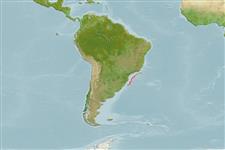
| Native range | All suitable habitat | Point map | Year 2050 |
|
| This map was computer-generated and has not yet been reviewed. |
| Hydrolagus matallanasi AquaMaps Data sources: GBIF OBIS |
Uploaden van uw Foto's en video's
Afbeeldingen | Google afbeelding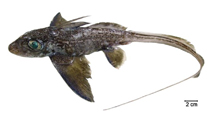 Hydrolagus matallanasi
Afbeelding van Fischer, L.G.
Afbeeldingen | Google afbeelding
Afbeelding van Fischer, L.G.
Classificatie / Namen Lokale namen | Synoniemen | Catalog of Fishes(Genus, Soort(en)) | ITIS | CoL | WoRMS | Cloffa
Holocephali (chimeren) (chimaeras) > Chimaeriformes (Chimaeras) > Chimaeridae (Shortnose chimaeras or ratfishes)
Etymology: Hydrolagus: hydro-, combining form of hydor (Gr.), water; lagos (Gr.), hare, i.e., “water rabbit,” probably referring to three pairs of tooth plates, which tend to protrude from the mouth like a rabbit’s incisors (See ETYFish); matallanasi: In honor of Jesús Matallanas Garcia, University of Barcelona (Spain), for his “extensive work and tireless dedication to ichthyology” (See ETYFish).
Eponymy: Jesús Matallanas Garcia is a Spanish ichthyologist and Professor in the Faculty of Biosciences at the University of Barcelona. [...] (Ref. 128868), visit book page.
Etymology: Hydrolagus: hydro-, combining form of hydor (Gr.), water; lagos (Gr.), hare, i.e., “water rabbit,” probably referring to three pairs of tooth plates, which tend to protrude from the mouth like a rabbit’s incisors (See ETYFish); matallanasi: In honor of Jesús Matallanas Garcia, University of Barcelona (Spain), for his “extensive work and tireless dedication to ichthyology” (See ETYFish).
Eponymy: Jesús Matallanas Garcia is a Spanish ichthyologist and Professor in the Faculty of Biosciences at the University of Barcelona. [...] (Ref. 128868), visit book page.
Milieu: milieu / Klimaatzone / Diepte / verspreidingsgebied Ecologie
Verspreiding Gebieden | FAO regio's | Ecosystemen | Voorkomen | Verspreidingskaart | Introducties | Faunafri
Southwestern Atlantic: Brazil.
Lengte bij maturiteit / Grootte / Gewicht / Leeftijd
Maturiteit: Lm ?, range 30 - ? cm
Max length : 69.5 cm TL mannelijk / geslacht onbekend; (Ref. 52554); 37.8 cm OT (female)
Max length : 69.5 cm TL mannelijk / geslacht onbekend; (Ref. 52554); 37.8 cm OT (female)
Korte beschrijving Determinatiesleutels | Morfologie | Morfometrie
Diagnosis: Differs from its congeners in having an irregular brown coloration with reticulations and spots over the body; ventral surface whitish, including pectoral bases; proximal margin of the second dorsal fin whitish; tooth plates striped and bicolor, yellowish and gray; length of dorsal fin spine equal to or slightly greater than head length; pectoral fin notably long, its tip extending beyond posterior margin of pectoral fin base; upper margin of second dorsal fin notably concave at middle region of second dorsal fin base; minimum height of second dorsal fin less than half of maximum height (located at points anterior and posterior to middle region of fin); eye length slightly smaller than preorbital length (Ref. 52554).
Body shape (shape guide): elongated.
Body shape (shape guide): elongated.
Female maximum length given as precaudal length (PCL). Inhabits deep-reefs on the continental slope, usually deeper than 400 meters; with gorgonians, hard corals, tube sponges, crinoids, and ophiuroids. It also shares this habitat with other sharks Heptranchias perlo, Scyliorhinus haeckelii, Galeus mincaronei, Schroederichthys saurisqualus, Squalus sp., and the skate Gurgesiella dorsalifera (Ref. 52554).
Levenscyclus en paargedrag Maturiteit | Voortplanting | Paaien | Eieren | Fecunditeit | Larven
Hoofdreferentie
Upload uw referenties | Referenties | Coördinator | Medewerkers
Soto, J.M.R. and C.M. Vooren, 2004. Hydrolagus matallanasi sp. nov. (Holocephali, Chimaeridae) a new species of rabbitfish from southern Brazil. Zootaxa 687:1-10. (Ref. 52554)
Status op de Rode Lijst van het IUCN (Ref. 130435: Version 2025-2 (Global))
Kwetsbaar (VU) (A2d); Date assessed: 02 September 2019
CITES
Not Evaluated
Gevaar voor de mens
Harmless
Gebruik door de mens
Visserij: van geen belang
FAO - Publication: search | FishSource |
Meer informatie
Trofische ecologie
Voedsel (prooien)
Dieetsamenstelling
Voedselconsumptie
Voedselrantsoenen
Predatoren
Voedsel (prooien)
Dieetsamenstelling
Voedselconsumptie
Voedselrantsoenen
Predatoren
Ecologie
Ecologie
Ecologie
Populatiedynamica
Groeiparameters
Max. leeftijden / maten
Lengte-gewicht rel.
Lengte-lengte rel.
Lengtefrequenties
Massaconversie
Rekrutering
Abundantie
Groeiparameters
Max. leeftijden / maten
Lengte-gewicht rel.
Lengte-lengte rel.
Lengtefrequenties
Massaconversie
Rekrutering
Abundantie
Levenscyclus
Voortplanting
Maturiteit
Rijpheid/kieuwen rel.
Fecunditeit
Paaien
Paaibestanden
Eieren
Ontwikkeling van de eieren
Larven
Larvale populatiedynamiek
Voortplanting
Maturiteit
Rijpheid/kieuwen rel.
Fecunditeit
Paaien
Paaibestanden
Eieren
Ontwikkeling van de eieren
Larven
Larvale populatiedynamiek
Anatomie
Kieuwoppervlak
Hersenen
Otoliet
Kieuwoppervlak
Hersenen
Otoliet
Fysiologie
Lichaamssamenstelling
Voedingsstoffen
Zuurstofverbruik
Type zwemmen
Zwemsnelheid
Visuele pigmenten
Vis geluid
Ziekten en parasieten
Toxiciteit (LC50)
Lichaamssamenstelling
Voedingsstoffen
Zuurstofverbruik
Type zwemmen
Zwemsnelheid
Visuele pigmenten
Vis geluid
Ziekten en parasieten
Toxiciteit (LC50)
Genetica
genoom
Genetica
Heterozygositeit
Erfelijkheid
Genetische diversiteit
genoom
Genetica
Heterozygositeit
Erfelijkheid
Genetische diversiteit
Menselijk gerelateerd
Aquacultuursystemen
Aquacultuurprofielen
Kweeklijnen
Ciguatera gevallen
Postzegels, munten, diversen.
Aquacultuursystemen
Aquacultuurprofielen
Kweeklijnen
Ciguatera gevallen
Postzegels, munten, diversen.
Tools
Speciale rapporten
Bekijk gegevens voor het houden in een aquarium | Bekijk Fact Sheets voor de soort | Bekijk Aquacultuur Fact Sheets
Download XML
Internetbronnen
AFORO (otoliths) | Aquatic Commons | BHL | Cloffa | Websites from users | Bekijk FishWatcher | CISTI | Catalog of Fishes: Genus, Soort(en) | DiscoverLife | ECOTOX | FAO - Publication: search | Faunafri | Fishipedia | Fishtrace | GloBI | Google Books | Google Scholar | Google | IGFA World Record | OneZoom | Open Tree of Life | Otolith Atlas of Taiwan Fishes | PubMed | Reef Life Survey | Socotra Atlas | TreeBase | Tree of Life | Wikipedia: ga naar, zoek | World Records Freshwater Fishing | Zoobank | Zoological Record
Schattingen op basis van modellen
Gewenste temperatuur (Ref. 123201): 6.4 - 10.2, mean 8.2 °C (based on 7 cells).
Fylogenetische diversiteitsindex (Ref. 82804): PD50 = 0.5000 [Uniqueness, from 0.5 = low to 2.0 = high].
Bayesian length-weight: a=0.00339 (0.00139 - 0.00824), b=3.07 (2.86 - 3.28), in cm total length, based on LWR estimates for this (Sub)family-body shape (Ref. 93245).
Trofisch niveau (Ref. 69278): 3.8 ±0.6 se; based on size and trophs of closest relatives
Weerstandsvermogen (Ref. 120179): laag, minimale populatieverdubbelingstijd 4,5-14 jaar (Assuming fecundity<100).