



Thryssa scratchleyi (Ramsay & Ogilby, 1886)
New Guinea thryssa
Adicionar o seu Fotografias e vídeos
Fotografias | Imagem do Google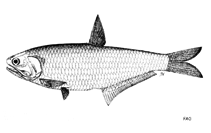 Thryssa scratchleyi
Fotografia de FAO
Fotografias | Imagem do Google
Fotografia de FAO
Classificação / Nomes Nomes comuns | Sinónimos | Catalog of Fishes(Género, Espécies) | ITIS | CoL | WoRMS | Cloffa
> Clupeiformes (Herrings) > Engraulidae (Anchovies) > Coiliinae
Etymology: Thryssa: Greek, thrissa, -es = shad (Ref. 45335).
Eponymy: Major-General Sir Peter Henry Scratchley (1835–1885) was the first High Commissioner of New Guinea. [...] (Ref. 128868), visit book page.
More on authors: Ramsay & Ogilby.
Etymology: Thryssa: Greek, thrissa, -es = shad (Ref. 45335).
Eponymy: Major-General Sir Peter Henry Scratchley (1835–1885) was the first High Commissioner of New Guinea. [...] (Ref. 128868), visit book page.
More on authors: Ramsay & Ogilby.
Ambiente: milieu / zona climática / intervalo de profundidade / gama de distribuição Ecologia
marinhas; Água doce; estuarina pelagic-neritic; catádromo (Ref. 138274). Tropical; 5°S - 15°S
Distribuição Territórios | Áreas FAO | Ecossistemas | Ocorrências | Mapa dos pontos | Introduções | Faunafri
Asia and Oceania: Papua New Guinea (Strickland and Fly Rivers), Indonesia (Lorentz River in Irian Jaya) and Australia (rivers entering the Gulf of Carpentaria).
Tamanho / Peso / Idade
Maturidade: Lm ? range ? - ? cm
Max length : 40.0 cm SL macho/indeterminado; (Ref. 44894); common length : 20.0 cm SL macho/indeterminado; (Ref. 44894)
Max length : 40.0 cm SL macho/indeterminado; (Ref. 44894); common length : 20.0 cm SL macho/indeterminado; (Ref. 44894)
Descrição breve Chaves de identificação | Morfologia | Morfometria
Espinhos dorsais (total) : 0; Raios dorsais moles (total) : 12 - 13; Espinhos anais: 0; Raios anais moles: 35 - 42. Belly with 19 + 12 = 31 keeled scutes from isthmus to anus. Maxilla short, only reaching to front border of pre-operculum; first supra-maxilla about two thirds of second. No dark blotches on nape or behind upper part of gill opening.
Body shape (shape guide): elongated; Cross section: compressed.
Body shape (shape guide): elongated; Cross section: compressed.
Adults inhabit streams and associated lagoons, in clear or turbid water; also in brackish estuaries (Ref. 44894), in main river channels as well as smaller tributaries (Ref. 2847). A riverine species reaching nearly 900 km up the Fly River, but also down to the estuary. They form shoals in deeper water of lagoons. Breeding biology is poorly understood, but it seems likely that spawning takes place in fresh water as juveniles have been collected from the upper reaches of some Queensland rivers. The diet consists of small crustaceans, fishes, insects and some plant material (Ref. 44894). Piscivorous (at least as large adults), recorded as feeding on Clupeoides papuensis and Melanotaenia nigra in the Fly River. The only anchovy that is restricted to mainly freshwater habitats (Ref. 44894). The largest anchovy known so far.
Ciclo de vida e comportamento de acasalamento Maturidade | Reprodução | Desova | Ovos | Fecundidade | Larvas
Referência principal
Carregar as suas referências | Referências | Coordenador | Colaboradores
Wongratana, T., T.A. Munroe and M. Nizinski, 1999. Order Clupeiformes. Engraulidae. Anchovies. p. 1698-1753. In K.E. Carpenter and V.H. Niem (eds.) FAO species identification guide for fishery purposes. The living marine resources of the WCP. Vol. 3. Batoid fishes, chimaeras and bony fishes part 1 (Elopidae to Linophrynidae). FAO, Rome. (Ref. 9822)
Categoria na Lista Vermelha da IUCN (Ref. 130435: Version 2025-2 (Global))
Dados insuficientes (DD) ; Date assessed: 14 February 2019
CITES
Not Evaluated
Ameaça para o homem
Harmless
Utilização humana
Pescarias: pescarias de subsistência
FAO - Publication: search | FishSource |
Mais informação
Ecologia Trófica
Produtos alimentares (presas)
Composição da dieta
Consumo alimentar
Rações alimentares
Predadores
Produtos alimentares (presas)
Composição da dieta
Consumo alimentar
Rações alimentares
Predadores
Dinâmica das populações
Parâmetros de crescimento
Idades / tamanhos máximos
Comprimento-peso rel.
Comprimento-comprimento rel.
Frequência de comprimento
Conversão de massa
Recrutamento
Abundância
Parâmetros de crescimento
Idades / tamanhos máximos
Comprimento-peso rel.
Comprimento-comprimento rel.
Frequência de comprimento
Conversão de massa
Recrutamento
Abundância
Ciclo de vida
Reprodução
Maturidade
Maturidade/Rel. das guelras
Fecundidade
Desova
Agregações de desova
Ovos
Desenvolvimento dos ovos
Larvas
Dinâmica larvar
Reprodução
Maturidade
Maturidade/Rel. das guelras
Fecundidade
Desova
Agregações de desova
Ovos
Desenvolvimento dos ovos
Larvas
Dinâmica larvar
Anatomia
Área branquial
Cérebro
Otólitos
Área branquial
Cérebro
Otólitos
Fisiologia
Composição corporal
Nutrientes
Consumo de oxigénio
Tipo de natação
Velocidade de natação
Pigmentos visuais
Som de peixe
Doenças e Parasitas
Toxicidade (LC50s)
Composição corporal
Nutrientes
Consumo de oxigénio
Tipo de natação
Velocidade de natação
Pigmentos visuais
Som de peixe
Doenças e Parasitas
Toxicidade (LC50s)
Genética
genoma
Genética
Heterozigotia
Hereditariedade
Diversidade genética
genoma
Genética
Heterozigotia
Hereditariedade
Diversidade genética
Relacionado com o ser humano
Sistemas de aquacultura
Perfis para aquacultura
Estirpes
Casos de Ciguatera
Selos, moedas, diversos.
Sistemas de aquacultura
Perfis para aquacultura
Estirpes
Casos de Ciguatera
Selos, moedas, diversos.
Ferramentas
E-book | Guia de campo | Chaves de identificação | Ferramenta auxiliar de frequências de comprimento | Ferramenta sobre a história de vida | Mapa dos pontos |
Captura-MSY |
Relatórios especiais
Descarregue XML
Fontes da internet
AFORO (otoliths) | Aquatic Commons | BHL | Cloffa | Websites from users | Consultar FishWatcher | CISTI | Catalog of Fishes: Género, Espécies | DiscoverLife | ECOTOX | FAO - Publication: search | Faunafri | Fishipedia | Fishtrace | GloBI | Google Books | Google Scholar | Google | IGFA World Record | OneZoom | Open Tree of Life | Otolith Atlas of Taiwan Fishes | PubMed | Reef Life Survey | Socotra Atlas | TreeBase | Árvore da vida | Wikipedia: ir para, procurar | World Records Freshwater Fishing | Registo zoológico
Estimativas baseadas em modelos
Índice de diversidade filogenética (Ref. 82804): PD50 = 0.5000 [Uniqueness, from 0.5 = low to 2.0 = high].
Bayesian length-weight: a=0.00427 (0.00185 - 0.00983), b=3.11 (2.93 - 3.29), in cm total length, based on LWR estimates for this Genus-body shape (Ref. 93245).
Nível Trófico (Ref. 69278): 4.2 ±0.73 se; based on food items.
Resiliência (Ref. 120179): Médio, tempo mínimo de duplicação da população 1,4 - 4,4 anos (Preliminary K or Fecundity.).