Élasmobranches (requins et raies) (sharks and rays) >
Rhinopristiformes (Shovelnose rays) >
Rhinidae (Wedgefishes)
Etymology: Rhynchobatus: Greek, rhingchos = snout + Greek, batis, -idos = a sting ray (Raja sp.) (Ref. 45335).
More on author: Forsskål.
Environment: milieu / climate zone / profondeur / distribution range
Écologie
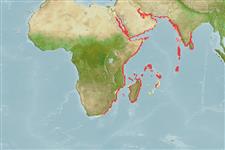
marin; saumâtre récifal; profondeur 1 - 75 m (Ref. 106604). Tropical; 35°N - 35°S, 22°E - 83°E
Western Indian Ocean: restricted to the Red Sea and the tropical western Indian Ocean to South Africa. Also reported from Persian Gulf (Ref. 68964). Apparently misidentified with closely related species in the northern and eastern Indian Ocean and western Pacific (however, Ref. 5978 seems to present a reliable record from western Indonesia).
Length at first maturity / Taille / Poids / Âge
Maturité: Lm ?, range 177 - ? cm
Max length : 310 cm TL mâle / non sexé; (Ref. 5578); poids max. publié: 227.0 kg (Ref. 3919)
Description synthétique
Clés d'identification | Morphologie | Morphométrie
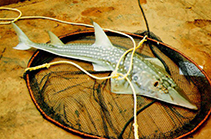
A large guitarfish with large black eyespots on the pectoral bases, a distinctive black cross between the eyes, and rows of small white spots on the upper body; snout pointed and lower caudal lobe short (Ref. 5578). Olive-green above, white below (Ref. 5578). Mouths small and contain flattened, pavement-like teeth.
Body shape (shape guide): elongated.
Occurs inshore and in shallow estuaries (Ref. 5578). Feeds on crabs, lobsters, bivalves, small fishes (Ref. 5578) and squids (Ref. 37816). Ovoviviparous (Ref. 50449). Takes crayfish and pilchard bait. Meat and fins sought after in Asian markets (Ref. 30573).
Life cycle and mating behavior
Maturité | Reproduction | Frai | Œufs | Fécondité | Larves
Exhibit ovoviparity (aplacental viviparity), with embryos feeding initially on yolk, then receiving additional nourishment from the mother by indirect absorption of uterine fluid enriched with mucus, fat or protein through specialised structures (Ref. 50449). With 4 young, about 43-60 cm in length (Ref. 37816), born in the summer (Ref. 3919).
Compagno, L.J.V., 1986. Rhinobatidae. p. 128-131. In M.M. Smith and P.C. Heemstra (eds.) Smiths' sea fishes. Springer-Verlag, Berlin. (Ref. 3919)
Statut dans la liste rouge de l'IUCN (Ref. 130435: Version 2025-1)
Menace pour l'homme
Harmless
Utilisations par l'homme
Pêcheries: commercial; pêche sportive: oui; Aquarium: Aquariums publics
Outils
Articles particuliers
Télécharger en XML
Sources Internet
Estimates based on models
Preferred temperature (Réf.
123201): 24.5 - 29.3, mean 27.1 °C (based on 304 cells).
Phylogenetic diversity index (Réf.
82804): PD
50 = 0.5024 [Uniqueness, from 0.5 = low to 2.0 = high].
Bayesian length-weight: a=0.00372 (0.00163 - 0.00845), b=3.11 (2.91 - 3.31), in cm total length, based on LWR estimates for this (Sub)family-body shape (Ref.
93245).
Niveau trophique (Réf.
69278): 3.6 ±0.6 se; based on diet studies.
Résilience (Réf.
120179): Faible, temps minimum de doublement de population : 4,5 à 14 années (Fec assumed to be <100).
Prior r = 0.28, 95% CL = 0.18 - 0.42, Based on 1 data-limited stock assessment.
Fishing Vulnerability (Ref.
59153): Very high vulnerability (90 of 100).
🛈
Climate Vulnerability (Ref.
125649): High to very high vulnerability (71 of 100).
🛈
Nutrients (Ref.
124155): Calcium = 7.69 [1.43, 29.34] mg/100g; Iron = 0.324 [0.076, 0.901] mg/100g; Protein = 19.9 [17.7, 22.1] %; Omega3 = 0.0794 [, ] g/100g; Selenium = 43.4 [12.2, 120.5] μg/100g; VitaminA = 20.3 [6.7, 58.7] μg/100g; Zinc = 0.733 [0.359, 1.509] mg/100g (wet weight);