



Chaenopsis roseola Hastings & Shipp, 1981
Flecked pikeblenny
Lägg till din observation i Fish Watcher
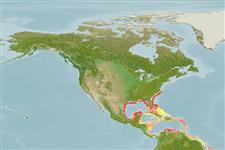
| Native range | All suitable habitat | Point map | Year 2050 |
|
| This map was computer-generated and has not yet been reviewed. |
| Chaenopsis roseola AquaMaps Data sources: GBIF OBIS |
Ladda upp din foton och Videor
Google image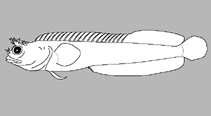 No image available for this species;
drawing shows typical species in Chaenopsidae.
Google image
drawing shows typical species in Chaenopsidae.
Klassificering / Namn Populärnamn | synonymer | Catalog of Fishes(Släkte, Arter) | ITIS | CoL | WoRMS | Cloffa
> Blenniiformes (Blennies) > Chaenopsidae (Pike-, tube- and flagblennies)
Etymology: Chaenopsis: Greek, chaeno = to yawn + Greek, opsis = appearance (Ref. 45335).
Etymology: Chaenopsis: Greek, chaeno = to yawn + Greek, opsis = appearance (Ref. 45335).
Miljö: miljö / Klimatzon / djupintervall / distributionsområde Ekologi
marina revassocierade; djupintervall 44 - 55 m (Ref. 13293). Tropical
Utbredning Territorier | FAO områden | Ekosystem | Förekomster | Prickkarta | Utplanteringar | Faunafri
Western Atlantic: USA.
Storlek / Vikt / Ålder
Kort beskrivning Bestämningsnycklar | Morfologi | Morfometri
Taggstrålar i analfenan: 2. Species distinguished by: side of body with 8 dark blotches; dorsal fin consisting of spines and segmented rays; total dorsal-fin elements 44 or 45. Common amongst Chaenopsids: small elongate fishes; largest species about 12 cm SL, most under 5 cm SL. Head usually with cirri or fleshy flaps on anterior nostrils, eyes, and sometimes laterally on nape; gill membranes continuous with each other across posteroventral surface of head. Each jaw with canine-like or incisor-like teeth anteriorly; teeth usually also present on vomer and often on palatines (roof of mouth). Dorsal-fin spines flexible, usually outnumbering the segmented soft rays (numbering 7 to 37), spinous and segmented-rayed portions forming a single, continuous fin; 2 flexible spines in anal fin; pelvic fins inserted anterior to position of pectoral fins, with 1 spine not visible externally and only 2 or 3 segmented (soft) rays; all fin rays, including caudal-fin rays, unbranched (simple). Lateral line absent. Scales absent (Ref.52855).
Body shape (shape guide): elongated.
Body shape (shape guide): elongated.
Specimens collected with a semi-balloon trawl from a coarse-rubble bottom (Ref. 13293). Minimum depth from Ref. 58018.
Livscykel och parningsbeteende Könsmognad | Reproduktion | Lek | Ägg | Fekunditet | Larver
Huvudreferens
Ladda upp dina referenser | referenser | Koordinator : Williams, Jeffrey T. | Medarbetare
Springer, V.G. and T.M. Orrell, 1996. Catalog of type specimens of recent fishes in the National Museum of Natural History, Smithsonian Institution, 5: Chaenopsidae, Clinidae, Dactyloscopidae, Labrisomidae, and Tripterygiidae. Smithson. Contrib. Zool. 576:38. (Ref. 13293)
Status på IUCN:s rödlista (Ref. 130435: Version 2025-2 (Global))
Least Concern (LC) ; Date assessed: 08 December 2024
CITES
Not Evaluated
Hot mot människor
Harmless
Mänskliga användningsområden
FAO - Publication: search | FishSource |
Ytterligare information
Trofisk ekologi
Livsmedelsartiklar (preys)
Födosammansättning
Födointag
Matransoner
Predatorer
Livsmedelsartiklar (preys)
Födosammansättning
Födointag
Matransoner
Predatorer
Ekologi
Ekologi
Ekologi
Populationsdynamik
Tillväxtparametrar
Max. åldrar / storlekar
Längd-vikt rel.
Längd-längd rel.
Längd-frekvenser
Massakonvertering
Rekrytering
Abundans
Tillväxtparametrar
Max. åldrar / storlekar
Längd-vikt rel.
Längd-längd rel.
Längd-frekvenser
Massakonvertering
Rekrytering
Abundans
Livscykel
Reproduktion
Könsmognad
Mognad/Gills rel.
Fekunditet
Lek
Lekande aggregat
Ägg
Utveckling av ägg
Larver
Larvdynamik
Reproduktion
Könsmognad
Mognad/Gills rel.
Fekunditet
Lek
Lekande aggregat
Ägg
Utveckling av ägg
Larver
Larvdynamik
Anatomi
Gälyta
Hjärna
Otolit
Gälyta
Hjärna
Otolit
Fysiologi
Kroppssammansättning
Näringsämnen
Syreförbrukning
Typ av simning
Simhastighet
Visuella pigment
Ljud från fisk
Sjukdomar & Parasiter
Toxicitet (LC50)
Kroppssammansättning
Näringsämnen
Syreförbrukning
Typ av simning
Simhastighet
Visuella pigment
Ljud från fisk
Sjukdomar & Parasiter
Toxicitet (LC50)
Genetik
Genom
Genetik
Heterozygositet
Ärftlighet
Genetisk mångfald
Genom
Genetik
Heterozygositet
Ärftlighet
Genetisk mångfald
Människorelaterad
Vattenbrukssystem
Vattenbruksprofiler
Avelslinjer
Ciguatera-fall
Frimärken, mynt, diverse.
Vattenbrukssystem
Vattenbruksprofiler
Avelslinjer
Ciguatera-fall
Frimärken, mynt, diverse.
Verktyg
E-bok | Fälthandbok | Bestämningsnycklar | Längdfördelnings-verktyg | Livshistorie-verktyg | Prickkarta |
Fångst-MSY |
Särskilda rapporter
Kontrollera för underhåll av akvarium | Kontrollera om det finns faktablad om arter | Kontrollera om det finns faktablad om vattenbruk
Ladda ner XML
Internet-källor
AFORO (otoliths) | Aquatic Commons | BHL | Cloffa | Websites from users | Check FishWatcher | CISTI | Catalog of Fishes: Släkte, Arter | DiscoverLife | ECOTOX | FAO - Publication: search | Faunafri | Fishipedia | Fishtrace | GloBI | Google Books | Google Scholar | Google | IGFA World Record | OneZoom | Open Tree of Life | Otolith Atlas of Taiwan Fishes | PubMed | Reef Life Survey | Socotra Atlas | TreeBase | Tree of Life | Wikipedia: Go, sök | World Records Freshwater Fishing | Zoobank | Zoologiskt register
Uppskattningar baserade på modeller
Önskad temperatur (Ref. 123201): 21.1 - 26.1, mean 24.2 °C (based on 9 cells).
Index för fylogenetisk mångfald (Ref. 82804): PD50 = 0.5005 [Uniqueness, from 0.5 = low to 2.0 = high].
Bayesian length-weight: a=0.00525 (0.00224 - 0.01232), b=3.07 (2.86 - 3.28), in cm total length, based on LWR estimates for this (Sub)family-body shape (Ref. 93245).
Trofisk nivå (Ref. 69278): 3.4 ±0.5 se; based on size and trophs of closest relatives