



Chaenopsis roseola Hastings & Shipp, 1981
Flecked pikeblenny
把你的觀察加入 Fish Watcher
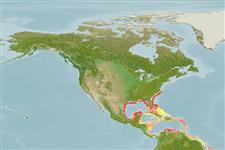
| Native range | All suitable habitat | Point map | Year 2050 |
|
| This map was computer-generated and has not yet been reviewed. |
| Chaenopsis roseola AquaMaps Data sources: GBIF OBIS |
分類 / 名稱 俗名 | 同種異名 | Catalog of Fishes(屬, 種) | ITIS | CoL | WoRMS | Cloffa
Teleostei > Blenniiformes (Blennies) 鱸形目 (Blennies) > Chaenopsidae (Pike-, tube- and flagblennies) 煙管鳚科 (Pike-, tube- and flagblennies)
Etymology: Chaenopsis: Greek, chaeno = to yawn + Greek, opsis = appearance (Ref. 45335).
Etymology: Chaenopsis: Greek, chaeno = to yawn + Greek, opsis = appearance (Ref. 45335).
環境: 環境 / 氣候帶 / 深度上下限 / 配送範圍 生態學
海洋 礁區魚類; 深度上下限 44 - 55 m (Ref. 13293). 熱帶
分布 領土 | FAO區域 | 生態系 | 發現紀錄 | 分布圖 | 簡介 | Faunafri
Western Atlantic: USA.
西大西洋: 美國。
西大西洋: 美國。
大小 / 重量 / 年齡
簡短描述 檢索表 | 型態特徵 | 形態測量圖
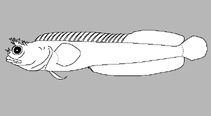
臀棘: 2. Species distinguished by: side of body with 8 dark blotches; dorsal fin consisting of spines and segmented rays; total dorsal-fin elements 44 or 45. Common amongst Chaenopsids: small elongate fishes; largest species about 12 cm SL, most under 5 cm SL. Head usually with cirri or fleshy flaps on anterior nostrils, eyes, and sometimes laterally on nape; gill membranes continuous with each other across posteroventral surface of head. Each jaw with canine-like or incisor-like teeth anteriorly; teeth usually also present on vomer and often on palatines (roof of mouth). Dorsal-fin spines flexible, usually outnumbering the segmented soft rays (numbering 7 to 37), spinous and segmented-rayed portions forming a single, continuous fin; 2 flexible spines in anal fin; pelvic fins inserted anterior to position of pectoral fins, with 1 spine not visible externally and only 2 or 3 segmented (soft) rays; all fin rays, including caudal-fin rays, unbranched (simple). Lateral line absent. Scales absent (Ref.52855).
Body shape (shape guide): elongated.
Body shape (shape guide): elongated.
Specimens collected with a semi-balloon trawl from a coarse-rubble bottom (Ref. 13293). Minimum depth from Ref. 58018.
標本用來自一個粗糙-碎石底部的一個半膨脹的拖網採集。 (參考文獻 13293)
標本用來自一個粗糙-碎石底部的一個半膨脹的拖網採集。 (參考文獻 13293)
生命週期和交配行為 成熟度 | 繁殖 | 產卵場 | 卵 | 孕卵數 | 仔魚
西大西洋: 美國。
主要參考資料
上傳您的推薦信 | 參考文獻 | 合作者 : Williams, Jeffrey T. | 合作者
Springer, V.G. and T.M. Orrell, 1996. Catalog of type specimens of recent fishes in the National Museum of Natural History, Smithsonian Institution, 5: Chaenopsidae, Clinidae, Dactyloscopidae, Labrisomidae, and Tripterygiidae. Smithson. Contrib. Zool. 576:38. (Ref. 13293)
CITES
Not Evaluated
對人類具威脅
無害處的
人類使用
FAO - Publication: search | FishSource |
更多資訊
營養生態學
食物項目(獵物)
食性組成
食物消耗量
食物配給
捕食者
食物項目(獵物)
食性組成
食物消耗量
食物配給
捕食者
生態學
生態學
生態學
人口動態
成長參數
最大年齡/尺寸
長度重量比
長度關係
長度-頻率
質量轉換
入添量
豐度
成長參數
最大年齡/尺寸
長度重量比
長度關係
長度-頻率
質量轉換
入添量
豐度
解剖學
鰓區
腦部
耳石
鰓區
腦部
耳石
生理學
身體成分
營養素
耗氧量
游泳類型
游泳速度
視覺色素
魚聲
疾病與寄生蟲
毒性 (LC50s)
身體成分
營養素
耗氧量
游泳類型
游泳速度
視覺色素
魚聲
疾病與寄生蟲
毒性 (LC50s)
遺傳學
基因組
遺傳學
異種性
遺傳率
遺傳多樣性
基因組
遺傳學
異種性
遺傳率
遺傳多樣性
工具
特別的報告
下載 XML
網路資源
AFORO (otoliths) | Aquatic Commons | BHL | Cloffa | Websites from users | 檢查 FishWatcher | CISTI | Catalog of Fishes: 屬, 種 | DiscoverLife | ECOTOX | FAO - Publication: search | Faunafri | Fishipedia | Fishtrace | GloBI | Google Books | Google Scholar | Google | IGFA World Record | OneZoom | Open Tree of Life | Otolith Atlas of Taiwan Fishes | PubMed | Reef Life Survey | Socotra Atlas | TreeBase | 樹狀分類階層 | Wikipedia: 去, 搜尋 | World Records Freshwater Fishing | Zoobank | 動物學的記錄
基於模型的估計
首選溫度 (參考文獻 123201): 21.1 - 26.1, mean 24.2 °C (based on 9 cells).
系統發育多樣性指數 (參考文獻 82804): PD50 = 0.5005 [Uniqueness, from 0.5 = low to 2.0 = high].
Bayesian length-weight: a=0.00525 (0.00224 - 0.01232), b=3.07 (2.86 - 3.28), in cm total length, based on LWR estimates for this (Sub)family-body shape (Ref. 93245).
營養階層 (參考文獻 69278): 3.4 ±0.5 se; based on size and trophs of closest relatives