Elasmobranchi (squali e razze) (sharks and rays) >
Rhinopristiformes (Shovelnose rays) >
Rhinobatidae (Guitarfishes)
Etymology: Rhinobatos: Greek, rhinos = nose + Greek, batis, -idos = a ray (Raja sp.) (Ref. 45335).
More on author: Linnaeus.
Environment: milieu / climate zone / distribuzione batimetrica / distribution range
Ecologia
marino; salmastro demersale; distribuzione batimetrica 0 - 100 m (Ref. 12951). Subtropical; 44°N - 17°S, 19°W - 36°E (Ref. 114953)
Eastern Atlantic: southern Bay of Biscay to Angola, including Mediterranean Sea.
Length at first maturity / Size / Peso / Age
Maturità: Lm 87.0, range 79 - ? cm
Max length : 185 cm TL maschio/sesso non determinato; (Ref. 127374); common length : 80.0 cm TL maschio/sesso non determinato; (Ref. 3261); peso massimo pubblicato: 26.6 kg (Ref. 127374)
Short description
Chiavi di identificazione | Morfologia | Morfometria
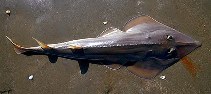
Spine dorsali (totale) : 0; Spine anali: 0. Rostral ridges widely separated over their entire length; anterior nasal lobe reaching to level of inner corner of nostril, posterior nasal flap wide; spiracle with two moderately developed folds, the outer one more prominent; thorns relatively small, present around inner margin of orbits, between spiracles, on shoulders, and along midline of disc and tail; Upper surface khaki-brown, underside white (Ref. 6675).
Body shape (shape guide): elongated; Cross section: flattened.
Inhabits sandy and muddy bottoms, from the intertidal zone to about 100 m. Sometimes near rocky reefs (Ref. 12951). Slow swimming over bottom or partially buried. Feeds on benthic invertebrates, mainly crustaceans and small fishes. Males mature at ca. 56 cm TL, females at ca. 64 cm TL; born at ca. 25 cm TL (Ref. 114953). Ovoviviparous, one or two litters per year with 4-10 embryos.
Exhibit ovoviparity (aplacental viviparity), with embryos feeding initially on yolk, then receiving additional nourishment from the mother by indirect absorption of uterine fluid enriched with mucus, fat or protein through specialised structures (Ref. 50449). One or two litters per year, of 4-10 embryos (Ref. 6675)
Schneider, W., 1990. FAO species identification sheets for fishery purposes. Field guide to the commercial marine resources of the Gulf of Guinea. Prepared and published with the support of the FAO Regional Office for Africa. Rome: FAO. 268 p. (Ref. 2683)
IUCN Red List Status (Ref. 130435: Version 2025-1)
Threat to humans
Harmless
Human uses
Pesca: commerciale
Strumenti
Special reports
Download XML
Fonti Internet
Estimates based on models
Preferred temperature (Fonte Biblio.
123201): 19.2 - 28, mean 26.1 °C (based on 104 cells).
Phylogenetic diversity index (Fonte Biblio.
82804): PD
50 = 0.5000 [Uniqueness, from 0.5 = low to 2.0 = high].
Bayesian length-weight: a=0.00204 (0.00165 - 0.00253), b=3.08 (3.02 - 3.14), in cm total length, based on LWR estimates for this species (Ref.
93245).
Trophic level (Fonte Biblio.
69278): 4.1 ±0.5 se; based on diet studies.
Generation time: 8.2 ( na - na) years. Estimated as median ln(3)/K based on 2
growth studies.
Resilienza (Fonte Biblio.
120179): Basso, tempo minimo di raddoppiamento della popolazione 4.5 - 14 anni (tmax=5; Fec=4).
Fishing Vulnerability (Ref.
59153): High to very high vulnerability (66 of 100).
🛈
Nutrients (Ref.
124155): Calcium = 20.2 [3.7, 87.7] mg/100g; Iron = 0.646 [0.170, 1.792] mg/100g; Protein = 19.8 [17.7, 21.8] %; Omega3 = 0.236 [0.109, 0.521] g/100g; Selenium = 24.8 [7.5, 65.6] μg/100g; VitaminA = 6.46 [2.60, 15.59] μg/100g; Zinc = 0.552 [0.281, 1.018] mg/100g (wet weight);