Environment: milieu / climate zone / Tiefenbereich / distribution range
Ökologie
seewasser; brackwasser demersal; tiefenbereich 0 - 40 m (Ref. 31184), usually 2 - 20 m (Ref. 35388). Temperate; 72°N - 49°N, 11°W - 52°E
Northeast Atlantic: White Sea, Cheshskaya Guba and Murmansk coast (Barents Sea) southward to English Channel (River Somme); eastern coasts of Scotland, England, also Irish Sea; the Orkneys, Shetlands and in shallow waters of North Sea and Baltic.
Length at first maturity / Size / Gewicht / Alter
Geschlechtsreife: Lm 17.0, range 16 - 18 cm
Max length : 52.0 cm TL Männchen/unbestimmt; (Ref. 4695); common length : 30.0 cm TL Männchen/unbestimmt; (Ref. 4695); max. veröff. Gewicht: 510.00 g (Ref. 6397); max. veröff. Alter: 10 Jahre (Ref. 35388)
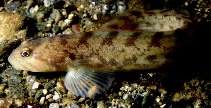
Bones are green due to harmless pigment. Skin slimy and variable color (Ref. 35388).
Body shape (shape guide): elongated.
Inhabits rocky shores under stones, among algae and in tide pools, between tide marks down to 40 m. May remain out of water under rocks or seaweeds (Ref. 31184). Feeds on gastropods, chironomids, crustaceans, eggs and fry of fishes. Gives birth to live young (Ref. 9900). Bones colored green by the harmless pigment Vivianit (Ref. 4645). Breathes air when out of water (Ref. 31184). Mating takes place in August - September with internal fertilization of the eggs. Female give birth to 30-400 developed young (35-55mm) (Ref. 35388).
Life cycle and mating behavior
Geschlechtsreife | Fortpflanzung | Ablaichen | Eier | Fecundity | Larven
Fertilization occurs in August-September. Egg development lasts for one month. Total bearing time is five months (Ref. 6397).
Andriashev, A.P., 1986. Zoarcidae. p. 1130-1150. In P.J.P. Whitehead, M.-L. Bauchot, J.-C. Hureau, J. Nielsen and E. Tortonese (eds.) Fishes of the North-eastern Atlantic and the Mediterranean. volume 3. UNESCO, Paris. (Ref. 4695)
IUCN Rote Liste Status (Ref. 130435: Version 2025-1)
Bedrohung für Menschen
Harmless
Nutzung durch Menschen
Fischereien: weniger kommerziell; Aquarium: Öffentliche Aquarien
Tools
Zusatzinformationen
Download XML
Internet Quellen
Estimates based on models
Preferred temperature (Ref.
123201): 7.3 - 11.3, mean 9.4 °C (based on 310 cells).
Phylogenetic diversity index (Ref.
82804): PD
50 = 0.5156 [Uniqueness, from 0.5 = low to 2.0 = high].
Bayesian length-weight: a=0.00316 (0.00186 - 0.00539), b=3.13 (2.97 - 3.29), in cm total length, based on LWR estimates for this species & (Sub)family-body (Ref.
93245).
Trophic level (Ref.
69278): 3.5 ±0.49 se; based on food items.
Widerstandsfähigkeit (Ref.
120179): niedrig, Verdopplung der Population dauert 4,5 - 14 Jahre. (tm=2; tmax=10; Fec=30; K=0.19-0.4).
Fishing Vulnerability (Ref.
59153): High vulnerability (60 of 100).
🛈
Climate Vulnerability (Ref.
125649): Very high vulnerability (84 of 100).
🛈
Nutrients (Ref.
124155): Calcium = 37.7 [20.6, 67.3] mg/100g; Iron = 0.3 [0.2, 0.5] mg/100g; Protein = 17.7 [15.0, 19.8] %; Omega3 = 0.361 [0.203, 0.613] g/100g; Selenium = 11.6 [5.6, 22.7] μg/100g; VitaminA = 14.1 [5.2, 39.9] μg/100g; Zinc = 0.711 [0.513, 0.993] mg/100g (wet weight);