>
Cyprinodontiformes (Rivulines, killifishes and live bearers) >
Poeciliidae (Poeciliids) > Poeciliinae
Etymology: Limia: Limia derived from the Latin 'limus' meaning mud, pertaining to the feeding habits of the fish, from Poey, 1854. Donald Taphorn, pers. comm. 22 Feb 2015.
More on author: Guichenot.
Environment: milieu / climate zone / rango de profundidad / distribution range
Ecología
; agua dulce; salobre demersal; pH range: 7.5 - 8.2; dH range: 25 - 30; no migratorio. Tropical; 18°C - 24°C (Ref. 13371)
Central America: endemic to Cuba.
Tamaño / Peso / Age
Madurez: Lm ? range ? - ? cm
Max length : 8.0 cm TL macho / no sexado; (Ref. 37198); 10.0 cm TL (female)
Short description
Claves de identificación | Morfología | Morfometría
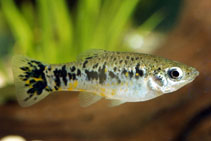
Blue-gray back, silvery sides and a white belly; scales edged with black producing a "fishnet" pattern on the sides; females with a yellow patch near the vent; male's dorsal fin and tail usually yellow-orange with blue black speckles; females with colorless fins and growing to more than double the size of males (Ref. 44091).
Body shape (shape guide): fusiform / normal.
Inhabits streams, lakes, estuaries, coastal lagoons and mangrove swamps. Feeds on worms, crustaceans, insects and plant matter (Ref. 7020). Often found in the company of sailfin molly and mosquitofish (Ref. 4409).
Life cycle and mating behavior
Madurez | Reproducción | Puesta | Huevos | Fecundidad | Larva
Produces 20-50 young. Large females can produce >100 fry every 4-6 weeks (Ref. 44091).
Lee, D.S., S.P. Platania and G.H. Burgess, 1983. Atlas of North American freshwater fishes, 1983 supplement. Occasional Papers of the North Carolina Biological Survey no. 1983-6. North Carolina State Museum of Natural History, Raleigh, N.C. 67 p. (Ref. 13498)
IUCN Red List Status (Ref. 130435: Version 2025-1)
Threat to humans
Harmless
Human uses
Pesquerías: sin interés; Acuario: Comercial
Herramientas
Special reports
Download XML
Fuentes de Internet
Estimates based on models
Phylogenetic diversity index (Referencia
82804): PD
50 = 0.5000 [Uniqueness, from 0.5 = low to 2.0 = high].
Bayesian length-weight: a=0.01023 (0.00454 - 0.02306), b=3.14 (2.95 - 3.33), in cm total length, based on LWR estimates for this (Sub)family-body shape (Ref.
93245).
Nivel trófico (Referencia
69278): 2.9 ±0.34 se; based on food items.
Resiliencia (Referencia
120179): Alto, población duplicada en un tiempo mínimo inferior a 15 meses (tm=0.66).
Fishing Vulnerability (Ref.
59153): Low vulnerability (10 of 100).
🛈