分類 / Names
俗名 | 同種異名 | Catalog of Fishes(屬, 種) | ITIS | CoL | WoRMS | Cloffa
Teleostei >
Cyprinodontiformes (Rivulines, killifishes and live bearers)
鱂形目 (Rivulines, killifishes and live bearers) >
Poeciliidae (Poeciliids)
花鱂科 (Poeciliids) > Poeciliinae
Etymology: Limia: Limia derived from the Latin 'limus' meaning mud, pertaining to the feeding habits of the fish, from Poey, 1854. Donald Taphorn, pers. comm. 22 Feb 2015.
More on author: Guichenot.
Environment: milieu / climate zone / 深度上下限 / distribution range
生態學
; 淡水; 半鹹淡水 居於水底的; pH range: 7.5 - 8.2; dH range: 25 - 30; 非遷移的. 熱帶; 18°C - 24°C (Ref. 13371)
Central America: endemic to Cuba.
中美洲: 古巴的特有種。
大小 / 重量 / 年齡
成熟度: Lm ? range ? - ? cm
Max length : 8.0 cm TL 雄魚/尚未辨別雌雄; (Ref. 37198); 10.0 cm TL (female)
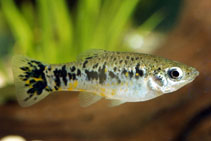
Blue-gray back, silvery sides and a white belly; scales edged with black producing a "fishnet" pattern on the sides; females with a yellow patch near the vent; male's dorsal fin and tail usually yellow-orange with blue black speckles; females with colorless fins and growing to more than double the size of males (Ref. 44091).
Body shape (shape guide): fusiform / normal.
藍灰色的背面, 銀色的側邊與一個白色的腹面; 鱗片側邊上有黑色的生產邊緣了一個 " 魚網 " 圖案; 雌性具有一個在排洩孔附近的黃色的小區塊; 雄魚的背鰭與尾部通常橘黃色的有藍色的黑色小斑點; 雌性有無色的鰭與增加的到超過加倍雄性的大小。 (參考文獻 44091)
Inhabits streams, lakes, estuaries, coastal lagoons and mangrove swamps. Feeds on worms, crustaceans, insects and plant matter (Ref. 7020). Often found in the company of sailfin molly and mosquitofish (Ref. 4409).
棲息於溪流,湖,河口,岸邊潟湖與紅樹林沼澤。 吃蠕蟲,甲殼動物,昆蟲與植物。 (參考文獻 7020) 摩爾時常發現伴隨著 sailfin 與 mosquitofish.(參考文獻 4409)
Life cycle and mating behavior
成熟度 | 繁殖 | 產卵場 | 卵 | 孕卵數 | 仔魚
Produces 20-50 young. Large females can produce >100 fry every 4-6 weeks (Ref. 44091).中美洲: 古巴的特有種。
Lee, D.S., S.P. Platania and G.H. Burgess, 1983. Atlas of North American freshwater fishes, 1983 supplement. Occasional Papers of the North Carolina Biological Survey no. 1983-6. North Carolina State Museum of Natural History, Raleigh, N.C. 67 p. (Ref. 13498)
IUCN 瀕危狀態 (Ref. 130435: Version 2025-1)
無危 (LC) ; Date assessed: 22 May 2020
人類使用
漁業: 沒有興趣; 水族館: 商業性
工具
特別的報告
下載 XML
網路資源
Estimates based on models
Phylogenetic diversity index (參考文獻
82804): PD
50 = 0.5000 [Uniqueness, from 0.5 = low to 2.0 = high].
Bayesian length-weight: a=0.01023 (0.00454 - 0.02306), b=3.14 (2.95 - 3.33), in cm total length, based on LWR estimates for this (Sub)family-body shape (Ref.
93245).
營養階層 (參考文獻
69278): 2.9 ±0.34 se; based on food items.
回復力 (參考文獻
120179): 高度, 族群倍增時間少於 15個月 (tm=0.66).
Fishing Vulnerability (Ref.
59153): Low vulnerability (10 of 100).
🛈