



Monopterus albus (Zuiew, 1793)
Asian swamp eel
Ladda upp din foton och Videor
Bilder | Google image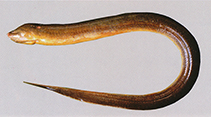 Monopterus albus
Bild av Vidthayanon, C.
Bilder | Google image
Bild av Vidthayanon, C.
Klassificering / Namn Populärnamn | synonymer | Catalog of Fishes(Släkte, Arter) | ITIS | CoL | WoRMS | Cloffa
> Synbranchiformes (Spiny eels) > Synbranchidae (Swamp-eels)
Etymology: Monopterus: Greek, monos = one, unique + Greek, pteron = fin (Ref. 45335).
Etymology: Monopterus: Greek, monos = one, unique + Greek, pteron = fin (Ref. 45335).
Miljö: miljö / Klimatzon / djupintervall / distributionsområde Ekologi
; sötvatten; brackvatten bottenlevande; flodvandrande (Ref. 126106); djupintervall 3 - ? m (Ref. 2686). Tropical; 25°C - 28°C (Ref. 2060); 34°N - 6°S
Utbredning Territorier | FAO områden | Ekosystem | Förekomster | Prickkarta | Utplanteringar | Faunafri
Asia: India to China, Japan, Malaysia and Indonesia. Probably occurring in Bangladesh.
Storlek / Vikt / Ålder
Könsmognad: Lm ? range ? - ? cm
Max length : 100.0 cm SL hane/ej könsbestämd; (Ref. 2686); common length : 40.0 cm SL hane/ej könsbestämd; (Ref. 44894)
Max length : 100.0 cm SL hane/ej könsbestämd; (Ref. 2686); common length : 40.0 cm SL hane/ej könsbestämd; (Ref. 44894)
Kort beskrivning Bestämningsnycklar | Morfologi | Morfometri
Anguilliform body; no scales; no pectoral and pelvic fins; dorsal, caudal and anal fins confluent and reduced to a skin fold; gill openings merged into single slit underneath the head (Ref. 27732). Rice paddy eels are red to brown with a sprinkling of dark flecks across their backs; large mouths and small eyes (Ref. 44091).
Body shape (shape guide): eel-like.
Body shape (shape guide): eel-like.
Obligate air-breathing (Ref. 126274); Found in hill streams to lowland wetlands (Ref. 57235) often occurring in ephemeral waters (Ref. 44894). Adults are found in medium to large rivers, flooded fields and stagnant waters including sluggish flowing canals (Ref. 12975, 12693), in streamlets and estuaries (Ref. 41236). Benthic (Ref. 58302), burrowing in moist earth in dry season surviving for long periods without water (Ref 2686). Occasionally dug out in old taro fields, in Hawaii, long after the field has been drained; more frequently observed in stream clearing operations using heavy equipment to remove large amounts of silt and vegetation where the eels are hidden (Ref. 44091). Nocturnal predators devouring fishes, worms, crustaceans, and other small aquatic animals (Ref. 44091); also feed on detritus. Are protandrous hermaphrodites. The male guards and builds nest or burrow (Ref. 205). Marketed fresh and can be kept alive for long periods of time as long as the skin is kept moist (Ref. 12693). Good flesh (Ref. 2686). Important fisheries throughout Southeast Asia (Ref. 57235).
Livscykel och parningsbeteende Könsmognad | Reproduktion | Lek | Ägg | Fekunditet | Larver
Male builds a large free-floating bubblenest among the submerged vegetation close to the shoreline; eggs are spat into the nest after being laid; male guards the nest and continues to guard the young after hatching till they are on their own (Ref. 44091). Spawning occurs in shallow water (Ref. 2060). Sex reversal is completed in 8-30 weeks (Ref. 34260).
Huvudreferens
Ladda upp dina referenser | referenser | Koordinator : Fávorito, Sandra | Medarbetare
Talwar, P.K. and A.G. Jhingran, 1991. Inland fishes of India and adjacent countries. Volume 2. A.A. Balkema, Rotterdam, i-xxii + 543-1158, 1 pl. (Ref. 4833)
Status på IUCN:s rödlista (Ref. 130435: Version 2025-2 (Global))
Least Concern (LC) ; Date assessed: 10 November 2020
CITES
Not Evaluated
Hot mot människor
Harmless
Mänskliga användningsområden
Fiskeri: kommersiell; Vattenbruk: kommersiell; Akvarium: Kommersiell
FAO - Vattenbrukssystem: produktion; fiskeri: landningar; Publication: search | FishSource |
Ytterligare information
Populationsdynamik
Tillväxtparametrar
Max. åldrar / storlekar
Längd-vikt rel.
Längd-längd rel.
Längd-frekvenser
Massakonvertering
Rekrytering
Abundans
Tillväxtparametrar
Max. åldrar / storlekar
Längd-vikt rel.
Längd-längd rel.
Längd-frekvenser
Massakonvertering
Rekrytering
Abundans
Livscykel
Reproduktion
Könsmognad
Mognad/Gills rel.
Fekunditet
Lek
Lekande aggregat
Ägg
Utveckling av ägg
Larver
Larvdynamik
Reproduktion
Könsmognad
Mognad/Gills rel.
Fekunditet
Lek
Lekande aggregat
Ägg
Utveckling av ägg
Larver
Larvdynamik
Anatomi
Gälyta
Hjärna
Otolit
Gälyta
Hjärna
Otolit
Fysiologi
Kroppssammansättning
Näringsämnen
Syreförbrukning
Typ av simning
Simhastighet
Visuella pigment
Ljud från fisk
Sjukdomar & Parasiter
Toxicitet (LC50)
Kroppssammansättning
Näringsämnen
Syreförbrukning
Typ av simning
Simhastighet
Visuella pigment
Ljud från fisk
Sjukdomar & Parasiter
Toxicitet (LC50)
Människorelaterad
Vattenbrukssystem
Vattenbruksprofiler
Avelslinjer
Ciguatera-fall
Frimärken, mynt, diverse.
Vattenbrukssystem
Vattenbruksprofiler
Avelslinjer
Ciguatera-fall
Frimärken, mynt, diverse.
Verktyg
Organisk frågesport | E-bok | Fälthandbok | Längdfördelnings-verktyg | Livshistorie-verktyg | Prickkarta |
Fångst-MSY |
Särskilda rapporter
Kontrollera för underhåll av akvarium | Kontrollera om det finns faktablad om arter | Kontrollera om det finns faktablad om vattenbruk
Ladda ner XML
Internet-källor
AFORO (otoliths) | Alien/Invasive Species database | Aquatic Commons | BHL | Cloffa | Websites from users | Check FishWatcher | CISTI | Catalog of Fishes: Släkte, Arter | DiscoverLife | ECOTOX | FAO - Vattenbrukssystem: produktion; fiskeri: landningar; Publication: search | Faunafri | Fishipedia | Fishtrace | GloBI | Google Books | Google Scholar | Google | IGFA World Record | Nationella databaser | OneZoom | Open Tree of Life | Otolith Atlas of Taiwan Fishes | PubMed | Reef Life Survey | Socotra Atlas | TreeBase | Tree of Life | Wikipedia: Go, sök | World Records Freshwater Fishing | Zoologiskt register
Uppskattningar baserade på modeller
Index för fylogenetisk mångfald (Ref. 82804): PD50 = 0.6250 [Uniqueness, from 0.5 = low to 2.0 = high].
Bayesian length-weight: a=0.00059 (0.00036 - 0.00095), b=3.06 (2.92 - 3.20), in cm total length, based on LWR estimates for this species & (Sub)family-body (Ref. 93245).
Trofisk nivå (Ref. 69278): 2.9 ±0.28 se; based on food items.
Generation time: 10.2 ( na - na) years. Estimated as median ln(3)/K based on 2 growth studies.
Resiliens (Ref. 120179): Mellan, lägsta populationsfördubblingstid 1,4-4,4 år (Fec = 1,000).
Näringsämnen (Ref. 124155): Calcium = 260 [73, 603] mg/100g; Iron = 1.07 [0.42, 2.82] mg/100g; Protein = 18.4 [17.0, 19.8] %; Omega3 = 0.0997 [, ] g/100g; Selenium = 30.9 [14.1, 74.9] μg/100g; VitaminA = 13.2 [4.2, 37.6] μg/100g; Zinc = 1.44 [0.74, 2.67] mg/100g (wet weight); based on nutrient studies.